Download Flyer as PDF to print




By Carl Davidson
Beaver County Blue
The United Steel Workers and the Mondragon Cooperative Corporation-the largest industrial union in the U.S. and the world's largest network of worker-owned cooperatives respectively-held an upbeat press conference at USW headquarters in Pittsburgh March 26, announcing new progress in their innovative two-year-old partnership.
"For American workers, the traditional corporate model for organizing production and producing jobs has broken down," stated Tom Conway, USW International Vice-President for Administration. "It's simply not fair, and we're not afraid to try something different."
For those unfamiliar with Mondragon, 'something different' was inspired by the Steelworkers investigation into the Mondragon cooperatives (MCC) in Spain's Basque country. MCC is a 50-year-old thriving and ongoing experiment in radical democracy consisting of some 120 worker-owned cooperatives involving nearly 100,000 workers and allied with another 130 allied coops in the region, with revenues in 2011 of some $24 billion.
The MCC coops operate one the basis of one worker, one share, one vote-and no one outside MCC holds any shares. It is the leading edge of the Spanish industrial economy.
The USW took note of MCC after a successful effort with the cutting edge Spanish wind turbine firm, GAMESA, to build three innovation green energy factories in Pennsylvania. While not part of Mondragon, GAMESA and MCC shared a common representative in the U.S., Michael Peck, who then took a USW team to Spain to visit MCC.
Leo Gerard, the USW's president, has long been an advocate for a 'clean energy and green manufacturing industrial revolution' as a progressive way out of the current economic crisis. But given the conflicted and deadlocked Congress on such matters, little is being done on the matter trough traditional channels. Hence the turn toward the Mondragon partnership.
After the initial announcement of the joint effort in the fall of 2009, little was heard about any progress on the matter. Yesterday's press conference, however, revealed what was going on behind the curtains. There were three major projects underway.
The first was the production of 'Sustainable Jobs, Sustainable Communities: The Union Coop Model.'
Read more!
By Carl Davidson
Beaver County Blue
About 80 labor and civil rights activists, together with a few elected officials, gathered at dusk at the Beaver County Courthouse April 4 for a candlelight vigil. The somber but militant event commemorated the anniversary of the assassination of Dr. Martin Luther King, Jr. and protested the current efforts of rightwing PA Republicans to block citizens from voting in 2012.

Lynwood repeated the refrain several times as he introduced new speakers. The vigil was also sponsored by the Lawrence County Labor Council, SEIU Local 668, and the Beaver County NAACP. The 12 CD Progressive Democrats of America also endorsed the vigil, and turned out a good-sized contingent.
The target of everyone's anger was the passage into law of HB 934 last month, the so-called 'Voter ID Law'.
"We plan to challenge this as a new version of the unconstitutional 'poll tax,'" explained a representative of the American Civil Liberties Union to the crowd. "They claim that a state driver's license or state ID is free. But since the new homeland security rules, you have to have a legal copy of you birth certificate. May people don't have one, and there is a charge for getting one, and you have to appear personally, also a cost.
"Many older people were also born at home, and never had a birth certificate. Also, if you are living in an assisted facility for the elderly, all of your old bills with old addresses are no longer legal backup ID. So this does have all the undue burden of a poll tax."

"Who are the main groups registering new voters", he asked? "The League of Women Voters, the NAACP, and the unions. But now in Florida they want to make it so that if your forms aren't turned in 48 hours, you're up on a felony for voter fraud. One union teacher registered her seniors on a Friday, but Monday was Memorial Day, and offices were closed. So she turned them in the next day. Not good enough, says Florida, they're a day late. Now she's hit with felony voter fraud charges. With this kind of stuff going on, what do you think is going to happen to volunteer voter registration efforts? Make no mistake about it. This is an attack on all of us, especially our unions."
"Our right to vote is precious," added County Commissioner Joe Spanik. "It's an outrage, and we have to fight it with all we've got."
Other speakers included Congressman Mark Critz, Willy Sallis, President of Beaver County NAACP, and Kathy Jellison, President of SEIU Local 668. Kim Villella, a Baden resident running for State Senator against Republican Senator Elder Vogel, who voted for the bill, spoke about the difficulties nursing home residents will have with this new voting restriction.

"Something has to change," said Rev. Kevin Lee, also and IBEW member, at the close. We have to find a way to mobilize the energies of a new generation." As everyone was lighting candles, the NAACP's Mtume Imani followed by recalling her own experiences at the 1963 March on Washington for Jobs and Freedom,' then led everyone in singing the civil rights anthem, 'Ain't Going to Let Nobody Turn Us Around." It captured the spirit of the gathering as it dispersed, newly informed and energized.
Eric Hoover, Vice-President of the Beaver-Lawrence Central Labor Council, closed the program by reminding everyone of the importance of standing together.
Read more!
Start: 02/04/2012 12:00 pm
End: 02/04/2012 5:30 pm
Will be held at Community Empowerment Association Training & Culture Center, 7120 Kelly St. in Homewood (accessible by the 67, 69, 71C, and all East Busway (P) buses - www.portauthority.org)
Join Occupy Pittsburgh for our second teach-in, organized by the Occupy the Hood, People of Color and Education Work Groups.
We hope to bring together the social and economic justice community in Pittsburgh, from all neighborhoods, acitivist concentrations, backgrounds, life circumstances and political viewpoints. By speaking together and sharing experiences and insight, we hope to strengthen the community that the Occupy has caused to take shape - in all our diversity of experience.
Speakers: Helen Gerhardt & Carl Redwood, facilitators: Guillermo Perez
Two Rounds of Workshops
1:45-3:15 p.m. - workshop session #1
3:15-3:30 p.m. - break
3:30-5:00 p.m. - workshop session #2
5:00-5:30 p.m. - group debrief
There will be at least 10 workshops. Half will be presented by the Occupy the Hood/People of Color Work Group and half by the Education Work Group
1. Who are the 99%?
(facilitator: Nicholas Rushin)
This is a discussion about the workings of class, oppression and exploitation through a materialist and historical perspective. We are the 99% fighting against the 1%, but how do the 1% and the 99% get to be the 1% and 99%? Where does wealth come from and who creates it? How does class affect political struggles? And how is class different and similar to other forms of oppression like sex and race?
2. The Disparity & Education of Black Students
(facilitator: Vickki Ayanna Jones)
This workshop will recognize, develop & repair the damage that has been done to our children in the educational system & Black people in general.
3. Healthcare for the 99%: Ending Race-Based, Class-Based, All-for-Profit Care
(panelists: Scott Tyson, Physician, PUSH/ Healthcare4ALLPA; Ed Cloonan, Save Our Community Hospitals & Western Pennsylvania coalition for Single Payer; Sandra Fox, Western PA Coalition for Single Payer; Residents from Braddock and surrounding areas, Footage from Tony Buba, Save Our Community Hospitals)
This workshop will consist of film footage and a panel of speakers who will tell the story of how UPMC created race- and class-based barriers to health care with its demolition of Braddock Hospital and building of a surplus hospital for Monroeville. Speakers will also discuss how and why they fought back, from street theatre to a civil rights lawsuit. What are the roots of this problem in U.S. healthcare and what would alternative system look like?
4. Impact of Mass Incarceration
(facilitator: Khalid Raheem, president/CEO of the National Council for Urban Peace and Justice; Steering Committee member of the Formerly Incarcerated and Convicted Persons Movement; member of Occupy the Hood Pitstburgh)
This workshop will explore the prison industrial complex as it pertains to mass incarceration of black males.
5. Gentrification and Our Right to the City
(facilitator: Carl Redwood)
This workshop will share information about the Right to the City Alliance organizing against gentrification using an urban human rights framework. The workshop will explore the forces behind gentrification and provide historical context for the issues we face. Through discussion we will examine how gentrification has impacted our neighborhoods and help us begin to look beyond our current reality to envision the rights we are fighting for.
5. Bringing Occupy Pittsburgh to the Neighborhoods: Outreach Strategies and Initiatives
(NAMES, DESCRIPTION To Come)
1. "Why Dismantle and Not Reform?" The Call of Occupy the Hood Pittsburgh
(facilitators: J.O. Yejide KMT & Bekezela Mguni)
This workshop will discuss why the Occupy movement needs radical approaches to change vs. reform of the current economic system in order to meet the needs of people of color and to ensure an equitable and humane future for all.
2. What are the Alternatives to Corporate Power?
(PANELISTS - Jackie Smith, Carl Davidson, etc)
So far the Occupy movement has helped draw public attention to what we're against, but what are the alternatives? This workshop will invite organizers from the region to present ideas that have been developed and tested in communities around the world to show that another world is possible. We will explore publicly-owned banks, community-supported agriculture; community currencies and barter systems; Davidson will present on the Mondragon co-operatives in Spain, and other forms of what is known as the "solidarity economy." Finally, campaigns that are working to counter corporate power to make room for community-based economic initiatives will be discussed.
3, Organizing within Marginalized Communities
(faciliators: Calvin Skinner & Kyndall Mason)
A workshop dedicated to successful strategies to do organizational outreach in marginalized communities with an emphasis on outreach to African-American and members of the LGBT communities.
4. Organized Labor & Occupy: Waging Class War on Two Fronts
(facilitators: Paul Le Blanc & Guillermo Perez)
Thanks to the Occupy movement, the issue of income and wealth disparity in the U.S. and the damage it's doing to our democracy are now front and center in the national discourse. Since its inception the Occupy movement has received considerable support from organizations affiliated with another national movement, organized labor. In this workshop we hope to engage union and Occupy activists in a discussion of how these two movements diverge and intersect and the ways we can work together to advance a common agenda.
5. Economic Disparities: Occupying Solutions for Black Communities
(Nazura Asaseyeduru)
This workshop will challenge the power structure of banks & government as it pertains to economic disparities for People of Color. Thus, participants will look at solutions in which Black communities have to be creative, innovative & self-determining.
Sponsors: Occupy the Hood (PghOccupythehood@riseup.net or call 412-244- 0298) &Occupy Pittsburgh (occupypittsburgh.org) and it'sPeople of Color & Education Working Groups
Read more!

By Carl Davidson
Beaver County Blue
Over 400 labor and human rights leaders and activists gathered at The Fez in Beaver County's Hopewell Township Oct. 8 to honor John Conyers, the Congressman from Detroit Michigan, now serving his 23rd term as a long-time champion of labor, civil rights and civil liberties.
 Sponsored by the Beaver-Lawrence Central Labor Council, the annual human rights banquet drew local labor unions, the NAACP and African American churches, and activist groups such as the 4th CD Progressive Democrats of America. The elected officials present included County Commissioners Joe Spanik and Tony Amadio, row officers Carol Fiorucci and Nancy Werme, as well as Dwan Walker and his 'One Aliquippa' organization. Walker's recent primary victory has position him to be the town's next mayor. The event was also honored by the attendance of several youth ambassadors from Aliquippa's Council of Men and Fathers.

Conyers was an excellent choice for the labor council's award. Not only is he known worldwide for his leadership in the House Judiciary Committee as a staunch defender of the Constitution and the Bill of Rights, he is also responsible for introducing some of the most progressive Bills in Congress. HR 676 'Improved and Expanded Medicare for All' has been widely promoted here in Beaver County by Unions and Progressive Democrats, including the first Citizen's Hearing on the Bill conducted in Aliquippa featuring Dennis Kucinich as convener. The Beaver County Commissioners and the Beaver/Lawrence Labor Council have both passed resolutions endorsing the Bill. Conyers has also recently drafted another groundbreaking bill, HR 870 Humphrey-Hawkins Full Employment Act, to be funded by a financial transaction tax on Wall Street speculators.
Read more!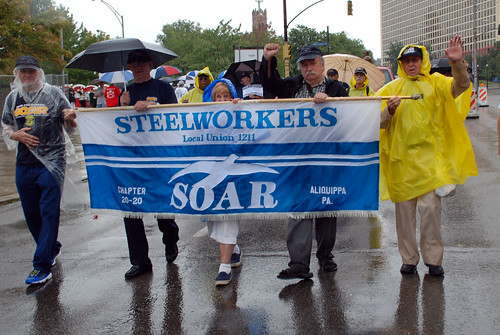
Photo: Aliquippa's SOAR Contingent in Parade
By Kaitlynn Riely
Pittsburgh Post-Gazette
Labor Day was a day off work for many, but for Shawn Wygant, it was one more day he didn't have a job.
In May, Mr. Wygant, 37, of Forest Hills, was laid off from his job as a washing machine operator for Sodexo. Since then, he has been searching for work, without success.
He uses unemployment benefits to pay his bills and makes large pots of spaghetti to feed his wife, her sister, her brother and a niece and nephew.
Frustration sets in when he sees news reports that say the job situation may not improve for years.
"I can't wait that long," he said. "We need people to start standing up for us."
On Monday morning, he stood in the rain on Freedom Corner in the Hill District as he prepared to march in the Pittsburgh Labor Day Parade. He was one of about 70,000 who participated in the Downtown procession.
On the annual observance of the contributions of workers, Mr. Wygant's story was similar to those of millions across the country who have found themselves unemployed or underemployed in the economic downturn.
Nationally, the unemployment rate is 9.1 percent, and in Pennsylvania, it is 7.4 percent.
Jack Shea, president of the Allegheny County Labor Council, and Frank Snyder, the secretary-treasurer of the Pennsylvania AFL-CIO, called attention to the plight of the jobless at a news conference before the parade Monday.
For the unemployed and the underemployed, the dreary holiday weather was another chapter in a bleak period of their life.
"For the past two years, it's not been that happy of a Labor Day as they've not been able to find work," Mr. Snyder said.
At this year's Labor Day Parade, one of the largest in the country, Mr. Snyder said he and other leaders of Pittsburgh's labor community wanted to focus on putting people back to work.
That focus includes both union and non-union workers, he said.
"Unemployment does not discriminate," he said. "Union members as well as non-union members, Democrats, Republicans, no affiliation, find themselves unemployed on this Labor Day."
Dave Ninehouser, the Pittsburgh coordinator for PA Wants to Work, said his group was using Labor Day to ramp up its efforts to help the jobless gain access to resources and to spur the creation of jobs.
"This parade is a perfect example of what we need to do," he said. "Come together, stick together, stand together and fight back."
The parade began at 10 a.m. and lasted almost three hours. Pittsburgh Mayor Luke Ravenstahl and Bishop David Zubik joined union members ranging from postal employees to Teamsters as they marched from the Civic Arena to the Boulevard of the Allies.
A steady rain fell throughout the morning, but there was a fair turnout, particularly among parade participants.
It was, for many parade participants, a bittersweet Labor Day.
About 5,000 members of the Pennsylvania State Education Association have been laid off from their jobs due to education cuts in the state budget, said Michael J. Crossey, president of the association. As the school year starts, they are out of work instead of in the classrooms, he said.
"We need to start doing the positive things that will move the economy forward," Mr. Crossey said. "This cuts budget doesn't work."
More than 50 people came out in support of the National Association of Letter Carriers, said Mike Plaskon, the executive vice president for Branch 84.
Part of their aim in marching in the parade, Mr. Plaskon said, was to urge Congress to find legislative solutions for the U.S. Postal Service's funding crisis.
"Our job is, we are going to get the facts out there, let the public know that they don't need to close post offices," he said. "They don't need to eliminate Saturday delivery. They just need to fix the funding."
Therese Kisic of Morningside has never been in a union but has family members who have, and she watches the parade every year.
This year, she said, she wished the labor movement would take its jobs message to Congress.
"I want to move this parade to D.C.," she said.
Although the parade had a definite message -- of supporting organized labor, providing access to health care and promoting job creation -- it was still a parade, with bands and banners and a few people throwing candy and other prizes to the umbrella-wielding bystanders.
Sandy and Andrew Pszenny of Franklin Park sat in lawn chairs on the sidewalk outside the DoubleTree Hotel, Downtown, and watched for their daughter Amanda, a piccolo player in the North Allegheny marching band.
They sought cover under their umbrellas as rain fell. It was their daughter's first time marching in a downpour, they said.
"But she's a tough kid. She likes the weather," Mr. Pszenny said.
Kaitlynn Riely: kriely@post-gazette.com o
Read more!
 By Carl Davidson
Keep On Keepin' On
Our regional daily newspaper, the Pittsburgh Post-Gazette, to its credit, came out with an editorial today, Aug. 22, 2011, urging President Obama to push for a substantial jobs program over Republican opposition.
"Action on jobs: Obama must push hard to get people back to work" is the headline, and a key point stresses "Mr. Obama now needs to offer proposals equal to the size of the problem. That means bold strokes, not half-measures. If his Republican antagonists in Congress are determined to stand in the way of getting Americans back to work, the president must say so publicly -- and then go over their heads to enlist the nation in his effort."
Terrific, a good framing of the question. Unfortunately, however, once you get into the substance of the piece, it turns into a muddle. The Post-Gazette offers up a hodgepodge of proposals that tinker around the edges of the problem-more tax cuts and credits for jobs created, more unemployment benefits, and oddly, more trade deals, even though these deals mostly result in net job losses.
Here's the heart of the matter. In a down economy, jobs are created by increasing demand, by more customers with bigger orders coming to a firm's doors. The problem is that consumer demand has taken a nose dive when the credit bubble burst. People don't have money to spend. They're cutting back on everything, and trying to unload their debt. This means business-to-business orders shrink as well. Companies may be cash-rich and have high profits, but with no increase in orders or customers at their door, they aren't likely to hire people to do nothing just to get a tax credit.
This is where government has to become the key customer. It has to make huge productive purchases for local work and local materials to build productive infrastructure-county-owned green energy plants, new and improved schools, modernized locks and dams, Medicare for all, investment in young students and veterans like we did with the GI Bill, investment in research in new industries, and so on.
Most important, to work well, it can't be nickel-and-dimed to death. It has to be on the scale of the expenditures for World War 2. That's when the 'multiplier effect' can kick in, and related growth in manufacturing can take off in turn. And it has to be paid for by going to where the most appropriate money is, imposing a financial transaction tax on unproductive and destabilizing speculation by Wall Street.
The best the P-G does on this matter is to support Obama's proposal for an 'Infrastructure Bank,' but urges him to find a way to bypass a GOP roadblock in Congress.
But even that is too passive. It says, in effect, here's a small pot of money. If you want to repair some roads, come and get some.
What we really need is something like the New Deal's Tennessee Valley Authority and Works Progress Administration, but on steroids, a TVA-WPA-CCC 2.0. We need to pass John Conyer's HR 870 Full employment Bill. We need the Dept. of Energy and the Dept. of Labor to go to every county in the country with a fully funded proposal to build new green energy wind farms and solar power arrays as public energy utilities, hiring local workers at union scale, with no obstacles to a union election. And that's just for starters.
Yes, we need a serious jobs program. But it's time for everyone who utters that phrase to get serious themselves. Why? Because it's going to take a massive upsurge in class struggle to get it by removing those standing in the way.
[Carl Davidson is a Steelworker Associate and a retired computer technician living in Beaver County. His 'Keep On Keepin' On' column appears in Beaver County Blue, website of the 4th CD Progressive Democrats of America.]
Read more!
By Carl Davidson and Tina Shannon
Beaver County Blue
Even though thunderstorms and downpours had swept through Beaver County all afternoon, close to 200 concerned citizens showed up for a candlelight vigil in front of the Beaver County Courthouse on Monday evening.
"Are you fired up?" shouted Roni Hamiel of SEIU Local 668 headquarters in Harrisburg, "Are you sick of this mess? The rich are getting richer and we're struggling every day, barely getting by. We want fairness, we want our bargaining rights, and we want a decent future."
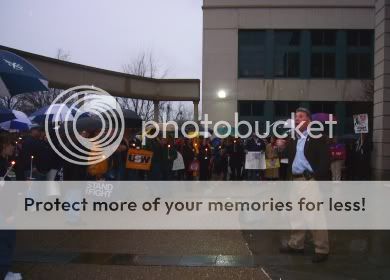
Local members of SEIU 668 spearheaded the vigil, with others joining in to organize a broadly supported event. Throughout PA, events scheduled around the anniversary of Dr. King's assassination were organized by CLEAR (Coalition for Labor Engagement and Accountable Revenues). CLEAR is a coalition of public and private sector unions involved in protecting labor rights and public services from impending budget cuts.
"We are standing beside you in solidarity," said Willie Sallis, president of the Beaver County NAACP, from the podium. "Not behind you, but beside you. We are partners in this struggle."
Read more!
By Carl Davidson
Nearly 500 progressive and liberal organizers gathered at Pittsburgh’s Sheraton Station Square over the sunny but bitterly cold weekend of Jan. 22-23 to drawn out the lessons of their setbacks in the 2010 elections and shape a new course for the future.
Under the theme of ‘Taking Pennsylvania Forward,’ the two-day meeting was mainly pulled together by four ‘Organizing Sponsors’—Keystone Progress, a popular online communications hub for the state; SEIU, representing some 100,000 PA workers; the Alliance for American Manufacturing, a coalition between the United Steelworkers and advocates for new manufacturing enterprises; and Democracy for America, the outgrowth of the Howard Dean campaign in the Democratic Party.
A large number of unions other than the USW and SEIU also took part, as well as many local political, civil rights, women’s rights, youth and environmental groups from around the state. Beaver County was represented by a delegation from the 4th CD Progressive Democrats of America.
Read more!
By Carl Davidson
If you wanted to know what a dynamic and emerging progressive majority of Americans looked like, the place to be was the National Mall at the foot of the Lincoln Memorial in Washington, DC on the beautiful and sunny Saturday afternoon of Oct. 2, 2010.
It was a sight to behold. Pulled together by the ‘One Nation Working Together’ coalition of some 400 groups, an estimated 175,000 people filled the area. They were the country’s trade unions, civil rights, women’s rights, and community organizations, peace and justice groups, and many more. The focus was jobs, justice and education, with sizable contingents against the wars as well.
“I hope they look at the mall today,” stated the Rev. Al Sharpton from the steps of the Lincoln Memorial, referring to the GOP and the Tea Party right, “because this is what America looks like, not just one color or one gender.”
A rainbow of nationalities, men and women, young and old, and with a solid core from all sectors of the working class filled the area. The crowd’s mood was upbeat and militant, and they let it be known with a range of voices, from old-fashioned liberals to the socialist left, that they were fed up with the right wing assaults from Tea Party, the GOP neoliberals and the Blue Dog Democrats going along with them.
“This gathering is a wakeup call for the American people,” declared Harry Belafonte, in one of the strongest and most critical speeches of the day. “"Do we really believe that sending 100,000 troops to kill innocent men and women in Afghanistan and Pakistan makes any sense?” he continued, clearly and sharply criticizing Obama’s concession to the war machine. The actor-singer went on to attack the “crippling poison of racism” and "the undermining of the Constitution and the systematic attack on our most inalienable rights….At the heart of this danger is the Tea Party which is coming close to achieving its villainous ends. On November 2, in the millions, we must overburden our voting booths, and vote against those who would have us become a totalitarian state."
Read more!
Photo: USW Blue-Green Rally at G20 for Green Jobs, Clean Energy
By Carl Davidson
Beaver County Blue
One of the first things you see entering Pittsburgh from the Fort Pitt Bridge is that the United Steel Workers, headquartered in this working-class town, are determined to deliver a strong message to the G20 bigwigs.
“Jobs, Good Jobs, Greens Jobs Now!’ declared the huge five-story-tall banner draped from the top of the even taller USW headquarters building that faces the Golden Triangle and its hotels. Despite squads of militarized police, some in their Ninja turtle outfits, no one anywhere near the downtown area can miss it.
Today I’m headed for the day-long ‘Teach-In on Human Rights, Global Justice and the G20’ organized by the USW at their 4th floor conference center. Later in the afternoon on this gray, drizzly and humid Sept 23 day, I plan to hear Nobel Laureate Joseph Stiglitz speak in the low-income Hill District, and attend a labor-environmentalist rally and concert featuring local politicians and rockers.
The street heat protests are planned for the last two days, Thursday and Friday, Sept 24-25. So far, the police have been going out of their way with petty harassment of out-of-town protestors—getting permits mixed up, trying to stop a Free Food bus, challenging small encampments. Some Green Peace people get busted today for hanging a huge banner on one of the bridges, but arrests and scuffles so far are minor.
I arrived early, just in time for the freshly brewed coffee and wide array of muffins and pastries that will load my blood sugar and won’t help my waistline—but who can resist? The TV cameras are there, and the room is filling up with union people and activists from near and far. The press is focused on Richard Trumka, the new president of the AFL-CIO who’s very popular here in Western Pennsylvania. He came from the coal mining area about 40 miles south of the city, where he started as a leader of the United Mine Workers of America.
“I’ve been given the job of ‘framing’ the discussion here today,” Trumka began, but warns us he won’t be around for criticism if he doesn’t do a good job. He’s got to take off early and meet with the top labor leaders from the other 20 or so countries here for the G20 event.
Trumka gave us a big picture. “From 1946 to 1976, the productivity of the American worker and our wages rose together and nearly doubled. But from the late 1970s, and especially after Ronald Reagan, things changed. Our productivity continued to rise, but our wages stagnated, and now are declining.” He followed with a good definition of neoliberalism, urging us to use and understand the term, and how it produced the cycle of consumer debt and the financial bubbles leading to the recent crash.
The neoliberals of both parties, he continued, have tried to put labor and its allies “in a policy box with six sides”—labor ‘flexibility,’ shareholder value primacy, globalization/ off shoring, ‘personal’ responsibility over all, small government to a fault, and economic ‘stability,’ meaning austerity for us. He explained the hidden trap and fallacy in each one of these.
“We make it, and they take it, that’s what it boils down to on wealth creation,” Trumka concluded, noting that it was unacceptable. Labor wasn’t about to be imprisoned in the box defined by neoliberalism, but was going to break out of it. It was clear that the new AFL-CIO chieftain was sharp as a tack, well-versed in political economy, and not about to be easily bamboozled by anyone.
Lisa Jordan of the USW took the podium as Trumka headed for his G20 meetings. “I can’t help but report what I saw driving in here yesterday and today,” she said. “A long caravan of paddy wagons, and for what? Just waiting to arrest us and scare other people away. She added that the USW would stand up to it at the rally tonight, and especially at the large ‘People’s March’ on Friday. She urged a large steelworker turnout from the locals. “We want to see a sea of our banners, so bring out our people and every local banner you can get.”
Jordon outlined the upcoming speakers and breakout sessions at six different roundtable spots on the floor—topics included labor in Latin America, the corporate agenda, the WTO, anti-sweatshop legislation, race, gender and globalization, and several others.
I picked one on economic development battles in the Pittsburgh region. The town I’m from, Aliquippa in Beaver County, is one of the hardest hit in the area and matches the ‘boarded up communities’ phrase in the session’s description.
Barney Oursler of Pittsburgh United leads us off with an account of Pittsburgh’s contrasting areas of downtown glitter, which extends along the high-tech corridor out to the airport, with the grime of neglected neighborhoods and depressed river valley mill towns. “What’s the first word that comes to mind when you hear the word ‘development?’ he asks. “Profits, big ones,” someone answers.” “That’s exactly right,” he says, “and more often than not, it’s the elites that benefit, not the rest of us.”
The case in point offered several times over the day is the Pittsburgh Penguins demanding $750 million from the city for a new stadium, and getting it. The main opposition came from ‘One Hill,” a coalition of mainly African American groups in the Hill District, which both the new stadium site and is targeted for gentrification. One Hill fought the Penguins corporate core for restrictions on expansion and a community benefits accord. They got a deal worth $10 million, but the battle goes on.
“We have a different problem,” I interjected. “We have no development even to demand a piece of in Aliquippa, and we used to be the home of one of the world’s largest steel mills.” I went on to briefly describe some local discussions about opening a closed hospital as part of our larger battle for ‘Medicare for All, Healthcare not Warfare, ‘ as well as some discussion we started around rebuilding locks and dams on the local rivers for green barge transport and green energy infrastructure. Steffi Domike of the USW Associates staff picks up on the latter point. “The Pittsburgh plateau is a good region for wind farms, but we’d have to modernize the energy grid to get the most from it.” We agreed to follow up with more discussion on the implied projects in the weeks ahead.
One thing is quite clear about the Steelworkers. They are very serious, from President Leo Gerard’s speeches down to the brochures in the lobby, about getting beyond traditional business unionism and fighting for a major green industrial policy and new structural reforms to get out of the economic crisis. Moreover, they want to do it in a way that benefits the entire working class. This is why they are putting resources behind the Blue-Green alliance with environmentalists and the ‘Green for All’ projects associated with Van Jones and his inner city youth programs. The steelworkers know they can’t do it alone, and need all the allies they can muster. What the union is doing during the G20 week is only incidental to this broader effort.
Two videos were also highlights of the teach-in. A short version of “The Battle of Seattle” was previewed, showing labor’s role in the anti-WTO global justice demonstrations going back ten years. Leo Gerard, now USW president, who appeared in the film, told those who just watched it that the union had bought up a good number of the two-DVD versions and combined it with a number of educational tools. “We’ll make in available to you for showing in your local groups or at house meetings. All we ask is that you have people sign in, and send us the lists.”
The other video was on the super-exploitation of workers in Bangla Desh, and show horrific scenes of the harsh conditions at sites deconstructing old merchant freighters for salvaged metals. “This goes beyond abuse of workers,” said Charlie Kernaghan of the National Labor Committee. “This is murder at the hands of these bosses.”
As the afternoon sessions drew to a close, a group of us got a ride up to the Monumental Baptist Church in The Hill district. Literally near the top of the hill near the center of downtown Pittsburgh, the 100-year-old African American church, with a long legacy of involvement in social justice causes, had offered its grounds for a ‘Tent City’ of out-of-town protestors.
This afternoon, the church had also opened its sanctuary for a speech by Joseph Stiglitz, economist and Nobel laureate. A former top insider with the World Bank, Stiglitz was fired from that body for exposing and speaking out against the disastrous impact of its policies in many parts of the world. When combined with his critique of the Obama administration’s more dubious concessions and Wall Street bailouts, he has gained rock star status among global justice activists.

After an introduction by John Nichols of The Nation, Stiglitz made a small concession to the G20 by noting that adding a few countries was better than the G8, but still, some 170 countries around the world were on the outside of these deliberations.
“But make no mistake about what going on here,” he warned. “Even if we had waged war on many of these countries, we could not have done as much damage in many parts of the world as that done by indirectly by the policies of these global powers. The question is not whether we have to change our ways, but how, and by how much.”
The claim that the global recession was over was simply not true, Stiglitz went on, especially given growing unemployment. “Nor is it likely to end anytime soon. They’re simply deploying money in the wrong direction, bailing out the giant banks rather than a greater job-creating stimulus. What has happened to the banks that were supposedly ‘too big to fail?’ They’ve only gotten bigger, and their lobbyists are still thwarting needed regulation.”
Leo Gerard of the USW was next up and picked up where Stiglitz left off. “Pay attention to this number, 30 million!” he told the crowd. That’s the true number of unemployed in this country. That’s what you get when you add up those looking for jobs, those working part time when they want more, and those who have given up, what they call the ‘labor reserve.’ You can tell be my accent that I’m a Canadian, and to give you some idea of the scale, 30 million is a greater number than every human being in my native country.”
“We need jobs,” Gerard continued, “we need good jobs, and we need green jobs. What make a good job? It’s a UNION job that can support a family, and we need a second stimulus to create them and a financial transaction tax on Wall Street speculation to pay for it all.”
Emira Woods of the Institute for Policy Studies and a native of Liberia brought the voice of the third world to the discussion. “What the G20 powers do,” she explained, “is prevent the poor countries to act in their own interests and determine their own future.” She stressed the need for ‘people power’ to bring change.
Carl Redwood Jr. brought it all back to the realities of Pittsburgh. Speaking for the Hill District Consensus Group, he told the story of the battle over the Penguin stadium to this crowd, where the problems just outside the church’s doors were staring everyone in the face.
We gathered up our crew a little early to head back downtown in time for the rally in Point Park. Out on the sidewalk, Redmond came up and said, “Hey, Aliquippa guy! I heard you at the union hall earlier.” He tells me he was a reader of the Guardian back in the 1970s, when I was a writer there. We agree to stay in touch around the Green Jobs and Health Care campaigns. Making new connections is what these activities are all about.
We wind our way down the wet streets. It’s drizzling again, and still hot and humid. At a light, a UPS truck pulls up beside us, with side doors open. ‘Where is everyone?” he laughs, noting that it’s rush hour and the only crowds you see are batches of cops on every other corner. “It’s like Sunday afternoon with a Steelers game on!”
Point State Park is a large and pleasant open space at the tip of the ‘Golden Triangle,’ the site of the historic fort at the forks of the Ohio. Here the Monongahela and the Allegheny rivers come together to form what the French explorers called “La Belle Riviere, or beautiful river, their translation of the Iroquois and Seneca word ‘Ohio,’ meaning roughly the same thing.
This night, however, it had a split personality. Part of it was fenced off and occupied by militarized police and the Secret Service, wanting it as a command center for the same reason the French and British armies did more than 200 years ago: it’s a strategic location. The other part was a huge double stage with a terrific sound system and giant video screen. The Steelworkers, the Sierra Club and Al Gore’s climate change group had gone all out to claim at least part of the space to deliver their message to the G20.
The question of the moment was whether the weather and oppressive police presence would prevent a crowd from forming. As I enter the area divided off for the rally, a youth street theater group was putting on a performance in front of a long line of cops in their new camouflage gear. The kids were having fun, while those in uniform tried to look stern. Inside, people were surveying the literature tables, food stands and cheering on the local opening bands. There were only 500 or so there, but once the speakers got going and more musicians warmed up, the crowd quickly grew to about 5000—enough to make it a success, given the circumstances.
A young speaker started off the rally. "Thomas Jefferson said that every generation needs a new revolution," said Alex Loorz of Kid vs. Global Warming. He noted that some adults weren’t worried about the worst effects of climate change because it was 50 years away. But in 50 years, he said, "my generation won't be dead, and neither will our grandchildren, but if we don't act now, it is my generation that is going to pay for it."
State Senator Jim Ferlo also welcomed everyone, stressing the need for a large and unified movement. “We need a powerful force to counter these pinheaded pundits in the media who want to cater to all this nonsense coming from the right wing!”
Next Joe Grushecky and the House Rockers, a local band, really got the crowd fired up. They gave us a very polished mix of Springsteen tunes with their own original numbers full of steel city grit and energy. They would be followed later by Big Head Todd and the Monsters.
Leo Gerard took center stage for the USW the third time this day, but was still in good form. “A wind turbine is made of 200 tons of steel and 8,000 parts," he shouted out, and this crowd knew exactly what he meant. "Imagine what we could do if we could turn not just this country's jobs, but the world's jobs green. Imagine if we had the will!” PA Governor Ed Rendell followed him on the stage, and likewise committed to green and clean energy innovation on the state level.
A number of local Democrats have got the Steelworkers message, and it was evident at this event. Only a new industrial policy with major structural reform is going to create jobs on a scale needed to rescue Pennsylvania and the rest of the Rust Belt. Only political will combined with street heat could challenge the G20. But a good number also are still dragging their feet, captured by the Blue Dogs and bowing to the neoliberal anti-government tirades of the far right. This is going to be a critical battleground in the months ahead.
I caught a few tunes from Big Head Todd, and then headed back to Beaver County for the night. The next two days will put the spotlight on battlegrounds of a different sort, in the streets with the police and in the realm of public opinion over what is really going on behind the closed door deliberations of the G20. Stay tuned!
[Carl Davidson is a writer for Beaver County Blue. He is also a national co-chair of the Committees of Correspondence for Democracy and Socialism and a national board member of the US Solidarity Economy Network. He is author, along with Jerry Harris, of 'Cyberradicalism: A New Left for a Global Age.' If you like this article, make use of the PayPal button at http://carldavidson.blogspot.com] ]
Read more!
By Carl Davidson
Beaver County Blue
The ‘G20' is a big deal in Pittsburgh, with multiple stories in the local press and TV, even though many everyday citizens are wondering what it’s really all about and whether it’s worth all the fuss and expense.
“I know all the big shots from around the world are coming, I see that on the news” my dad told me last week. “But what do they actually do behind all those guards and closed doors?”
It’s a good question. The ‘big shots,’ of course, are all the top political and economic leaders of the world’s nineteen largest economies, with the European Union added to make twenty. And lots of people would love to be a fly on the wall when they start wrangling over who’s really to blame for the latest financial meltdown and how to recover from it.
I told my dad, for starters, that they’re cooking up schemes to have the rest of us pay off the gambling debts of Wall Street speculators while they ship more jobs overseas. That’s why the unions are going to be in streets, along with the environmental people, the antiwar movement, and everyone else. He’s dubious that it will do any good, but I told him I’ll be in the thick of it, and I’d let him know what happens.
So today I headed for one of the first actions, a mass march for jobs, sponsored by the ‘Bail Out the People Movement.’ It’s a coalition pulled together by a number of left and community groups, with an assist from the Western Pennsylvania United Steel Workers and the United Electrical Workers. The organizers have picked Pittsburgh’s low-income African American ‘Hill District’ as the launch site, and it couldn’t be a better one, since this is the heart of the neighborhoods that need jobs the most. The route is a little under a mile, and ends at the edge of downtown, in an open space behind the Civic Arena.
Coming into town on the parkway, the first things that hit you are the giant ‘Pittsburgh Welcomes the World!” banners on the large corporate lawns lining the highway. Next is a higher density of police cars. Finally, there’s a blizzard of orange detour signs re-routing traffic so the sports arenas and casinos can function while the security zones go up around select areas downtown. I maneuvered through it all, and made my way through bleak blocks with boarded-up storefronts to the ‘Tent City’ on the grounds of the Monumental Baptist Church near the top of ‘The Hill.’ I find a tenuous place to park on a rise that gives me an excellent view for photos.
It’s immediately clear this is going to be a spirited and colorful march, but of a militant minority. The weather is good, but on the hot and humid side. Nearly 500 people are there, and perhaps half of these are from out of town. There are a number of preachers around, some ladies from churches in their Sunday finery, a number of people with UE T-shirts and Steelworker ball caps, and dozens of young people putting together picket signs and adjusting sound systems. In brief, all the components of the coalition are there, but this is going to be a relatively small kickoff march rather than a massive outpouring.
I started to survey the crowd and right away run into Scott Marshall from the ‘People’s Weekly World.’ He’s been in town for a week covering the AFL-CIO convention, which just ended.
“Whaddya think?” Scott asked. “Multiply by 100, and it would be terrific,” I answered. I added that I thought the media overkill on the supposed threats of violence and the city’s dragging out the permit process until the least minute had taken a toll. “They’re getting very clever on dealing with us, and we have to find ways to counter it.”
Next I ran into some friends from the Committees of Correspondence for Democracy and Socialism from New York City and Los Angeles, who traveled from both coasts in vans. The tables of the main sponsoring left groups with the ‘People’s Bailout’ coalition are prominent. From Pittsburgh, there’s a sizable group from the Thomas Merton Center and its Pittsburgh Antiwar Committee, as well as Paul LeBlanc, a local leftist professor and antiwar leader. He reported favorably on the large educational sessions held over the weekend.
A Pickup truck with a decent sound system got positioned in the middle of the line of marchers. It’s playing ‘Ain’t No Stopping Us Now!’ and as the line moved, the chants begin: “We want a J-O-B, so we can E-A-T! is a popular one, as is ‘We’re fired up, won’t take no more!” Since it’s all downhill, it’s an easy hike. I describe a few historic sites we passed to some out-of-towners, like the Crawford Grill, center of the Pittsburgh jazz scene for decades, as well as the home of the famous Pittsburgh Crawfords and the Negro Baseball Leagues of which it was an important part.
Waiting for us at the rally site at the other end were Pennsylvania State Senator Jim Ferlo and his assistant Mikhail Pappas. Ferlo has long used his Harrisburg Senate position to advocate for labor, civil rights and antiwar causes, and today is no exception.
We’re welcomed to the rally by Rev. Thomas Smith of the Monumental Baptist Church. He started off by answering my dad’s question: “These G20 people are here to make deals that benefit the corporations; they’re not here helping the workers, or the rest of us in the communities.” Our efforts today are only the beginning, he reminds us, there’s much more to come, in Pittsburgh and elsewhere.
Senator Ferlo was next. “We’re here to speak out to right our countries wrongs, not only here but around the globe. Capitalism is in deep crisis. Some here may say capitalism IS the crisis. In any case, we have to press for a sustainable economy that works for us, the majority of the working people.”
Ferlo then took up a topic that had everyone buzzing all day. The morning’s Post Gazette including an article based on an interview with Obama, where the President said, in relation to the G20 protests: “I was always a big believer in — when I was doing organizing before I went to law school — that focusing on concrete, local, immediate issues that have an impact on people’s lives is what really makes a difference; and that having protests about abstractions [such] as global capitalism or something, generally is not really going to make much of a difference.
The Senator was furious with Obama. “This is worse than misguided and a major miscalculation; it’s intellectually dishonest. It was people in the streets that put him there. It was mass protests that built the unions, that got rid of Jim Crow, that won rights for women. This is the problem with the whole top layer of the Democratic Party in dealing with these attacks from the far right. They’re acquiescing to it; they should hang their heads in shame-and I’m telling you this as an active and registered Democrat. We have got to rise up and turn this around.”
“If we had a hundred more elected Democrats like him,” said one protester standing next to me in reference to Ferlo. “It would be a whole different ball game.”
Brenda Stokley followed up. She was with the Katrina and Rita Hurricane Survivors Committee, and delivered a blistering indictment of the government’s ongoing failures to deal with these crises. “There’s no reason for people to be homeless, no reason for people to be without jobs. We need these for survival.”
One speaker stood out in his ability to command the attention of almost everyone. Fred Richmond, a vice president of the United Steelworkers and an African American, started off by asserting that “the issue of poverty is central to labor’s agenda, and not just in this country, but globally.” He went on to describe in some detail exactly what the AFL-CIO would be pressing on the G20-fair trade, green jobs, a ‘Tobin Tax’ worldwide on financial speculation, a ’second stimulus’ on a global scale to spur job growth and the transition to clean energy and a green economy.
Richmond also put the earlier critique of Obama in a larger perspective. “This president is under a heavy and fierce attack from the far right. What he’s going through is unprecedented, unless you go back to Roosevelt. We have to back him up, but we also have to make sure all of them act in our interests.” Some were dubious on this point, but most of the crowd took him very seriously.
I missed a few of the final speakers, since I was making a point of connecting with some of the Progressive Democrats of America activists there. Western PA’s 4th CD was represented, as well as a group in from Akron, Ohio, who was passing out PDA’s ‘Healthcare, Not Warfare’ placards to use for the rest of the week. We exchanged stories of our dealings with the rightwing ‘Tea Bagger’ rallies in various places, plus the days to come.
Two important events are up soon for the remaining days of the G20. One is a union-sponsored rally in Point Park on Wednesday, Sept. 23. The negotiations for the permit there have been contentious, because the police and Secret Service wanted the same spot as a staging area. On Thursday, Pittsburgh’s anarchist youth will be heard from in one way or another-no one is quite sure what they will do. And Friday, Sept. 25, there will be ‘the big march,’ with the area’s peace and justice movements at the heart of it. Stay tuned!
[Carl Davidson writes for Beaver County Blue, the online voice of the 4th CD Progressive Democrats of America. He is also a national co-chair of the Committees of Correspondence for Democracy and Socialism. If you like this article, make use of the PayPal button at the top of this site]
Read more!
By Carl Davidson
Beaver County Blue
If you want to get a good picture of the hard core of the Western Pennsylvania working class and its concerns, one of the best ways to do it is to take part in the annual Labor Day Parade on a gray and rainy Pittsburgh morning.
Pittsburgh is known as a town that takes its Labor Day parades seriously, with turnouts of upwards of 50,000, rivaled only by Detroit and New York City. This year's Sept 7 event, which featured an appearance by Vice President Joseph Biden, was only a fraction of that, but still numbered in the thousands, with high spirits and an array of contingents.
The main political concerns of the day were passing the Employee Free Choice Act as a spur to unionization, along with health care reform leading to universal coverage. Many of the unions favored HR676 'Single Payer' Medicare for All as the most effective solution. The purpose of it all? "Solidarity and bringing in new members," said Teamster Carl Paullet, 75, of Ligonier, PA, to a local news reporter.
My day started early. I drove through Beaver County's hills and hollows at 7AM to get to the United Presbyterian Church in Hopewell Township, outside the town of Aliquippa, in time for the busload of retired steelworkers headed for the city. Marion Prasjner, president of the county chapter of the Steelworkers Organization of Active Retirees (SOAR), was determined to get us all there on time, before any traffic jams. One by one, about twenty cars and pickups filled the lot, and about thirty retirees loaded themselves into the church bus.
"Let me take the roll before we get started,' said Prasjner, clipboard in hand. He went through a list of names the sound of which told a story in themselves-Serbian, Polish, Italian, German, African-American, Scots-Irish and more, all the various peoples drawn to this area around the turn of the last century and forged into a multinational industrial working class. "Let's move out," Marion concluded, noting that the weather had kept away only three from our group.
The majority of steelworkers left in Aliquippa are retirees, although there are a good number of them. They mostly still live up on the hills in the working-class townships. At one time, Aliquippa had one of the largest concentrations of steelworkers in a single plant in the world, originally known as Jones & Laughlin Steel. Beaver County in 1960 had the highest density of blue-collar workers of any county in the nation. There is still plenty of construction, service, and metal-related workers living there, but the mill towns along the Ohio River are largely empty shells of their former industrial glory.
As we passed through other mill towns like Carnegie, PA, the chatter on the bus was mainly about health care, with SOAR among the hardliners for HR 676, Medicare for All. "What are we going to do about Altmire?" was one grumbled topic, referring to the 4th CD's Congressman Jason Altmire, who recently joined the rightwing "Blue Dog" caucus. "He was never with us on health care," was one reply. "But we'll see what we have to do if he turns on us on the Employee Free Choice Act with the rest of that bunch." These retired workers are usually well-informed, often very astute and always vote-in brief, they have some independent clout in local politics.
Coming through the Fort Pitt tunnel is always a treat-rolling hills, then a minute or two of darkness, then the entire Pittsburgh skyline and the three rivers dramatically burst out and suddenly fills your vision. I found it awesome as a kid, and still very impressive. Our bus headed for the hillside parking lots just above the downtown 'Golden Triangle,' where one large and prominent building has the 'United Steel Workers' logo across the top.
We found ourselves in a waiting line, which turned out to be a security checkpoint, due to Joe Biden's presence in the area. A guard came on board and declared, "We're going to bring a dog on board. Don't try to pet him. He's friendly, but he's sniffing for explosives and weapons. Just let him do his job." A nice looking rust-colored German shepherd moved down the aisle and out again. All clear.
Most considered some security measures appropriate because of rising threats against Obama and his team. But the talk turned to the security plans for the next two weeks, where the city is shutting down practically everything for the Sept. 24th G20 confab of world leaders. The plan: the streets will be empty, save for militarized police and protestors. "Now that's just overkill," said one worker. "They're just trying to scare people away and shut us up." Once we parked, the first order of business was finding coffee, donuts, and the location of the portapotties. No problem all around; everything was well organized.
We were among the early arrivals, so we got to see everyone else pouring in. Unions express their solidarity with a type of team spirit; boxes are opened on the backs of a dozen different pickups, and the various trades and industries are passing out union caps and T-shirts-I get a pair with the SOAR logo, with dark blue as the background. The unions are colored-coded these days-blue for the steelworkers, purple for SEIU's service employers, red and black for the hotel workers, green for AFSCME's government workers, chartreuse for the carpenters, and so on.
Most striking was the arrival of the coal miners. Several hundred filed into the lot, all wearing camouflage T-Shirts with a bold UMWA across the chest. They looked like war veterans, too, since life in the mines is not easy.
"I told a few of them to be careful, the recruiters might round them up for Iraq!" said Tom Mosholder, one of the Aliquippa steelworkers on our bus. "Seriously," he added, "those guys deserve everything they can get. That's got to be one of the toughest jobs there is." An African-American USW woman from Wilkinsburg standing next to us agreed. "My grandfather worked in the mines. He told me a story about a Polish miner he knew who never saw daylight. It was dark outside when he went into the mine before dawn, and dark after dusk when he came back out, and he had to mine coal seven days a week."
"That story reminds me of my favorite union button," I replied, "the one that says, 'from the folks that brought you the weekend." They concurred, but Tom was on a roll: "You know, unions have problems, including ours, and they need fixing. Nothing's perfect in this world. But when I add up everything we've got from the union-better hours, more safety in the mill, and so on, I don't resent paying my union dues one bit. That's why even with our mill gone and our local gone, I still turn out for these things."
Tom's story helped explain some of the new steelworker banners and contingents that were from manufacturing and services outside of steel proper. "USW Technical Workers" was one that caught my eye, largely because of its youthful composition. It was an antidote to the problem the AFL-CIO was focusing on with its 'Young Workers: A Lost Decade' campaign. All the unions are pointing out that the current economic crisis is falling heavily on the least unionized workers, especially the younger generation.
"Some younger guys fall for this 'up by your own bootstraps' crap," said Tom, pointing out some difficulties. "But nobody does it all on their own. Every one of us has had a hand up at some point, from our families, neighbors, schools, everywhere. And it didn't come easy; we had to join and fight together to get it. Sometimes I think drafting the younger generation into the army wasn't all that bad, a cure for some of that 'on mine own' attitude. But today, with these terrible wars, I wouldn't wish it on anyone."
Many union members made sure the younger generation was there by making the parade a family affair. There was more than one inter-generational bunch standing together with the same union T-shirt, with a range from white-haired grandparents to a few teenagers with silver rings in their ears and noses.
There were also dozens of high school marching bands lining up. Many observers recognized them from their colors, which matched their athletic teams. People in Western PA take high school football and basketball with seriousness unmatched elsewhere, and know the better teams well. My favorite of the day was the Westinghouse High School band, an all-Black school, which brought some hip-hop rhythms to marching tunes. Westinghouse has had a good share of NBA stars and Pittsburgh Steelers as alumni, as well as famous jazzmen, including Billy Strayhorn and Ahmad Jamal.
Before long a couple parade marshals arrived and let us know where to line up. "I need two more people to carry this banner," said Denise Edwards, a USW veteran of the Mon Valley battles against plant shutdowns and a SOAR officer. "How about you and you," she says, pointing to me as one of the two. So I'm drafted to the front, where I can see the action.
Moving down the Hill went smoothly. Suddenly, a tall and hefty African American guy jumps in front of our banner with a bevy of followers. I immediately recognized him, as did everyone else. It was Franco Harris, the Steelers famed running back from the 1970s who, because of his Italian American mother, is also claimed by the Steelers Italian-American fans, who comprised the colorful 'Franco's Italian Army' in the stands.
"Steelworkers? Can I jump in front of the Steelworkers?" "Any time, Franco," I tell him. "Be our guest." Harris was campaigning for an independent run for mayor by his son, Franco 'Dok' Harris, who was making a big push as labor's candidate. How well the campaign goes remains to be seen, but every ten feet, fans of all nationalities shouted out warm greetings for Franco. 'Steelerism' approaches the status of official secular religion in this town.
Things took a negative turn at the bottom of the hill. For an entire block, in both sides, the far right had made a gauntlet of large and offensive billboard posters. On the left side were huge gory pictures of aborted fetuses with Obama named as baby-killer-in-chief. On the right, were grotesque caricatures of Obama, comparing him to Hitler and Mussolini. Somewhere between 50 and 100 right wingers stood with the signs, shouting out slogans against health care reform of any sort-but making up only a tiny minority of those present.
One worker from our bus made a point of thumbing his nose at this crew. "I know we're not supposed to provoke these creeps," he said, 'but I just gotta let them know I think they stink. They're disgusting."
But we passed into the downtown area with tall buildings without incident. Here the chants picked up for 'Health Care' and 'Free Choice', echoing off the walls. Bystanders cheered and waved. Franco plunged into the sidewalk crowd and worked it like a political pro, clearly enjoying himself.
The Steelworkers building was right after the reviewing stand, so our contingent didn't make the last two blocks to the dispersal area in the park. The union had promised hot dogs, pasta salad, and beer or pop, and the walk had worked up our appetites. It was a decent spread, and hundreds of us moved through the lines quickly, getting to the seating at tables in the outer lobby. Despite the weather, everyone thought it was a good turnout and well worth the effort.
On the bus back to Beaver County, the same political discussions continued. How are we going to get more manufacturing jobs? Can we ever get HR 676? What do we have to do to get some politicians who will represent us and not the corporations that buy them off? No one had all the answers, but the rainy day had been an open-air classroom, and everyone's class consciousness was more fine tuned and focused, and ready for the next round of tasks in the months ahead.
[Carl Davidson is a writer and longtime peace and justice organizer. Today he is a national co-chair of the Committees of Correspondence for Democracy and Socialism and a national board member of the US Solidarity Economy Network. He is author, along with Jerry Harris, of 'Cyberradicalism: A New Left for a Global Age.' If you like this article, make use of the PayPal button at http://carldavidson.blogspot.com]


