Showing posts with label Youth. Show all posts

Sunday, December 21, 2014

Agencies of Social Change Often Wear a Clerical Collar

Faith making a difference in Aliquippa

Resurrecting Aliquippa: Faith

Kevin Lorenzi/The Times: Chris Ingram speaks to a church gathering at a "Black Lives Matter" service Dec. 14 at New Ebenezer African Methodist Episcopal Church in Aliquippa.

By Tom Davidson

Beaver County Times

 tdavidson@timesonline.com |

ALIQUIPPA — Beyond the facts and figures in the sheaf of 150 pages that is the city's Act 47 recovery plan are the people who live and do business here.

They've endured decades of economic downturns and slow decay since the industrial lifeblood of the community — Jones & Laughlin Steel and its successors — left with the collapse of the steel industry in the 1980s.

But the city's people have leaned on another institution, one that many say is even tougher than steel: their churches and what springs forth within them, namely their faith. Despite the city's financial woes, it has a strong spiritual foundation, and scores of people of all faiths are working to help the city resurrect itself.

"We see united ... clergy like we've never seen before" crossing congregational and racial boundaries to unite for the city's common good, said Rich Liptak, pastor of Wildwood Chapel in Hopewell Township, just across the border from Aliquippa.

"There's genuine love and care for each other. It's been great," he said.

More than 300 people attended a September service billed as Aliquippa Celebrates Faith, and for five years, each Saturday morning, a group of clergy has gathered to pray at various places in the city, Liptak said. He remembers times when there would be a shooting or stabbing on a Friday night, and the next morning they'd gather to pray near the scene of the crime.

But in the five years, the Saturday group has prayed in every neighborhood of the city, and it's made a difference. After a stretch of more than a decade where there was at least one homicide each year in Aliquippa, the city saw a 16-month stretch in 2012 and 2013 without a murder, Liptak said.

"We see answer to prayer," he said.

He himself been a witness to the demise of the mills and the jobs they provided. His father, uncle and grandfather were all steelworkers. "It's been a slow spiral downward" is how he puts it.

Liptak has listened to people longing for the mills to come back since they were shuttered. But the mills haven't come back, and for 30 years, the city has been stuck in the state's Act 47 program for financially distressed communities. The city's latest recovery plan was approved earlier this year, and city officials are working to exit the program and foster a renaissance in town.

"I think we're poised for improvement," Liptak said. He serves as president of the Greater Aliquippa Ministerial Association, a vibrant group of pastors who work together to make a difference in Aliquippa.

Making an impact

There are also groups including Aliquippa Impact that work to help youth.

Steve Rossi, executive director of Aliquippa Impact, said its main aim is to "foster tangible hope to youth" in the city.

"It's not just spiritual in nature; it's practical," Rossi said.

Aliquippa Impact has an after-school program at Linmar Terrace, a one-on-one mentoring program, a city camp, arts education and several summer programs for youth in the city. They try to teach kids what they can do themselves to ensure they have a bright future, Rossi said.

"A lot of it is common-sense stuff," he said. "We want you (the youth they serve) to own it."

The youth in the city are full of potential, he said, and they try to teach kids that they have the answers to the problems they face.

Many of the people involved with Aliquippa Impact, including Rossi, aren't Aliquippa natives. They came to serve and not to "fix Aliquippa," he said, but to help the people there "fix themselves."

"It is a long-haul ministry," he said, with the long-term goal being that the kids served now will one day be a part of the ministry's leadership.

A big part of it is "just showing up" to be there for the kids. "We can go so far through love," Rossi said. "It brings hope to families."

Offering coffee — and hope

Another group that's active in Aliquippa is Uncommon Grounds, a coffee shop and ministry program based on Franklin Avenue downtown that was founded in 2005 by Church Army evangelist John Stanley, an Australian who has since returned to his native land.

The ministry lives on, thanks to Herb Bailey, whose first impression of Aliquippa differed from the persistent negative perceptions of the city that are common in Beaver County.

Read more!

Friday, May 09, 2014

Jackson Rising: An Electoral Battle Unleashes a Merger of Black Power, the Solidarity Economy and Wider Democracy

Photo: Closing session of Jackson Rising

By Carl Davidson

SolidarityEconomy.net

Jackson,MS - Nearly 500 people turned out over the May 2-4, 2014 weekend for the ‘Jackson Rising’ conference in Jackson, Mississippi. It was a highly successful and intensive exploration of Black power, the solidarity economy and the possibilities unleashed for democratic change when radicals win urban elections.

The gathering drew urban workers and rural farmers, youth and the elderly, students and teachers, men and women. At least half were people of color. About 50 were from the city of Jackson itself, and most were from other Southern states. But a good deal came from across the country, from New York to the Bay area, and a few from other countries—Quebec, South Africa, Venezuela and Zimbabwe.

The major sponsors included Malcolm X Grassroots Movement, the Federation of Southern Cooperatives, Praxis Project, Southern Grassroots Economies Project, US Solidarity Economy Network, and the US Social Forum. Funding came from Community Aid and Development, Inc., Mississippi Association of Cooperatives, Coalition for a Prosperous Mississippi, Fund for Democratic Communities, Ford Foundation, Wallace Action Fund, Surdna Foundation, and the Rosa Luxemburg Foundation.

But to grasp the meaning and significance of this meeting, a step back to see how it began—and why it almost didn’t happen—is required.

The conference was the brainchild of Jackson’s late Mayor Chokwe Lumumba and one group of his close supporters, the Malcolm X Grassroots Movement (MXGM) soon after he was elected on June 4, 2013 and had placed his people in a few key city positions. They had initiated the conference, which was then endorsed by the city council, to help shape and economic development plan for the city and the outlying Black majority rural areas, known as the ‘Kush.’--hence the name of the overall project, the ‘Jackson-Kush Plan.’

Chokwe Lumumba was rooted in the Black revolutionary organization, the Republic of New Afrika (RNA), which claimed the Black majority areas of several states in the Deep South. He was one of its leading members, and a widely respected civil rights attorney. The RNA also had an economic outlook, a form of cooperative economics through the building of ‘New Communities’—named after the concept of ‘Ujamaa’, a Swahili word for ‘extended family,’ promoted by former Tanzanian President Julius Nyerere. The new mayor connected this core idea with the long-standing role of cooperatives in African American history, the experience of the Mondragon coops in Spain, and the solidarity economy movement that had emerged and spread from the Third World in recent decades. Together, all these ideas merged in the mayor’s project, ‘Cooperation Jackson.’

Lumumba’s election had taken Jackson’s political elite off guard. Making use of the Mississippi Freedom Democratic Party to run as an independent in the Democratic primary, he defeated the incumbent and forced a runoff. Given that Jackson is an 80% Black city, he then won overwhelmingly. So when he died suddenly of heart failure Feb 25, 2014, with his supporters in a state of shock, his opposition moved quickly to counterattack. The MXGM, the Peoples Assembly and other pro-Chokwe groups now had two tasks, trying to get Chokwe’s son, Chokwe Antar Lumumba, elected mayor while continuing to plan the conference, but with city support on hold.

Lumumba, 31 years old, lost to Tony Yarber, 46% to 54%. Chokwe Antar received over 65% of the Black vote, but the turnout had dropped. The Yarber team immediately moved to fire all the Choke sympathizers from city government, and tried to sabotage the conference. Local rightwing web publications attacked it as “thinly veiled communism.”

A Tale of Two Cities

What is behind this antagonism? Jackson is indeed a tale of two cities, on the cusp of two competing visions. Given its demographics, any mayor is likely to be Black, but what that can mean is another matter. Just driving around the city gives you a quick glimpse of the problem. While the largest city in the state and the Capitol, replete with major government buildings, the city is eerily quiet and empty. There are a few upscale areas, but also large areas of older, wood-framed housing of the unemployed and the working poor. There are huge fairgrounds, but little in the way of basic industry.

So two paths emerged. One was neoliberal, and aimed at exporting as much of the Black poor as possible, in order to open up wider areas from gentrification attracting the better-paid servants of the businesses that served government. The other was progressive, the Jackson Cooperation plan, which aimed at growing new worker-owned businesses and new housing coops that worked in tandem with the Black farmers of the ‘Kush.’ It also stressed democratized city services, while creating new alternative energy and recycling startups and also taking advantage of the city’s position as a major regional transport hub. It’s a conflict not unique to Jackson and shared by many cities around the country. Here’s the four points summing up ‘Cooperation Jackson’:

  • Cooperation Jackson is establishing an educational arm to spread the word in their communities about the distinct advantages and exciting possibilities of mutual uplift that business cooperatives offer.
  • When Mayor Chokwe Lumumba was still in office, Cooperation Jackson planned to establish a “cooperative incubator.” providing a range of startup services for cooperative enterprises. Absent support from the mayor’s office, some MXGM activists observed, a lot of these coops will have to be born and nurtured in the cold.
  • Cooperation Jackson aims to form a local federation of cooperatives to share information and resources and to ensure that the cooperatives follow democratic principles of self-management that empower their workers. We’ve always said “free the land,” observed one MXGM activist. Now we want to “free the labor” as well.
  • Finally Cooperation Jackson intends to establish a financial institution to assist in providing credit and capital to cooperatives.

The conference project thus found itself in the eye of a storm. But with luck and some judicious tactics, one key figure, Jackson State University President Carolyn Meyers, decided to stick with MXGM and allowed the conference to continue its plans on her campus, using the huge Walter Patton Center and two classroom buildings. A last minute fundraising blitz pulled in enough resources to squeeze through and make it happen.

Opening plenary: John Zippert, Jessica Gordon Nembhard, Ed Whitfield, Kali Akuno

When the hundreds of registered participants poured into the huge hall Friday evening and saw it filling up, one could sense the excitement and rising spirit of solidarity amidst diversity. The opening plenary keynote speakers included Jessica Gordon Nembhard of the US Solidarity Economy Network (SEN), Wendell Paris of the Federation of Southern Coops (FSC) Land Assistance fund, Cornelius Blanding, Special Projects Director of the FSC, Ed Whitfield of the Southern Grassroots Economies Project based in North Carolina, and Kali Akuno of Jackson’s MXGM.

Gordon-Nembhard started off. A professor at John Jay College in New York, she recently published Collective Courage: A History of African American Cooperative Economic Thought and Practice, a groundbreaking study on the topic.

“Courage is a word I had to use,’ she explained. ‘Everywhere I turned, from the early efforts of free Blacks to buy others in their family out of slavery, to the Underground Railroad, to burial societies and other clandestine forms of mutual aid; it took courage to motivate all these cooperative forms of resistance to slavery and white supremacy, from the beginning down to our own times.”

She gave the example of Fannie Lou Hamer in the battles in Mississippi in the 1960s, well known as a founder of the Mississippi Freedom Democratic Party. “But do we know her as a coop member, a group that sustained her when she was denied an income. As Ms. Hamer put it, ‘Until we control our own food, land, and housing, we can't be truly empowered.’”

Wendell Paris who, as a young SNCC worker mentored by Ms. Hamer, continued the theme: “Land is the basis for revolution and it is important for us to hold on to our land base." He described the workings of the Panola Land Buyers Association in Sumpter County Alabama. “Freedom isn’t free. In the training to run coops successfully, you learn more than growing cucumbers. You learn organizing and administration, the training ground for taking political offices.”

At different times during introductions, or even in the remarks of speakers, the chant, ‘Free the Land!’ would rise from the participants, accompanied by raised fists. This came from the RNA tradition, referring to an older battle cry of self-determination for the Black areas of the Deep South. It clearly still had resonance, and was often followed with ‘By Any Means Necessary!’

The opening session was closed out by comments from Ed Whitfield and Kali Akuno. “All successful enterprises produce a surplus,” said Whitefield, "and our empowerment runs through retaking the surplus we have created, and putting it to uses that best serve us. We're not here making excuses. We're here making history. As long as we accept the current economic structures and approaches to development that flow from those structures and paradigms, we can’t get out of bondage.”
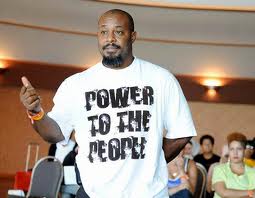
 

"It's an uphill climb here in Mississippi,” added Akuno. “The Republican Tea Party government we have on a state level is not in favor at all of what we're trying to push through cooperative development. There was a bill supporting cooperatives that they killed earlier this year. On a municipal level, we are looking to transform all of the procurement policies of the city, all of the environmental regulations and standard policies within the city, and particularly all of the land-use policies in the city, that will support cooperatives. On the more practical side, we are launching a new organization from this conference called Cooperation Jackson, and it is going to be the vehicle by which all of the follow-through is going to be carried out.”

But the municipal battle, Akuno concluded, would be difficult, given the neoliberal, repressive and pro-gentrification policies of the new team in charge.

All the items presented by the opening speakers expressed the common theme of the conference organizers—Political power in the hands of the Black masses and their allies, then anchoring and using that power to shape and grow a cooperative economic democracy that would serve the vast majority. It was both a tribute to Chokwe Lumumba and an expression of his vision. Winning it, however, would not come easy.

The next day, Saturday, was a different story. Here space was opened up for more than 30 diverse workshops, spread out over three time slots, with two more plenary sessions. Topics included the influence of Mondragon, community land trusts, Black workers and the AFL-CIO, the communes in Venezuela, mapping the solidarity economy, coops on a global scale, waste management and recycling, working with legislatures, and many more. No one report can cover them all, but here’s the flavor of a few.

Mondragon and the Union Coop Model.

What were the nuts and bolts of Spain’s Mondragon Coops (MCC), and how could unions serve as allies in creating similar enterprises in the U.S.? This was the question posed at an excellent workshop with three presenters: Michael Peck, the U.S. representative of Mondragon; Kristen Barker of the Cincinnati Union Coop Initiative; and Dennis Olson, of the United Food and Commercial Workers.

Peck began with a brief overview of MCC and its 120 coops and their accomplishments. The key point: In MCC, workers own their labor, but rent their capital, rather than the other way around. “But sometimes," he noted, "you can tell more about something by look at one of its failures than all its successes."

He was referring to the fact that a major MCC coop, FAGOR, which made kitchen appliances, recently closed down. “The housing market in Spain and Europe collapsed, and without new homes, new appliance sales sink Plus there was tough price competition from Asia.” MCC had carried FAGOR for several years, but could no longer justify it. Despite anger, “the vote of the workers to close it was unanimous.” In the regular world, the workers would get their pink slips, and be on the street.

But Mondragon was different. “MCC first set up a solidarity fund with every worker donating 1.5% of their salary, adding up to some 15 million Euros,” he explained. “This was to cushion the transition. Then it worked to reassign all the FAGOR workers to other coops, which it has now accomplished for the large majority.” Peck added that Mondragon would continued creating new coops both in Spain and around the world, and the true test was not that some would eventually close, which was natural, but what happened when they did.

Kristen Barker, right, at Our Harvest Coop

Kristen Barker then gave the workshop an enthusiastic account of how a small group in Cincinnati, armed with only a few good ideas, had over four years moved to a point where three substantial coops were opening in the city and several more were in the works.

“We were really inspired when we heard of the agreement between Mondragon and the United Steelworkers,” said Barker. “Our effort also stands on the shoulders of the Evergreen Coops in Cleveland. To date, Evergreen has launched three co-ops, Evergreen Laundry, Ohio Cooperative Solar that offers energy retrofits and solar panel installation, and Green City Growers that grows high end lettuce for hotels and restaurants in Cleveland. They have dozens of potential cooperatives in the pipeline. We are partnering with the major players of this initiative including the Ohio Employee Ownership Center for our unique project."

The first three coops in Cincinnati, Barker added, were Sustainergy, a building trades coop to retrofit buildings to better environmental standards; the Cincinnati Railway Manufacturing Cooperative, which will make undercarriages for rail cars, and partnered with both the United Steel Workers and the local NAACP; and Our Harvest, a food hub coop which starts with local farms and takes their produce to a central site for packaging and marketing. It’s partnered with the UFCW union and other agricultural groups. Dennis Olson explained how the UFCW was particular helpful in connecting growers through the distribution centers to the unionized grocery chains, as opposed to Wal-Mart.

“We only had a small study group to start—some community organizers, some Catholic nuns, a few union people,” concluded Barker. “But we did a lot of research, made partners and got the word out in the media. Soon we had more people calling with more ideas, like coop grocery stores in ‘food desert’ areas, jewelry makers’ coops and so on. We started getting some interest from the city, and now things are taking off.”

Starting Coops in Jackson and the ‘Kush’

This session was chaired by John Zippert of the Federation of Southern Cooperatives. He started with an excellent short summary of ‘Cooperatives 101,’ but quickly turned to drawing out the workshop participants on their concerns. Most were Black women from Jackson—one was interested in whether an African hair care products and services was possible; another wanted to start a coop of home health care workers. One man from Memphis said he had a small business distributing African products to small Black stores in the surrounding states, but he was getting on in years. How could he turn it into a coop that would live after him? Everyone shared ideas and legal options
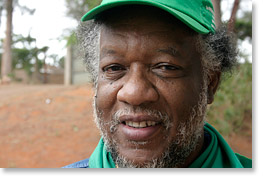
As the session ended, I ran into Ben Burkett, a Black farmer locally active the Indian Springs Farmers Association, part of the ‘Kush.’ I knew he was also president of the National Family Farm Coalition, but asked him more about his local operation.

“Well, I don’t do cotton anymore, not much cotton in Mississippi these days,” he explained. ‘I do many vegetables, and sweet potatoes are a good crop. But it’s one thing for a farmer to grow and dig sweet potatoes. It’s quite another to have the equipment to scrub them, cut them into French fires, and then bag and store them, while getting them quickly to your markets. That’s where the value of the coop comes in. We can pool our resources for these things, and it makes a big difference. We’d be in bad shape without the coop.”

Waste Management, Recycling and City Politics

The politicss of garbage was the main topic here. Chaired by Kali Akuno, this workshop gave the most insight into what was going on in Jackson as a new and backward regime was replacing that of Chokwe Lumumba. “Waste Management serves the city poorly,” said Akuno. “It often ignores our neighborhoods. It does no recycling; it dumps the waste in a landfill in a small city to the North of here, gives them a payment, and that’s the end of it.”

Akuno explained they had a different plan. Since a large part of the city budgets deal with services like these, they wanted to break them into smaller pieces so local contractors or coops could bid on them, then recycle the waste into a revenue stream. In addition to helping the environment and employment, it would keep the money circulating locally.

“Another piece was setting up an incubator to foster the development of cooperatives,” Akuno added. “The government can’t run the co-ops. It won’t build them, but it can set the table. For most of the past 20 years, even though there has been a succession of black mayors, 90-95 percent of contracts to people who don’t live in Jackson. It was all about hiring people in Jackson.”

“Now everything is going to be a fight,’ he added. “Even if your plan is reasonable and sustainable, it won’t matter if it’s stepping on the wrong toes.”

Saturday also included two mealtime plenary sessions, one, at lunch, featuring the diverse organizations taking part, and the other, at dinner, giving everything an international dimension.

The lunch plenary included Omar Freilla of Green Workers Cooperatives, Steve Dubb of the Democracy Collaborative, Michael Peck of Mondragon USA, Ricky Maclin of New Era Windows, and Saladin Muhhamad of Black Workers for Justice and MaryBe McMillian, Secretary Treasurer of the North Carolina AFL-CIO.

“Community cooperatives,” said Steve Dubb, “can be considered part of a long civil rights movement that fights for both racial and economic justice. For example, Dr. Martin Luther King in the last year of his life helped launch the Poor People’s Campaign for an Economic Bill of Rights. The return of cooperatives to the movement, as illustrated by what’s happening here, is a welcome development.”

MaryBe McMillian stressed the importance both of labor and the concentration of forces in the South. “Why organize in the South? Because what happens in the South affects the entire nation." Speaking for Black workers, Saladin Mummamad added, ‘We need power not just democracy; we need power that shapes what democracy looks like. When plants shut down workers, should seize control and turn them into cooperatives.”

The evening session started with a tribute to Chokwe Lumumba by his son, Chokwe Antar Lumumba. “We are victorious because we struggle. I'm not afraid of the term revolutionary. We need to be as revolutionary as the times require. Free the land! The struggle my father started is not over, but only beginning. It continues, by any means necessary.”

Also featured were Francoise Vermetter of Chantier in Quebec, Pierre LaLiberte on the International Labor Organization in Switzerland, Mazibuko Jara of AMandela! Magazine in south Africa, Elbart Vingwe, Organization of Collective Cooperative in Zimbabwe, Omar Sierra, Deputy Counsel General of Venezuela-Boston, and Janvieve Williams-Comrie, Green Worker Coops in the U.S.

"Freeing the land has given our people a new sense of belonging," said Omar Sierra, of Venezuela. “Chokwe Lumumba extended his solidarity to us in a time of need. Our people are saddened by his passing, and will not forget him.”

William Copeland, a cultural organizer from Detroit. Summed up the spirit of the crowd: “These presentations demonstrate the international significance of the Black Liberation Movement and Southern movement building.”

On Sunday morning, those who hadn’t had to leave early for the airport, gathered in a large session of the whole that closed out the weekend. One after another, people stood up and testified to how their consciousness had been altered by their discussions and new experiences over the weekend. Emily Kawano of the Solidarity Economy Network made the point of understanding that the projects ahead, while including coops also reached beyond them to other forms, such as participatory budgeting, public banks and alternative currencies. Finally, at an auspicious moment, an African American women rose and in a strong church choir voice, began singing an old civil rights anthem, “Organize, organize, organize!” Everyone was on their feet, hands clapping, fists raised, and interspersing ‘Free the Land! with the chorus. It couldn’t have had a better closing moment.

Read more!

Friday, August 09, 2013

Digging In, Reaching Out…


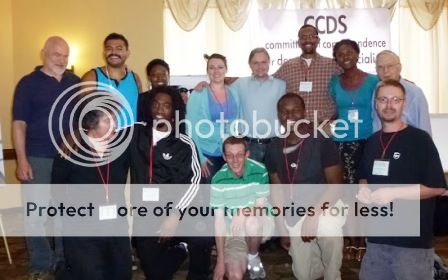
Student and teachers from the Convention ‘School for Young People’

CCDS 7th Convention Debates Growth

of the Left and the Progressive Majority

in Combating Austerity, War and the Right

[This report was assembled by Carl Davidson, with considerable and valuable help from Cheryl Richards and Ellen Schwartz, our recorders. Others who added a lot were Janet Tucker, Harry Targ, Ted Reich, Pat Fry, Will Emmons, Randy Shannon, Anne Mitchell and Duncan McFarland. Photos by Ted Reich]

Nearly 100 delegates, observers and friends gathered in Pittsburgh, PA for the 7th Convention of the Committees of Correspondence for Democracy and Socialism over the July 18-21, 2013 weekend. The goals of the gathering were to take stock of the political battles since their last convention in 2009, to assess the organization’s strengths, weaknesses and ongoing challenges, and to chart a path of unity and struggle for the upcoming period.

The participants came from all sections of the country: from California to Florida, from Texas to Boston, and many points in between. Almost all were deeply embedded in mass struggles—trade unions and community organizations, women’s groups, civil rights organizations and peace and justice coalitions. Many had also taken part in a variety of independent electoral battles against the GOP and the right, and everyone had been in the streets during the battles against the wars, the Occupy upsurge and for justice in the Trayvon Martin case.

Kicking off the meeting was a “School for Young People.” That innovation started a day before the main sessions of the convention. The presence of 20 young activists—men and women, of several nationalities, fresh from many battles, especially in the South—added a dynamic quality to all the discussions for the entire weekend.

“We appreciated the steps CCDS has made to accept the need for youth leadership in the socialist left and progressive movements,” said Will Emmons of Kentucky. The students saw the school as a “good first start,” and looked forward to more and better efforts in overcoming the intergenerational divide in much of the socialist movement.

The convention itself was organized into five plenary sessions and 16 workshops, with a cultural event and dinner on Saturday evening. It opened for the youth school and other early arrivers Thursday evening with the showing of the new film, “Anne Braden: Southern Patriot,” an inspiring story of the battles of Anne Braden and her husband, Carl Braden of Kentucky, in decades of battles against white supremacy and other fronts in the class struggle across the South. Filmmaker Anne Lewis from Texas was on hand to lead a discussion that followed.

All the convention’s deliberations were organized around a “main resolution,” with the various plenaries and workshops dealing with its different sections. The five plenary topics were 1) assessing the concrete conditions, 2) the terrains of struggle against austerity, 3) the climate change crisis, 4) strategic formations and the progressive majority, and 5) the quest for left unity.

Time of Day: The Opening Plenary on Concrete Conditions

“What time is it?” asked Mildred Williamson, a CCDS national committee member from Chicago, in her remarks opening the first plenary session, which was chaired by Randy Shannon of Western PA. “It's a time of economic, social, environmental, and racial injustice on steroids.” she continued, “a time of no respect for humanity.” She proceeded to spotlight the full range of current conditions with the lens showing the inter-connection of class, race and gender. “What time is it?” she repeated, “As long as Black and brown lives are thought of and treated as disposable, in a 21st century-three-fifths-of-a-person fashion, it will be impossible to achieve working class power in this country. Economic and social policies are literally destroying Black and brown lives, and simultaneously further weakening working class power…. we must fight with humility and purpose to strengthen and promote radicalized thought and action in the quest for social justice, human rights and working class power. This requires a fresh look at what it means to be ‘Left’ in this phase of capitalism.”

Williamson concluded by posing the most poignant questions to the delegates:

“What is the winning strategy to reduce the number of white working class people from voting against their own class interests, especially since fewer are unionized and fewer live in integrated communities? What will be the winning strategy to achieve left unity - and just what does that mean today? How can we build respect for youth in leadership of social justice movements while still showing simultaneous respect for elders? How do we fully move our thought and action from the multiracial unity ‘slogan’ to normalized, genuine demonstrations of respect for multiple cultures, gender expressions and sexual orientations? These questions--and more tough ones--need answers in order to chart the path forward in the quest for working class power. Let's work on them at this convention and thereafter.”

Read more!

Wednesday, November 14, 2012

How the Left Can Become a True Political Force to Be Reckoned With

By Bill Fletcher & Carl Davidson
Progressive America Rising via Alternet.org

Nov 13, 2012 - The 2012 elections may prove to have been a watershed in several different respects.  Despite the efforts by the political Right to suppress the Democratic electorate, something very strange happened: voters, angered by the attacks on their rights, turned out in even greater force in favor of Democratic candidates. The deeper phenomenon is that the changing demographics of the USA also became more evident—45% of Obama voters were people of color, and young voters turned out in large numbers in key counties.

Unfortunately for the political Left, these events unfolded with the Left having limited visibility and a limited impact—except indirectly through certain mass organizations—on the outcome.

The setting

On one level it is easy to understand why many Republicans found it difficult to believe that Mitt Romney did not win the election.  First, the US remains in the grip of an economic crisis with an official unemployment rate of 7.9%.  In some communities, the unemployment is closer to 20%.  While the Obama administration had taken certain steps to address the economic crisis, the steps have been insufficient in light of the global nature of the crisis.  The steps were also limited by the political orientation of the Obama administration, i.e., corporate liberal, and the general support by many in the administration for neo-liberal economics.

The second factor that made the election a ‘nail biter’ was the amount of money poured into this contest.  Approximately $6 billion was spent in the entire election.  In the Presidential race it was more than $2 billion raised and spent, but this does not include independent expenditures.  In either case, this was the first post-Citizen United Presidential campaign, meaning that money was flowing into this election like a flood after a dam bursts.  Republican so-called Super Political Action Committees (Super PACs) went all out to defeat President Obama.

Third, the Republicans engaged in a process of what came to be known as “voter suppression” activity.  Particularly in the aftermath of the 2010 midterm elections, the Republicans created a false crisis of alleged voter fraud as a justification for various draconian steps aimed at allegedly cleansing the election process of illegitimate voters.  Despite the fact that the Republicans could not substantiate their claims that voter fraud was a problem on any scale, let alone a significant problem, they were able to build up a clamor for restrictive changes in the process, thereby permitting the introduction of various laws to make it more difficult for voters to cast their ballots.  This included photographic voter identification, more difficult processes for voter registration, and the shortening of early voting.  Though many of these steps were overturned through the intervention of courts, they were aimed at causing a chilling impact on the voters, specifically, the Democratic electorate.[1]

Read more!

Monday, October 22, 2012

Beaver County and the ‘Cracker’ Debate

Potential site for major new ‘cracker’ plant near Monaca in Beaver County, PA

By Carl Davidson

Our county was was hit hard and early by globalization and the export of jobs. Our towns were largely formed around mills, and when the mills were closed in the 1980s, the towns were stressed to the extreme. Many workers moved away or retired, and those remaining in the towns themselves were largely poor and Black with few options.

Now with the new natural gas boom creating by dubious and dangerous deep underground ‘fracking’ explosions, Shell Oil wants to build a new 'ethylene cracker’ plant that turns natural gas into plastics. Fewer than 1000 people would work in the new $1.2 billion facility, but 10,000 people would be hired over five years to build it, and perhaps another 7000 more for new plastic manufacturing plants draw to be created alongside it.

For the county, it means two things. First, a complete turnaround for employment and new small business and new orders for the tube mill still running. Second, since hundreds of new ‘fracking’ gas wells would be needed to feed the ‘cracker,’ there is serious danger to the county’s water supply and many other health and environmental issues.

So we have a big ongoing debate. Are you for or against the ‘cracker.’ Are you opposed to fracking? Or do you just want to tax and regulate it? And what about clean and green energy?

Natural beauty of our townships soon to be ‘fracked.’

The issue keeps coming up in various forums, including our Beaver County Marcellus Awareness Committee page on Facebook. I had posted some pictures to it showing the natural beauty of our area, which led some to say it could all be ruined by the ‘cracker’. Here’s my brief reply:

'Beauty' looks one way out in the townships. But in the deindustrialized mill towns along the rivers, you see something else--the impact of joblessness is not so pretty. You have to view these things strategically, meaning the whole, not just the part, the future, not just the present, and who are the key engines of change as your allies, if not the unemployed and underemployed. In order to unite the many to defeat the few, you have to find ways to unite people who disagree on many things--no easy task, but it's demanded of us.

Query to me: Why haven't jobs come to Beaver County? The skilled left the area for better jobs and now the perfect storm. I do not know the percentages of skilled or college grads or even people who only have a high school diploma or just a GED in Beaver County.

CarlD: The lack of opportunity means we already have exported a good number of our youth, or at least those with options and prospects. We are demographically now one of the oldest counties, if not the oldest, even though we still have many distressed young people among us, under-employed and unemployed. We have the means to create skills--BCCC, Robert Morris, Geneva and Penn State Beaver--and we have done so.

But I know younger folks in my own family, educated, who have moved away for lack of new industry. For those remaining, the fracking jobs, the trucker jobs related to it and the construction jobs related to the 'cracker' are viewed by them as a Godsend, or potentially so.

Our task is first, to defend clean water, and second figure out a positive way to deal with this developing industry. I doubt that it's going to be stopped, but it can be modified and a share of the profits from it can be diverted toward green renewables in the longer run. The devil is in the details, of course, but I don't think we do well simply to avoid those details with an abolitionist stance not likely to get very far and likely to separate us from real friends. Even people working at building a 'cracker' have an interest in clean water…

Don’t look for this debate to be resolved easily. The opinion and suggestion box is now open! Feel free to comment.

Read more!

Saturday, December 17, 2011

Book Review - Revolutionary Youth and the New Working Class: Lost Writings of SDS


cover-front-revyouth Edited by Carl Davidson,

Changemaker Publications

Pittsburgh PA, 2011

By Jerry Harris

Carl Davidson has done a tremendous service to anyone who studies the history of social movements or anyone interested in the 1960s rebellion. This "lost" collection of papers reveals the depth and richness of radical thinking coming out of the student movement as the war raged in Viet-Nam and militant protestors marched through the streets of America.

The most important document is the "Port Authority Statement," by SDS members David Gilbert, Robert Gottlieb and Gerry Tenney. Although at the time not widely circulated, it offers great insight into the thinking and analysis of SDS as it turned to revolutionary theory and debate. This is an impressive document. Detailed in statistical and economic analysis, grounded in revolutionary social theory, and innovative in its thinking and insights.

One of the most important sections of the paper was its class analysis with its focus on the new working class and the relationship of students to an economy shifting from manufacturing to services and technology. The documents notes that, "Modern American capitalism is characterized by rapid technological change with scientific knowledge growing at a logarithmic rate." This will result in the "elimination of unskilled labor (as) the blue-collar sector will decrease (and) jobs that require high degrees of education and training" will increase. (pages 88-89)

That analysis was made in 1966. Now read a recent article by Edward Luce from the Financial Times: "the middle-skilled jobs that once formed the ballast of the world’s wealthiest middle class are disappearing. They are being supplanted by relatively low-skilled (and low-paid) jobs that cannot be replaced either by new technology or by offshoring – such as home nursing and landscape gardening. Jobs are also being created for the highly skilled, notably in science, engineering and management. (12/11/11) Decades later the paper's main thesis still holds up.

Continuing its class analysis the Port Authority document examined the capitalist class and the debate over ownership and control. The authors focused attention on the growing trend towards paying executives with large stock rewards, merging management and ownership. Again we can turn to a recent article published in the December 2011 Monthly Review that reads, "More recently, David Harvey has argued that ownership (share holders) and management (CEOs) of capitalist enterprises have fused together, as upper management is increasingly paid with stock options." (Richard Peet) This "recent" argument now being made by a leading Marxist trails Port Authority by some 45 years.

Although the authors grasped the sweeping impact that technology would have on American workers, what they could not see would be globalization and the advent of neo-liberalism as a governing ideology. As the paper notes at the time, "Corporate liberalism implies that the dominant economic institution is the corporation and that the prevailing political and social mode is liberalism." (page 68) Of course it's understandable how such changes would be all but invisible in 1966; it's also a good reminder why political tactics and strategy must remain flexible and activists should always be willing to reevaluate their analysis.

The above are but a few of the enticing insights that are contained in page after page of these documents. As new social movements gather force throughout the world, a look into the thinking of activists from the last great social movement can help give direction to coming future battles. I would highly recommend this book to all activists and academics interesting in building a better world.

Jerry Harris, National Secretary of the Global Studies Association and author of "The Dialectics of Globalization."

Read more!

Tuesday, November 29, 2011

Do They Really Want 'Specific Demands' from the Occupiers?

By Carl Davidson
Keep On Keepin' On

I’m getting fed up with pompous pundits lecturing the ‘Occupy!’ movement for not having a set of specific demands.

A case in point: New York Time financial columnist Joe Nocera quoted at length in a story by Phoebe Mitchell in the Daily Hampshire Gazette on Nov 29.  He was speaking at the Amherst Political Union, a debate club at UMass Amherst.

Nocera starts off with the now usual tipping of the hat to the protestors:

“Nocera believes the anger caused by income inequality, a divisive issue across the country in this prolonged economic downturn, is the fuel for both popular uprisings. ‘If we lived in a country that had a growing economy and where the middle class felt that they could make a good living and had a chance for advancement and a decent life, there would be no tea party or Occupy Wall Street,’ he said.”

But we don’t live in such times, and the more interesting story is that OWS and its trade union allies are displacing the Tea Party, and energizing the progressive grassroots. Nocera, however, makes OWS the target.

“He believes that for the Occupy Movement to be successful, it must frame clear demands that outline a plan for creating jobs and refashioning Wall Street to benefit the entire country and not just a select few wealthy investors. Without a solid plan for moving forward, he said, the Occupy protestors will be continued to be viewed by Wall Street supporters as little more than “a gnat that needs to be flicked from its shoulder blades.”

A ‘gnat’ indeed. In due time, a progressive majority may well come to view our dubious ‘Masters of the Universe’ on Wall St as bothersome gnats to be flicked away.

But to get to the main point, Nocero knows perfectly well that there is any number of short, sweet and to the point sets of demands aimed at Wall Street finance capital and the Congress it works to keep under its thumb. Richard Trumka of the AFL-CIO has been hammering away at his six-point jobs program—one point of which is a financial transaction tax of Wall Street as a source of massive new revenues to fund the other five.

The United Steel Worker’s Leo Gerard has been tireless for years working for a new clean energy and green manufacturing industrial policy that could create millions of new jobs and get us out of the crisis in a progressive way.

So what happens when these demands are put forward? With our Wall Street lobbyists working behind the scene, the best politicians money can buy declare them ‘off the table.’ Nocera and others of like mind in punditocracy put the cart before the horse. OWS arose as a result of a long train of abuses, year after year of sensible, rational, progressive demands and programs swept off of Congress’s agenda like so many bread crumbs from a dining table. Not even brought to a vote. OWS and a lot of other people are fed up with being dismissed.

The pundits should watch what they wish for. The demands and packages of structural reforms will be back, much sharper and clearer, and with the ante upped by hundreds of thousands in the streets, as well as millions turning out for the polls. In fact, the solutions have always been there for anyone with ears to hear. We’ll see if our voices are loud enough to crack the ceiling at the top, and let some light shine through.

Read more!

Sunday, September 25, 2011

‘Street Heat’ vs. Finance Capital and the Right

Solidarity Time: Young People Occupying

Wall Street Are Standing Up for All of Us

By Carl Davidson
Keep On Keepin' On

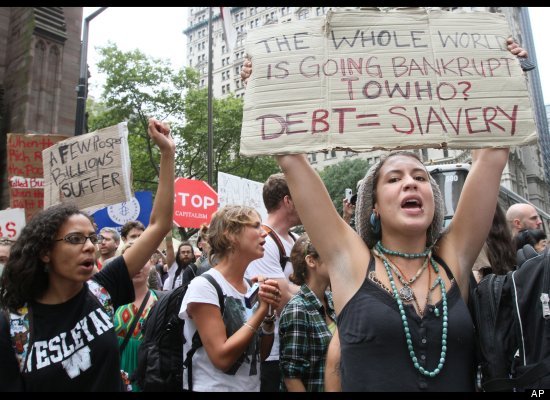
The actions of thousands of young people in New York City's financial district, simply calling themselves "Occupy Wall Street," is now entering a second week, with many camping out overnight in the area's parks. How long its will continue and whether its numbers will swell is anyone's guess, but the response of the NYPD in arresting and otherwise restricting them is already banging heads with our First Amendment rights to peacefully assemble.

"At Manhattan's Union Square, police tried to corral the demonstrators using orange plastic netting," reports the Sept 25, 2011 Washington Post. "Some of the arrests were filmed and activists posted the videos online. One video appears to show officers using pepper spray on women who already were cordoned off; another shows officers handcuffing a man after pulling him up off the ground, blood trickling down his face."

Most of the youth are students, but many are also unemployed and underemployed young workers. And a small but important grouping of staffers and activists with NYC's trade unions have also made their way downtown to spend a few hours helping out.

The students certainly have a just cause. While the denizens of Wall Street have bailed themselves out and paid themselves huge bonuses with trillions from the public treasury, these young people are saddled with a degree of crushing debt to pay for their educations that would have been unthinkable 40 years ago. If they manage to graduate, they face a financial burden large enough for a home mortgage-all before they start their first full-time jobs, assuming their lucky enough to find one that pays a living wage.

But these youth and students are fighting for more than their own immediate concerns. They have raised a whole range of demands-Medicare for All, defending social security, for passing the various jobs bills in congress, opposing racism and sexism, ending the wars, and abolition of the death penalty in the wake of the recent unjust execution of Troy Davis.

They are the cutting edge of a new popular front against finance capital.

Young rebels often manifest a moral clarity that awakens and prods the rest of us. Through their direct actions, they become a critical force, holding up a mirror for an entire society to take a look at itself, what it has come to, and what choices lay before it. The historic example is the four young African American students that sat at a lunch counter and ordered a cup of coffee in Greensboro, North Carolina back in 1960.

The Wall Street protests are thus a clarion call to the trade unions and everyone concerned with economic and social justice. While the youth are clearly a critical force here, when all is said and done, they are not the main force. That power resides in labor and in the wider communities. It's in the hands of everyone that's part of an emerging progressive majority for peace and prosperity, everyone that wants a U-Turn against the country's current path to more wars and deeper austerity.

It's time to exercise that power and lend a hand with active solidarity. More actions are in the works, including an occupation and encampment on Freedom Plaza in Washington, DC starting Oct. 6, following the 'Rebuild the Dream' DC conference focused on a renewed labor-community coalition for the 2012 election.

It's going to take more than votes to push back the right wing and its Wall Street allies. It's going to take some serious 'street heat' as well.


[Carl Davidson is a national co-chair of Committees of Correspondence for Democracy and Socialism, a national board member of the Solidarity Economy Network, and a member of Steelworker Associates residing in Beaver County, Western PA.

If you like this article, make use of the PayPal button at http://carldavidson.blogspot.com  His books are available at http://stores.lulu.com/changemaker]

Read more!

Wednesday, August 10, 2011

London: ‘Shock Doctrine’ as a Two-Way Street

The Approaching Winter of Our Discontent

By Carl Davidson
Keep On Keepin' On

Watching the rebellions of the young and poor continue in London and now spread to other industrial centers in the UK raises an interesting question: Will the Arab spring and the European summer lead to a fall and winter of discontent here in the USA?

All the makings for it are here. We have impoverished communities of the unemployed where there are huge numbers of young people who have never had a regular job of any sort. Now that any form of taxing the rich for funding a jobs program like that proposed by Rep. John Conyers’ HR 870 has been declared ‘off the table,’ it doesn’t appear likely to change, either.

Add to that the GOP’s ‘Shock Doctrine’ (with an assist from the White House) of creating a neoliberal deficit hoax to take from the working class and give to Wall Street, and you spread deeper misery across all of Main Street.

Now the AFL-CIO, thank goodness, is calling for a new round of mass actions against austerity and in defense of the tattered safety net. Add to that the October2011.org project, where the peace and justice movement is planning to camp out in downtown DC’s Freedom Plaza until all the troops are brought home from the wars.

It’s a perfect storm shaping up.  Hopefully, many of our young unemployed and under-employed will be drawn to these events. But any police outrage could set off a chain reaction like those in London-we’ve seen this many times in our history.

We have a few decent politicians facing up to the problem, like the 80 votes of the Congressional Progressive Caucus behind the People’s Budget. But our top political class has declared their efforts ‘off the table,’ too.

In brief, they’re telling us our views don’t count and we have nowhere to go.


That’s what the bigwigs in London thought, too. Now they’re all in a tizzy about riots and violence. In contrast, in one NBC report, a young man in Tottenham was asked if rioting really achieved anything:

“Yes,” said the young man. “You wouldn’t be talking to me now if we didn’t riot, would you? Two months ago we marched to Scotland Yard, more than 2,000 of us, all blacks, and it was peaceful and calm and you know what? Not a word in the press. Last night a bit of rioting and looting and look around you.”

Of course, many small shops and working-class homes, unfortunately, are being harmed in the UK events. Street heat is best when the target is narrowed on the upper class, and you keep the moral high ground. That way you can draw even more millions into relatively peaceful assembly with powerful and lasting implications. But when long-ignored social dynamite explodes, things don’t always work out that way, with the well-controlled niceties of a tea party, no pun intended.

It is right to rebel against outrages and unjust conditions imposed from above. The ‘Shock Doctrine’ is a two-way street, and once it erupts, more than you might think will know which side of the barricades to gather on.

Read more!

Wednesday, January 26, 2011

Aliquippa’s Harsh Realities Featured in Story of the Hope and Vision of its Athletes


Jets cornerback Darrelle Revis visiting his hometown, Aliquippa, Pa.

The Heart Of Football Beats In Aliquippa

Over five decades of economic decline and racial conflict, a Western Pennsylvania mill town has found unity and hope on the football field

By S.L. Price

Sports llustrated’s ‘Vault’

Jan 31, 2011 Issue - The fear came for Willie Walker that November. He was not expecting it. Evening had dropped early and hard, as it does in Western Pennsylvania in the fall, but these were streets he had known forever. Hours had passed since the 2004 regional championship game had ended down in Pittsburgh; the adrenaline and bravado on the ride home had long since burned off, replaced by grief, then mere regret. They had lost. The Aliquippa High football team, for all its history of success, had been beaten. Now, in the backseat, Walker felt a numbness settling in. Losing happens. You move on. You start thinking about what's next.

Walker was a senior. Just seven months until graduation, and he'd be able to say it: He had survived. The town hadn't killed, hadn't crippled, hadn't defeated him, though God knows it had tried. His life had been a cliché of criminal pathology: father long dead, mother struggling with crack addiction, days of hunger, corners promising casual violence. Aliquippa's streets are, as one of Walker's coaches put it, "a spiderweb" capable of ensnaring the most innocent, and though Walker never lost sight of his prize—college somewhere, anywhere—he was hardly innocent. No, for a time he had leaped into the web, daring it to grab hold.

Read more!

Monday, November 29, 2010

Solidarity and Hope: The Ongoing Saga To Close ‘School of the Assassins’


Bearing Witness, Making Solidarity:

5000 Turn Out vs. Torture and Murder

At Fort Benning’s ‘School of the Americas’

By Carl Davidson

CCDS Field Organizer

The annual School of the Americas Watch vigil and procession are a unique and powerful event in America political life

Going on for 20 years now, the mobilization against the training of torturers and killers in Fort Benning, GA is part peace mobilization, part solidarity with Latin America event, part religious pageant, part public face of the Catholic left, and part gathering of the tribes for newly radicalized youth. The gathering draws thousands of people, including nuns and priests, veterans and labor organizers, along with other peace and solidarity activists. They all come for a two-day creative mixture of diverse events that leaves everyone politically transformed and emotionally peaked.

This year’s event was no different. Over the weekend of Nov 19-21, close to 5000 people took part is a series of colorful and dramatic actions. Thirty were arrested and held several days by police. Four of these were arrested after intentionally committing civil disobedience by climbing over a fence topped with barbed wire at the entrance to Fort Benning. Others were arrested for simply straying off a sidewalk in an attempt to march to downtown Columbus, GA. Local courts imposed heavy fines and maximum sentences.

Why is the U.S military training torturers and death squads? The answer is an old one: wealth, power and intimidated, non-union labor.

“For the past several decades, the US has allied with dictators in Latin America who helped that region’s small, elite group of wealthy landowners,” said SOAW founder Father Roy Bourgeois, a Louisiana native, who lives just outside the gates of the school in Fort Benning where he carries on his work.

“We got involved militarily with these countries because they were rich in natural resources, with coffee in Colombia, bananas in Central America, copper in Chile, petroleum in Venezuela and tin in Bolivia. With their militaries, the U.S. joined with them to exploit those natural resources and to pay workers $1 a day. There were no labor laws there,” Bourgeois noted. “We were like the new conquistadors.”

The high point of the weekend was the Sunday procession of thousands, each carrying a white cross with the name of a slain Latin American peasant, worker or child, and a number of priests and nuns, including Salvadoran Archbishop Oscar Romero, slain by those trained in Fort Benning’s SOA facility. Teams of singers mournfully sang the names and ages, and after each one, everyone raised their crosses, and answered with the classic salute of the living to those who have fallen in battle: “Presente!”

The procession lasted for hours as the column of mourners bearing crosses of the dead walked from the front of the stage up one side of the street to the police barriers and back down the other side of the street to the back of the stage. There they placed the crosses into the chain link fence blocking the entrance to the military base. Many mourners cried. Some raised their fists. Some knelt in prayer or meditation as the singing of the names and the chant of “Presente!” continued. Behind the stage a theatre group staged a scene of murdered members of a religious order, their bodies spattered with blood. Others snapped pictures or stood quietly.

Read more!

Saturday, September 26, 2009

Pittsburgh G20 Diaries: Day Three

front-march

Photo: PDA's Randy Shannon with banner, center, next Michael McPhearson of Vets for Peace with Rick Kimbrough, right.

10,000 Marchers Beat Back

The Steel City’s ‘State of Siege’

By Carl Davidson

Beaver County Blue

Nearly 10,000 protesters marched through the streets of Pittsburgh on the last day of the G20 this Sept. 25 afternoon, delivering a powerful message for global justice that was expressed with a brilliantly colored display of unity, militancy and diversity.

Peace and justice groups demanded an end to wars and occupations, trade union contingents demanded green jobs and fair trade, women and people of color raised the banners of equality and empowerment, and young people called for a sustainable and liberated future in a new world.

“Will we make any difference?” Rick Kimbrough asked me a few hours earlier as we headed down a parkway heavily secured with police cars at every exit on our way into town. Kimbrough is an old high school friend, an African American steelworker with 37 years in a huge Beaver County mill that’s now shutdown and gone, Jones And Laughlin Steel. When I asked him to join me the day before, he was fired up to go already, until he heard a nephew had taken a bullet as a bystander in a senseless street fight. When he heard his nephew would do OK, he called back, ready to ride in with me and join the United Steel Workers contingent in ‘the People’s March’ at the close of the G20 sessions.

“We’ll make SOME difference, but not nearly enough, and not yet,” was my reply. “These G20 people think they can run the world as they please, but we have to show them they can’t, that there are limits, at least until we can grow stronger, and turn things around completely.” I asked Rick if he had ever been to something like this before. No, he’d been to political, union and civil rights rallies, but this was different.

We turned to discussing the news from the previous day, mainly about the efforts by anarchist youth, a thousand or so of them, to stage actions on a variety of targets, and march on the G20 without permits. They had a number of skirmishes all day and into the night with the highly militarized police, who made use of tear gas, pepper spray and rubber bullets. Some 82 protesters were arrested overall, and the day had seen numerous smashed windows and trash cans sent rolling into the streets.

Far worse, the Pittsburgh riot police, on the night of Sept 24, swept the university neighborhood streets, downtown Oakland, clean of students with pepper spray and tear gas canisters. Students were trapped on stairwells by riot police above and below and gassed. Students were gassed in closed passages between dormitories. They had committed no crime, no offense, no discourtesy, no disrespect, but had simply been walking to get a bite to eat, or to visit a friend, or to study, or stand around in the cool night air and talk with friends.

The media accounts had worried Rick’s family about his participation. In fact, a number of other Beaver County workers I had asked to take part flat out said “No!,’ they had no interest in playing tag with heavily armed cops who were largely inexperienced--and my assertion that today’s march would likely be large and peaceful didn’t count for much. In fact, it was entirely peaceful on this last day—no windows broken, and only one arrest.

“What’s the deal with breaking windows? Don’t they realize that’s just a big diversion that waters down the message?” Rick asked about the previous night. I tried to explain that anarchists didn’t necessarily share our message, and could be manipulated by police and provocateurs. But young people had minds of their own, often having to learn things the hard way. He agreed, turning the talk back to his nephew, and venting his anger against the criminal profiteers selling guns to kids in his neighborhood. “I’ve seen too much senseless street violence,” he concluded, “I’ve got no patience for it.”

When we hit Pittsburgh, our attention turned to trying to park downtown near the Steel Workers building, so we would have the car nearby at the end of the march. Nice idea, but no way it was going to happen. Every downtown exit was blocked until Oakland, near the university. We tried twice to double back, and were turned back by police and blockaded streets.

Security was tough and serious. The militarized police, more than 6000 of them brought in from across the country, had shut down normal commerce and movement of people in the city. The city was placed in a real, not a virtual state of siege.

Finally, Randy Shannon from Beaver County’s Progressive Democrats of America got us on the cell phone. He’s across the river on the South Side, the closest spot he could find. So we picked him up, and made our way to Oakland, and luckily found a parking lot right near the head of the march.

As we neared the top of a steep block and reached the staging area, Rick got a little wide-eyed at the first thing we saw, a contingent of 200 Tibetans, some with monk robes and beating drums, and all with red and yellow flags and banners. So I gave him a quick crash course in who’s who—the Tibetans are protesting what they see as a raw deal from China threatening their Buddhist culture, the young people dressed in black with masks are mostly the anarchists we were taking about, the people with checkered scarves and green, black red and white flags are pro-Palestinian, the women in shocking pink are Code Pink, a militant peace group, and so on.

“This is wonderful, all kinds of people are here,” was Rick’s conclusion. I suggested we look for union caps and jackets, or people in fatigues with Army veteran’s stuff, and we’ll find the folks we’re looking for. Right away, Carl Redwood Jr. from the battles in the Hill District, a low-income African American neighborhood, comes over to talk. I met him at a teach-in two days before. We fill Rick in on the issues around the new Penguin stadium and gentrification.

As we neared the front ranks, I spotted Michael McPhearson, a national leader of Vets for Peace I knew through United for Peace and Justice. When I introduce Rick, it turns out Mike has folks in Aliquippa, so they are quickly making connections.

There were two groupings up front. Randy had connected with his daughter, a University of Pittsburgh student, and was positioned with the Thomas Merton Center antiwar people. Rick and I were with the Iraq Vets Against the War group along side them. Aaron Hughes, an IVAW national leader, came up to greet us. He and Rick were soon talking about post traumatic stress and it impact on communities when soldiers return. “I still haven’t spotted the Steel Workers,” I told him, “but let’s just stay here until we do.”

Suddenly the march moved out, and we’re in the front ranks, about four rows back. It’s a long walk, more than a mile, but fortunately, almost all of it is downhill. After we’ve gone twenty blocks or so and are on a little rise, I walked backwards and looked for the end. I couldn't see it; we were still filling the streets. It meant we numbered somewhere between 5000 and 10,000, and we could declare a victory for the day. Progressive activists had beaten back attempts at intimidation.

Rick picked up on all the rhythmic chanting. “The people, united, will never be defeated!” seemed to suit him best, while “This is what democracy looks like!” was my favorite for the day. As we come in sight of the Hill District, I’m informed that a feeder march of the residents numbering about 500 has merged with us, as have a number of other groupings with feeder marches throughout day.

Eventually we decide to stand to the side and wait for the USW contingent to show up. This meant we got a terrific review of the march’s composition: large banners from the Green party went by, followed by a huge HR 676 Single Payer health care contingent, then several hundred young anarchists in black with black flags, the Gay and Lesbian people, more environmentalists, then Middle East peace militants. Finally we spotted the large blue USW flags, with dozens of people in union T-Shirts, perhaps 50 in all. I waved to Maria Somma, a Steel Worker organizer. Interestingly, the front banner is featuring the rights of immigrant workers. Plenty of ‘Good Jobs, Green Jobs’ placards are also visible. We fell in at the back of the contingent, carrying our own placard with a picture of Dr. Martin Luther King, Jr., and a demand for jobs.

The taller downtown buildings provided and excellent echo chamber for our chants and drum beats, so spirits were high as we turned the corner to the rally scheduled at an open plaza near the City-County Building.

“We had this successful people’s march today only because we FOUGHT for it, every step of the way” declared Peter Shell of the Thomas Merton Center’s Antiwar Committee from the platform. He delivered a powerful indictment of the federal and city tactics designed to disorganize the protestors and dampen the turnout. “Look at all these militarized police brought in here from everywhere. They have taught us an important lesson, even if in a small way, about what it’s like to live under and occupation, and why we have to increase out efforts this fall to end the occupations in Iraq, Afghanistan and Gaza.”

Lisa Jordan of the USW Education Dept spoke for the steelworkers. “The G20 is undemocratic and unrepresentative,” she stated. “They only speak for the CEOs; there is no voice for the workers.” She pledged the solidarity of the USW with all the ongoing fights for global and social justice.

We listened to a few more speeches, but the crowd was breaking up. One contingent would go on to the East Side within a few blocks of the convention center, where the G20 was wrapping up, and thus technically getting within ‘sight and sound’ of the gathering. It was a thin concession to what was really needed.

Rick had a bum leg, injured years back in the J&L tin mill when a sheet of metal sliced a tendon, and it was giving out on him. Given the restrictive logistics, we called it a day. Getting to a bus to get back to our car was hard enough—we had to pass through three barriers of hundreds of police, including a long line of German shepherd police dogs that looked forlorn behind their uncomfortable muzzles. The bus quickly filled, and in twenty minutes, we were back at the car and headed home.

Since the G20 bigwigs were also headed toward the airport, which is located near the border of Beaver County, security was even more intense on the highway on the way back. “It’s all overkill,” said Rick. “They just want to use us for practice. We’re just a training exercise for them, and it’ll be turned against us even more somewhere down the line.”

As I dropped him off at home, I reminded him to check the news. “The cameras all loved your picket sign; you may get your fifteen minutes of fame, and can brag to your grandkids.” When I got home and turned on the news, however, reality sunk in. There were a few brief snippets about our huge march today, followed by great detail about how many windows and storefronts had been smashed the night before, complete with charts and maps of targeted areas, and lots of footage of broken glass, with kids in black masks, while cops do their best to round them up or disperse them.

Randy Shannon called to check in, making sure we made it back OK. “In that state of siege,” he summed up, “the march today was a shining example of the courage and determination of those of us who understand the need to fight for the First Amendment.”

But on the wider messages, if we’re ever to get beyond preaching to the choir of the militant minority, and instead break through to the progressive majority, we’re going to have to find the ways and the forces to do things differently.

Carl Davidson is a writer for Beaver County Blue, and a long-time organizer going back to the 1960s New Left. Today he is a national co-chair of the Committees of Correspondence for Democracy and Socialism and a national board member of the US Solidarity Economy Network. He is author, along with Jerry Harris, of 'Cyberradicalism: A New Left for a Global Age.' If you like this artile, make use of the PayPal button at http://carldavidson.blogspot.com

Read more!

Sunday, February 08, 2009

Steelworkers Meet Hip-Hoppers and Tree-Huggers

Photo: Van Jones at
Green Jobs 2009

Blue-Green Insurgency
Gets Fired Up at the
DC Green Jobs Conference


By Carl Davidson
Beaver County Blue

When you walk into a large and stately Washington, DC hotel lobby and find it teeming with thousands of smiling, buzzing people-half in labor union jackets and ball caps, the other half dressed in 30-something hip-hop causal-you know some special is happening.

This was the lively, energized scene for three cold wintry days this Feb 4-6 at the Marriott Wardman Park Hotel, as nearly 3000 activists and organizers gathered for the "Good Jobs, Green Jobs" National Conference. The gathering was convened by more than 100 organizations, representing every major trade union and every major environmental group in the country, among others.

It's called the "blue-green alliance," the core of which is the United Steel Workers and the Sierra Club, which jointly launched the "Green Jobs" movement nationally at a conference in Pittsburgh, PA a year ago. The turnout this year is triple in size and highly energized by both the victory of President Barack Obama and the looming onset of an economic crisis unmatched in scope since the Great Depression of the 1930s. In addition to the steelworkers, the building trades were well represented, and the green groups spanned a wide range of concerns, for toxics to alternative energy to climate change. Also notable was the participation of a contingent of "high road" corporations rooted in the growing "green economy." Gamesa, a major Spanish firm specializing in wind turbines, and Piper Jaffray, a large paper company focused on recycled paper products, are two examples.

But a critical new dimension was added by Green For All, an organization rooted among inner city youth, and headed up by Van Jones. Jones is the author of "The Green Collar Economy" and an inspirational voice for a rising generation of multinational, multicultural insurgent youth.

The conference started off with 'Advocacy Day,' with a well-organized deployment of buses and team leaders that took hundreds of participants to Capitol Hill, and got them headed in the direction of the offices of their respective Senators and Representatives. With remarkable serendipity, the Senate was deadlocked that same day over details of the Obama stimulus package, with the GOP Right trying to gut many of the Green Jobs components as "wasteful," while seeking tax cuts and bailouts for the rich. The voices and pressure from the conference activists come not have been timelier.

"A trickle has become a torrent,' said plenary speaker Margie Alt from Environment America the next morning, comparing their present efforts with the organizing and direct action campaign of the civil rights movement of the early 1960s. There are two paths in repowering America with clean energy, she explained. "One would have us chase short-term profits; the other has us moving on new public transit and plug-in hybrid cars, built in the USA and powered by the sun and the wind. Only the second puts us back to work. It means that when the clean energy revolution is done right, when each does their part, all benefit."

Alt warmed up the session for Richard Trumka, the AFL-CIO's Secretary-Treasurer and a former leader of the United Mine Workers. Trumka was a hero to millions in the Obama campaign for the no-nonsense way he took on the question of racism in rallying trade union organizers to win over white workers to vote for a Black candidate in the Appalachian areas.

"What a year!" Trumka proclaimed as he took the podium, referring not only to the election, but the Blue-Green Alliance's growth since Pittsburgh. "It's brought forward all the issues of race and class, and there's no going back. Good ideas and loud voices are desperately needed. In the mines, we were often told, jobs or the environment was the choice. But now we know the truth. It's not one or the other; it's both or neither. So get over it! This blue-green alliance isn't going away. We're in this together for the long haul."

Trumka had warm praise for Obama, but a sharp rebuke for the GOP Right. "All they can do is say, No!-No to fair trade, no to the Employee Free Choice Act, no to protecting the environment, no to domestic investment in new manufacturing. In the face of this, we have no guarantees; we'll get nothing here without a fight."

One topic discussed across many panels and workshop was the theme of the conference, "What is a Green Job?" and "What is a 'Good Job'?" The later was easily defined: a good job was a union job, a living wage with decent benefits. Green jobs were viewed from a number of angles. Trumka defined it as every job that contributes to a low-carbon future. Nuclear power and 'clean coal' efforts might come under that, but would be opposed by a good number in the coalition. There was no effort, moreover, to enforce unanimity on the point; debate and discussion would continue. There was wide agreement, however, on the Green jobs most in reach of unemployed youth: solar panel installations, 'winterizing' older housing stock to Green standards, urban agriculture plans, and expansion of mass transit.

The conference planners stressed the issue in a booklet distributed to all attendees, entitled "High Road or Low Road? Job Quality in the New Economy." It was aimed at Green corporations trying to do things on the cheap, paying workers at near the minimum wage. Terence O'Sullivan, president of the Laborer's International Union, exposed the problem:

"We did a survey of every job currently being called 'Green' by employers, and found the majority of them didn't pay enough to support a family of two." There was no sustainability, he suggested, without the working class itself being sustained. Borrowing from Henry Ford, he said, "Every worker building a Green product should be able to afford a plug-in hybrid car. It's very possible to build green, pay union wages, and still make a profit. There's no caring for the Earth that doesn't also include caring for the people on it."

Labor, government and business could be partners, O'Sullivan explained further, so long as the focus was "good jobs, at a living wage and the prevailing wage." The dynamic union leader, whose union represents some 500,000 building trades workers, stressed that "low road businesses and policies must not be rewarded….This fight isn't over; it's just started. The Republicans can't lead us anywhere; they couldn't find the supposed weapons of mass destruction in Iraq, and today they can't find even a trace of the first half of $700 billion given to the banks on Wall Street." To tremendous applause, he concluded by saying "No retreat, no surrender!" and that a "workers revolution" had to be paired with the "green revolution."

The conference participants got to speak their minds in the nearly 50 workshops spread over the three days. These covered a wide range on topics, from prison re-entry and green jobs to high road capital strategies for new wealth creation in a green economy. Everywhere, however, there was the common theme of expanding employment and guarding the environment.

In a workshop on capital strategies, for instance, about 100 people discussed methods for investing in a green economy. One case in point was Ontario's Algoma Steel, one of the largest worker-owned coops in North America, now thriving after a worker buyout assisted by venture capital and government funds. Fred Richmond, USW International Vice President, presented the example of his union's cooperation with Gamesa, a Spanish firm specializing in building wind turbines. One mill has been recently reopened in Bucks County in Eastern Pennsylvania, and another is underway in Western PA, creating 1000 new USW jobs. The ensuing demand for structural steel for the turbines has directly meant 250 steelworker jobs in Northwest Indiana.

Another workshop of 200 people went deeply into the energy policy of the state of Colorado, which now has the target of 20 percent 'clean energy' consumption set by the state legislature. Discussion focused on the transformation of two isolated minorities, green militants and labor unions, in a traditionally GOP-dominated 'Red' state. By coming to see each other as allies rather than adversaries, they were able to reframe common issues and win majorities. Said one presenter: "When you explain to farmers how the royalties from a wind turbine in their county can pay their local school budget and lower their taxes, and bring some new jobs as well, you have their attention. That's what we did, and as you know, Colorado turned 'Blue' in the last election, with the blue-green alliance playing a key role."

James Hoffa of the Teamsters also spoke to the blue-green alliance and how it started in the streets of Seattle in the massive street battles of "Teamsters and Turtles" on one side, and the World Trade Organization and the police on the other. "You learn who your friends are," he declared, 'and you learn a few things in the process. We originally supported drilling in ANWAR. I'd like to announce to you today that we no longer do."

Some of the most powerful presentations came on the last day. First up was Winona LaDuke, member of the Ojibwe (Chippewa) Tribe living in the White Earth Indian Reservation in Minnesota. She was the Vice Presidential Candidate with Ralph Nader on the Green Party ticket in 2000, but endorsed John Kerry in 2004 and Obama in 2008.

After greeting the crowd in her traditional language, LaDuke proclaimed with a smile, "I must admit it's a treat to come here from Minnesota to the home of the Great Black Father!" which brought down the house.

But she quickly turned serious, and the need to break with a petroleum-centered economy. "We can't build a society based on conquest. We are addicted, and like addicts, we hang out with dealers and do bad stuff. Our people lived in a green economy on this continent for nearly 30,000 years, and knew how to live within their means." She also took aim at the nuclear industry, noting that two-thirds of uranium was mined on Indian lands, and all of the proposals of where to store hazardous nuclear waste were Indian lands as well. "In what was the largest uranium mine in New Mexico, they've now build three prisons. How's that for a future?" For a Green solution, she pointed out that Indian lands were also "the windiest and sunniest' places in the country, and welcomed wind turbines and solar collectors, "but we want local ownership and control" as part of the package.

Fred Richmond of the steelworkers took the platform next and declared to the several thousand now present, "Feel the spirit of our sister, Winona LaDuke! Feel her passion for this land, as opposed to those global corporations with no loyalty to anyone apart from themselves!"

Richmond went on to give a history of how the blue-green alliance started and evolved, beginning with the USW and the Sierra Club. "We both came to understand that we cannot get good jobs without a clean environment, and that we can't get a clean environment without good jobs. We both needed unconventional allies to fight the low road's worldwide race to the bottom." Speaking about decades of fathers and grandfathers killed and poisoned in the mills, he ended with "We need to take our planet back!"

Now it was time for Green For All, which fired everyone up with the Hip-Hop video, "Green Anthem 1," (available on YouTube) a powerful portrayal of the entry of multicultural youth into the mix of "unconventional" but very natural allies. It brought Van Jones to the stage.

"We started this because we were tired of going to funerals," Jones began. "We were tired of police killing kids, and kids killing kids." These were rooted in the oppression of the inner city's joblessness and hopelessness, he explained and described initial work with the Ella Baker Center to fight for home repair and cleanup jobs, and called it "Green Jobs, Not Jails." Later the concept deepened into major structural reforms described in his book, "The Green Collar Economy."

"This is a profound movement that goes deeper than installing solar panels," Jones went on. This is showing the world a new America…. But no change can come in one day. We have to work every day. We have to change the economy, not just with green proposals, but with solidarity back in the center of it. We have to move democracy from the ballot box to the workplace. We are the human family coming back to itself. Think long and hard on this question: in the final hour, who are we? Who are we on this planet? Are we a swarm of locusts, devouring everything? Or are we honeybees, building together and adding to life?"

"This is our world historic moment, am I right, brother steelworkers?" Jones said gesturing to Richmond. "I'm not working for a lot of grants and awards on a dead planet….The clean energy movement can't be stopped, and labor is the pillar of the whole pro-democracy movement we need." To the Green For All youth, Jones added, "You are Ground Zero in this fight. To green the planet, we must green the city, and there's no greening the city without greening the ghetto. This is a movement that let's you rise!

Jones was adamant on the need to organize and mobilize at the base, to go back to the union halls and neighborhoods, and speak to all those not yet involved. He was warmly supportive of Obama, and the need to back him up. "But there will be times to push him, and times to be a few steps in front on him."

The question of war and militarism was brought front and center by Rev. Lenox Yearwood, who followed Jones. Yearwood is president of the Hip-Hop Caucus and a minister who serves as an ambassador for the hip-hop generation. Formerly an Air Force officer and chaplain, he raised a ruckus when he delivered a sermon to the Joint Chiefs of Staff entitled, "Who Would Jesus Bomb?" and was further radicalized by the events around Hurricane Katrina. Trying to enter a Capitol Hill hearing featuring General Petraeus, he was arrested and severely beaten.

""No War, No Warming!' is a slogan that has to link our struggles," said Yearwood. "I recall the words of our departed brother, Damu Smith, asking me if my job was to keep to myself, or fight for my people. This is our generation's lunch-counter moment. One hundred years from now, not of us in this room will be here; but we have to make sure the planet will still be inhabitable for our children and grandchildren. Organize everywhere, mobilize everyone, and lift up all! Power to the people!"

It was a fitting summation of the spirit of the conference participants. Their next task was clear enough: to take the nature of the unity and the wide alliances in the room at this national gathering, and replicate them at the grassroots in every state and major city in the country.

[Carl Davidson writes for "Beaver County Blue," a website anchored in Western Pennsylvania. He is also a steering committee member of the U.S. Solidarity Economy Network (http://ussen.org) and a national committee member of the Committees of Correspondence for Democracy and Socialism (http://cc-ds.org), as well as webmaster for 'Progressives for Obama' If you like this article, go to the http://progressivesforobama.net and make use of the PayPal button.]
Read more!

GoStats web counter