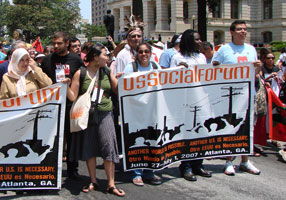
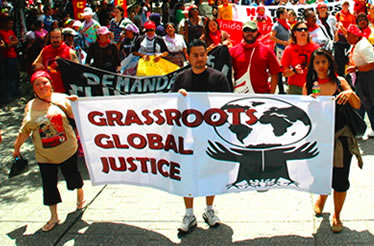
Showing posts with label Solidarity Economy. Show all posts

Friday, May 09, 2014

Jackson Rising: An Electoral Battle Unleashes a Merger of Black Power, the Solidarity Economy and Wider Democracy

Photo: Closing session of Jackson Rising

By Carl Davidson

SolidarityEconomy.net

Jackson,MS - Nearly 500 people turned out over the May 2-4, 2014 weekend for the ‘Jackson Rising’ conference in Jackson, Mississippi. It was a highly successful and intensive exploration of Black power, the solidarity economy and the possibilities unleashed for democratic change when radicals win urban elections.

The gathering drew urban workers and rural farmers, youth and the elderly, students and teachers, men and women. At least half were people of color. About 50 were from the city of Jackson itself, and most were from other Southern states. But a good deal came from across the country, from New York to the Bay area, and a few from other countries—Quebec, South Africa, Venezuela and Zimbabwe.

The major sponsors included Malcolm X Grassroots Movement, the Federation of Southern Cooperatives, Praxis Project, Southern Grassroots Economies Project, US Solidarity Economy Network, and the US Social Forum. Funding came from Community Aid and Development, Inc., Mississippi Association of Cooperatives, Coalition for a Prosperous Mississippi, Fund for Democratic Communities, Ford Foundation, Wallace Action Fund, Surdna Foundation, and the Rosa Luxemburg Foundation.

But to grasp the meaning and significance of this meeting, a step back to see how it began—and why it almost didn’t happen—is required.

The conference was the brainchild of Jackson’s late Mayor Chokwe Lumumba and one group of his close supporters, the Malcolm X Grassroots Movement (MXGM) soon after he was elected on June 4, 2013 and had placed his people in a few key city positions. They had initiated the conference, which was then endorsed by the city council, to help shape and economic development plan for the city and the outlying Black majority rural areas, known as the ‘Kush.’--hence the name of the overall project, the ‘Jackson-Kush Plan.’

Chokwe Lumumba was rooted in the Black revolutionary organization, the Republic of New Afrika (RNA), which claimed the Black majority areas of several states in the Deep South. He was one of its leading members, and a widely respected civil rights attorney. The RNA also had an economic outlook, a form of cooperative economics through the building of ‘New Communities’—named after the concept of ‘Ujamaa’, a Swahili word for ‘extended family,’ promoted by former Tanzanian President Julius Nyerere. The new mayor connected this core idea with the long-standing role of cooperatives in African American history, the experience of the Mondragon coops in Spain, and the solidarity economy movement that had emerged and spread from the Third World in recent decades. Together, all these ideas merged in the mayor’s project, ‘Cooperation Jackson.’

Lumumba’s election had taken Jackson’s political elite off guard. Making use of the Mississippi Freedom Democratic Party to run as an independent in the Democratic primary, he defeated the incumbent and forced a runoff. Given that Jackson is an 80% Black city, he then won overwhelmingly. So when he died suddenly of heart failure Feb 25, 2014, with his supporters in a state of shock, his opposition moved quickly to counterattack. The MXGM, the Peoples Assembly and other pro-Chokwe groups now had two tasks, trying to get Chokwe’s son, Chokwe Antar Lumumba, elected mayor while continuing to plan the conference, but with city support on hold.

Lumumba, 31 years old, lost to Tony Yarber, 46% to 54%. Chokwe Antar received over 65% of the Black vote, but the turnout had dropped. The Yarber team immediately moved to fire all the Choke sympathizers from city government, and tried to sabotage the conference. Local rightwing web publications attacked it as “thinly veiled communism.”

A Tale of Two Cities

What is behind this antagonism? Jackson is indeed a tale of two cities, on the cusp of two competing visions. Given its demographics, any mayor is likely to be Black, but what that can mean is another matter. Just driving around the city gives you a quick glimpse of the problem. While the largest city in the state and the Capitol, replete with major government buildings, the city is eerily quiet and empty. There are a few upscale areas, but also large areas of older, wood-framed housing of the unemployed and the working poor. There are huge fairgrounds, but little in the way of basic industry.

So two paths emerged. One was neoliberal, and aimed at exporting as much of the Black poor as possible, in order to open up wider areas from gentrification attracting the better-paid servants of the businesses that served government. The other was progressive, the Jackson Cooperation plan, which aimed at growing new worker-owned businesses and new housing coops that worked in tandem with the Black farmers of the ‘Kush.’ It also stressed democratized city services, while creating new alternative energy and recycling startups and also taking advantage of the city’s position as a major regional transport hub. It’s a conflict not unique to Jackson and shared by many cities around the country. Here’s the four points summing up ‘Cooperation Jackson’:

  • Cooperation Jackson is establishing an educational arm to spread the word in their communities about the distinct advantages and exciting possibilities of mutual uplift that business cooperatives offer.
  • When Mayor Chokwe Lumumba was still in office, Cooperation Jackson planned to establish a “cooperative incubator.” providing a range of startup services for cooperative enterprises. Absent support from the mayor’s office, some MXGM activists observed, a lot of these coops will have to be born and nurtured in the cold.
  • Cooperation Jackson aims to form a local federation of cooperatives to share information and resources and to ensure that the cooperatives follow democratic principles of self-management that empower their workers. We’ve always said “free the land,” observed one MXGM activist. Now we want to “free the labor” as well.
  • Finally Cooperation Jackson intends to establish a financial institution to assist in providing credit and capital to cooperatives.

The conference project thus found itself in the eye of a storm. But with luck and some judicious tactics, one key figure, Jackson State University President Carolyn Meyers, decided to stick with MXGM and allowed the conference to continue its plans on her campus, using the huge Walter Patton Center and two classroom buildings. A last minute fundraising blitz pulled in enough resources to squeeze through and make it happen.

Opening plenary: John Zippert, Jessica Gordon Nembhard, Ed Whitfield, Kali Akuno

When the hundreds of registered participants poured into the huge hall Friday evening and saw it filling up, one could sense the excitement and rising spirit of solidarity amidst diversity. The opening plenary keynote speakers included Jessica Gordon Nembhard of the US Solidarity Economy Network (SEN), Wendell Paris of the Federation of Southern Coops (FSC) Land Assistance fund, Cornelius Blanding, Special Projects Director of the FSC, Ed Whitfield of the Southern Grassroots Economies Project based in North Carolina, and Kali Akuno of Jackson’s MXGM.

Gordon-Nembhard started off. A professor at John Jay College in New York, she recently published Collective Courage: A History of African American Cooperative Economic Thought and Practice, a groundbreaking study on the topic.

“Courage is a word I had to use,’ she explained. ‘Everywhere I turned, from the early efforts of free Blacks to buy others in their family out of slavery, to the Underground Railroad, to burial societies and other clandestine forms of mutual aid; it took courage to motivate all these cooperative forms of resistance to slavery and white supremacy, from the beginning down to our own times.”

She gave the example of Fannie Lou Hamer in the battles in Mississippi in the 1960s, well known as a founder of the Mississippi Freedom Democratic Party. “But do we know her as a coop member, a group that sustained her when she was denied an income. As Ms. Hamer put it, ‘Until we control our own food, land, and housing, we can't be truly empowered.’”

Wendell Paris who, as a young SNCC worker mentored by Ms. Hamer, continued the theme: “Land is the basis for revolution and it is important for us to hold on to our land base." He described the workings of the Panola Land Buyers Association in Sumpter County Alabama. “Freedom isn’t free. In the training to run coops successfully, you learn more than growing cucumbers. You learn organizing and administration, the training ground for taking political offices.”

At different times during introductions, or even in the remarks of speakers, the chant, ‘Free the Land!’ would rise from the participants, accompanied by raised fists. This came from the RNA tradition, referring to an older battle cry of self-determination for the Black areas of the Deep South. It clearly still had resonance, and was often followed with ‘By Any Means Necessary!’

The opening session was closed out by comments from Ed Whitfield and Kali Akuno. “All successful enterprises produce a surplus,” said Whitefield, "and our empowerment runs through retaking the surplus we have created, and putting it to uses that best serve us. We're not here making excuses. We're here making history. As long as we accept the current economic structures and approaches to development that flow from those structures and paradigms, we can’t get out of bondage.”
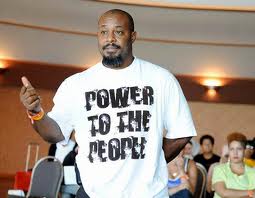
 

"It's an uphill climb here in Mississippi,” added Akuno. “The Republican Tea Party government we have on a state level is not in favor at all of what we're trying to push through cooperative development. There was a bill supporting cooperatives that they killed earlier this year. On a municipal level, we are looking to transform all of the procurement policies of the city, all of the environmental regulations and standard policies within the city, and particularly all of the land-use policies in the city, that will support cooperatives. On the more practical side, we are launching a new organization from this conference called Cooperation Jackson, and it is going to be the vehicle by which all of the follow-through is going to be carried out.”

But the municipal battle, Akuno concluded, would be difficult, given the neoliberal, repressive and pro-gentrification policies of the new team in charge.

All the items presented by the opening speakers expressed the common theme of the conference organizers—Political power in the hands of the Black masses and their allies, then anchoring and using that power to shape and grow a cooperative economic democracy that would serve the vast majority. It was both a tribute to Chokwe Lumumba and an expression of his vision. Winning it, however, would not come easy.

The next day, Saturday, was a different story. Here space was opened up for more than 30 diverse workshops, spread out over three time slots, with two more plenary sessions. Topics included the influence of Mondragon, community land trusts, Black workers and the AFL-CIO, the communes in Venezuela, mapping the solidarity economy, coops on a global scale, waste management and recycling, working with legislatures, and many more. No one report can cover them all, but here’s the flavor of a few.

Mondragon and the Union Coop Model.

What were the nuts and bolts of Spain’s Mondragon Coops (MCC), and how could unions serve as allies in creating similar enterprises in the U.S.? This was the question posed at an excellent workshop with three presenters: Michael Peck, the U.S. representative of Mondragon; Kristen Barker of the Cincinnati Union Coop Initiative; and Dennis Olson, of the United Food and Commercial Workers.

Peck began with a brief overview of MCC and its 120 coops and their accomplishments. The key point: In MCC, workers own their labor, but rent their capital, rather than the other way around. “But sometimes," he noted, "you can tell more about something by look at one of its failures than all its successes."

He was referring to the fact that a major MCC coop, FAGOR, which made kitchen appliances, recently closed down. “The housing market in Spain and Europe collapsed, and without new homes, new appliance sales sink Plus there was tough price competition from Asia.” MCC had carried FAGOR for several years, but could no longer justify it. Despite anger, “the vote of the workers to close it was unanimous.” In the regular world, the workers would get their pink slips, and be on the street.

But Mondragon was different. “MCC first set up a solidarity fund with every worker donating 1.5% of their salary, adding up to some 15 million Euros,” he explained. “This was to cushion the transition. Then it worked to reassign all the FAGOR workers to other coops, which it has now accomplished for the large majority.” Peck added that Mondragon would continued creating new coops both in Spain and around the world, and the true test was not that some would eventually close, which was natural, but what happened when they did.

Kristen Barker, right, at Our Harvest Coop

Kristen Barker then gave the workshop an enthusiastic account of how a small group in Cincinnati, armed with only a few good ideas, had over four years moved to a point where three substantial coops were opening in the city and several more were in the works.

“We were really inspired when we heard of the agreement between Mondragon and the United Steelworkers,” said Barker. “Our effort also stands on the shoulders of the Evergreen Coops in Cleveland. To date, Evergreen has launched three co-ops, Evergreen Laundry, Ohio Cooperative Solar that offers energy retrofits and solar panel installation, and Green City Growers that grows high end lettuce for hotels and restaurants in Cleveland. They have dozens of potential cooperatives in the pipeline. We are partnering with the major players of this initiative including the Ohio Employee Ownership Center for our unique project."

The first three coops in Cincinnati, Barker added, were Sustainergy, a building trades coop to retrofit buildings to better environmental standards; the Cincinnati Railway Manufacturing Cooperative, which will make undercarriages for rail cars, and partnered with both the United Steel Workers and the local NAACP; and Our Harvest, a food hub coop which starts with local farms and takes their produce to a central site for packaging and marketing. It’s partnered with the UFCW union and other agricultural groups. Dennis Olson explained how the UFCW was particular helpful in connecting growers through the distribution centers to the unionized grocery chains, as opposed to Wal-Mart.

“We only had a small study group to start—some community organizers, some Catholic nuns, a few union people,” concluded Barker. “But we did a lot of research, made partners and got the word out in the media. Soon we had more people calling with more ideas, like coop grocery stores in ‘food desert’ areas, jewelry makers’ coops and so on. We started getting some interest from the city, and now things are taking off.”

Starting Coops in Jackson and the ‘Kush’

This session was chaired by John Zippert of the Federation of Southern Cooperatives. He started with an excellent short summary of ‘Cooperatives 101,’ but quickly turned to drawing out the workshop participants on their concerns. Most were Black women from Jackson—one was interested in whether an African hair care products and services was possible; another wanted to start a coop of home health care workers. One man from Memphis said he had a small business distributing African products to small Black stores in the surrounding states, but he was getting on in years. How could he turn it into a coop that would live after him? Everyone shared ideas and legal options
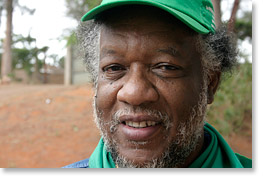
As the session ended, I ran into Ben Burkett, a Black farmer locally active the Indian Springs Farmers Association, part of the ‘Kush.’ I knew he was also president of the National Family Farm Coalition, but asked him more about his local operation.

“Well, I don’t do cotton anymore, not much cotton in Mississippi these days,” he explained. ‘I do many vegetables, and sweet potatoes are a good crop. But it’s one thing for a farmer to grow and dig sweet potatoes. It’s quite another to have the equipment to scrub them, cut them into French fires, and then bag and store them, while getting them quickly to your markets. That’s where the value of the coop comes in. We can pool our resources for these things, and it makes a big difference. We’d be in bad shape without the coop.”

Waste Management, Recycling and City Politics

The politicss of garbage was the main topic here. Chaired by Kali Akuno, this workshop gave the most insight into what was going on in Jackson as a new and backward regime was replacing that of Chokwe Lumumba. “Waste Management serves the city poorly,” said Akuno. “It often ignores our neighborhoods. It does no recycling; it dumps the waste in a landfill in a small city to the North of here, gives them a payment, and that’s the end of it.”

Akuno explained they had a different plan. Since a large part of the city budgets deal with services like these, they wanted to break them into smaller pieces so local contractors or coops could bid on them, then recycle the waste into a revenue stream. In addition to helping the environment and employment, it would keep the money circulating locally.

“Another piece was setting up an incubator to foster the development of cooperatives,” Akuno added. “The government can’t run the co-ops. It won’t build them, but it can set the table. For most of the past 20 years, even though there has been a succession of black mayors, 90-95 percent of contracts to people who don’t live in Jackson. It was all about hiring people in Jackson.”

“Now everything is going to be a fight,’ he added. “Even if your plan is reasonable and sustainable, it won’t matter if it’s stepping on the wrong toes.”

Saturday also included two mealtime plenary sessions, one, at lunch, featuring the diverse organizations taking part, and the other, at dinner, giving everything an international dimension.

The lunch plenary included Omar Freilla of Green Workers Cooperatives, Steve Dubb of the Democracy Collaborative, Michael Peck of Mondragon USA, Ricky Maclin of New Era Windows, and Saladin Muhhamad of Black Workers for Justice and MaryBe McMillian, Secretary Treasurer of the North Carolina AFL-CIO.

“Community cooperatives,” said Steve Dubb, “can be considered part of a long civil rights movement that fights for both racial and economic justice. For example, Dr. Martin Luther King in the last year of his life helped launch the Poor People’s Campaign for an Economic Bill of Rights. The return of cooperatives to the movement, as illustrated by what’s happening here, is a welcome development.”

MaryBe McMillian stressed the importance both of labor and the concentration of forces in the South. “Why organize in the South? Because what happens in the South affects the entire nation." Speaking for Black workers, Saladin Mummamad added, ‘We need power not just democracy; we need power that shapes what democracy looks like. When plants shut down workers, should seize control and turn them into cooperatives.”

The evening session started with a tribute to Chokwe Lumumba by his son, Chokwe Antar Lumumba. “We are victorious because we struggle. I'm not afraid of the term revolutionary. We need to be as revolutionary as the times require. Free the land! The struggle my father started is not over, but only beginning. It continues, by any means necessary.”

Also featured were Francoise Vermetter of Chantier in Quebec, Pierre LaLiberte on the International Labor Organization in Switzerland, Mazibuko Jara of AMandela! Magazine in south Africa, Elbart Vingwe, Organization of Collective Cooperative in Zimbabwe, Omar Sierra, Deputy Counsel General of Venezuela-Boston, and Janvieve Williams-Comrie, Green Worker Coops in the U.S.

"Freeing the land has given our people a new sense of belonging," said Omar Sierra, of Venezuela. “Chokwe Lumumba extended his solidarity to us in a time of need. Our people are saddened by his passing, and will not forget him.”

William Copeland, a cultural organizer from Detroit. Summed up the spirit of the crowd: “These presentations demonstrate the international significance of the Black Liberation Movement and Southern movement building.”

On Sunday morning, those who hadn’t had to leave early for the airport, gathered in a large session of the whole that closed out the weekend. One after another, people stood up and testified to how their consciousness had been altered by their discussions and new experiences over the weekend. Emily Kawano of the Solidarity Economy Network made the point of understanding that the projects ahead, while including coops also reached beyond them to other forms, such as participatory budgeting, public banks and alternative currencies. Finally, at an auspicious moment, an African American women rose and in a strong church choir voice, began singing an old civil rights anthem, “Organize, organize, organize!” Everyone was on their feet, hands clapping, fists raised, and interspersing ‘Free the Land! with the chorus. It couldn’t have had a better closing moment.

Read more!

Monday, June 03, 2013

Carl Davidson’s Sessions at the Left Forum in NYC, June 7-9, Pace University

LEFT FORUM SESSIONS

WITH CARL DAVIDSON and his related groups—the Online University of the Left, Committees of Correspondence for Democracy and Socialism, and the Solidarity Economy Network

11 Talking Points on 21st Century Socialism
Session 3     E326     Sat 03:40pm - 05:20pm

A Slide Show presentation by Carl Davidson on the core features of socialism in today's world, followed by responses and discussion. Issues will include technology, human rights, the role of markets, mixed economies and strategic allies.

Sponsoring Journal:
Online University of the Left

Speakers: Carl Davidson, Committees of Correspondence for Democracy and Socialism; David Schwartzman, DC Statehood Green Party; Dario Cankovic, Northstar.org   

--------------

Shift Change: potential and limits of worker cooperatives in building a sustainable future
Session 4     W615     Sat 05:30pm - 07:10pm

In SHIFT CHANGE, a new documentary that visits coops in the US and Mondragon, worker owners share some practical challenges of a democratic workplace, and how coops can help build a more just and sustainable society. Clips from the film will be shown, with comments from panelists, and discussion involving workshop participants about broad issues of economic democracy and a more ecological future.

Panelists include:
Gar Alperovitz, author, What Then Must We Do;
Carl Davidson, Solidarity Economy Network
Mark Dworkin & Melissa Young, filmmakers

---------------

Left Third Party Organizing: Challenges and Opportunities
Session 6     W211     Sun 12:00pm - 01:50pm

In an age of two-party domination and neoliberal hegemony, what opportunities exist for left electoral politics through third party campaigns? Why and when should leftists focus on third party campaigns, as opposed to Democratic Party primaries? Where should the left focus its electoral resources, and how might it overcome division? Should third-party politics be thought of in terms of consciousness-raising, or is the left in a position to affect public policy by taking power?

Sponsoring Journal:
The North Star
Seamus Whelan, Socialist Alternative
Tim Horras, Philly Socialists        
Carl Davidson, CCDS       
Ursula Rozum, Green Party

Read more!

Saturday, November 10, 2012

Lessons for 21st Century Socialism from Buddhism

Buddhism and ecology both refuse to separate the human and natural worlds – and demand that we act accordingly

Vultures at a Tibetan sky burial ritual in Dari county in northwest China's Qinghai province 27 November 2009. Photo by Alex Lee/epa/Corbis

By David P Barash
Aeon Magazine

Nov 5, 2012 - Once, while waiting for a wilderness permit at a ranger station in North Cascades National Park, Washington state, I overheard the following message, radioed into headquarters by a backcountry ranger: ‘Dead elk in upper Agnes Creek decomposing nicely. Over.’ This ranger was not only a practical and profound ecologist, she also possessed the wisdom of a Buddhist master. The ‘over’ in her communication seemed especially apt. For Buddhists, as for ecologists, all individual lives are eventually ‘over’, but their constituent parts continue ‘living’ pretty much for ever, in a kind of ongoing process of bio-geo-chemical reincarnation.

People who follow ecological thinking (including some of our hardest-headed scientists) might not realise that they are also embracing an ancient spiritual tradition. Many who espouse Buddhism — succumbing, perhaps, to its chic, Hollywood appeal — might not realise that they are also endorsing a world view with political implications that go beyond bumper stickers demanding a free Tibet.

Plenty of us recognise that Buddhist writings and teachings — especially in their Zen manifestation — celebrate the beauty and wisdom in the natural world. A monk asks a master: ‘How may I enter in the Way?’ The master points to a stream and responds: ‘Do you hear that torrent? There you may enter.’ Walking in the mountains, the master asks: ‘Do you smell the flowering laurel?’ The monk says he does. ‘Then,’ declares the master, ‘I have hidden nothing from you.’

Part of this sensitivity to nature is a Buddhist grasp of suffering, whose existence constitutes the first of Buddhism's Four Noble Truths. It is no coincidence that Henry David Thoreau, America's first great environmentalist, was also a student of Indian religion and the first translator of the ‘Lotus Sutra’ into English. In this classic teaching, Shakyamuni Buddha compares the ‘Dharma’ — the true nature of reality — to a soothing rain that nourishes all beings.

The pioneering ecologist Aldo Leopold wrote that to have an ecological conscience is to ‘live alone in a world of wounds’. The Buddha urged his followers to be sensitive to the suffering of all sentient beings. His First Precept is to commit oneself to ahimsa, or nonharming. The Mahayana Buddhist ideal is to go further, and to become a bodhisattva, an enlightened individual who vows to relieve the suffering of all beings. In the ‘Metta Sutta’, Theravada monks and lay adherents vow to practise loving kindness: ‘Even as a mother protects with her life her child, her only child, so with a boundless heart should one cherish all living beings.’ And here is the first verse of ‘The Bodhisattva Path’, by Shantideva, a revered eighth-century poet: ‘May I be the doctor and the medicine/And may I be the nurse/For all sick beings in the world/Until everyone is healed.’

For Buddhists and ecologists alike, we are all created from spare parts scavenged from the same cosmic junk-heap

Read more!

Thursday, April 26, 2012

USW Report: A ‘Union Model’ Plans to Bring Worker Coops to the Ohio Valley

Michael Peck, Mondragon Cooperative delegate in North America, speaking at recent USW press conference in Pittsburgh

Steelworkers Announce 'Union Model' for

Bringing Worker-Owned Coops to the U.S.

By Carl Davidson
Beaver County Blue

The United Steel Workers and the Mondragon Cooperative Corporation-the largest industrial union in the U.S. and the world's largest network of worker-owned cooperatives respectively-held an upbeat press conference at USW headquarters in Pittsburgh March 26, announcing new progress in their innovative two-year-old partnership.

"For American workers, the traditional corporate model for organizing production and producing jobs has broken down," stated Tom Conway, USW International Vice-President for Administration. "It's simply not fair, and we're not afraid to try something different."

For those unfamiliar with Mondragon, 'something different' was inspired by the Steelworkers investigation into the Mondragon cooperatives (MCC) in Spain's Basque country. MCC is a 50-year-old thriving and ongoing experiment in radical democracy consisting of some 120 worker-owned cooperatives involving nearly 100,000 workers and allied with another 130 allied coops in the region, with revenues in 2011 of some $24 billion.

The MCC coops operate one the basis of one worker, one share, one vote-and no one outside MCC holds any shares. It is the leading edge of the Spanish industrial economy.

The USW took note of MCC after a successful effort with the cutting edge Spanish wind turbine firm, GAMESA, to build three innovation green energy factories in Pennsylvania. While not part of Mondragon, GAMESA and MCC shared a common representative in the U.S., Michael Peck, who then took a USW team to Spain to visit MCC.

Leo Gerard, the USW's president, has long been an advocate for a 'clean energy and green manufacturing industrial revolution' as a progressive way out of the current economic crisis. But given the conflicted and deadlocked Congress on such matters, little is being done on the matter trough traditional channels. Hence the turn toward the Mondragon partnership.

After the initial announcement of the joint effort in the fall of 2009, little was heard about any progress on the matter. Yesterday's press conference, however, revealed what was going on behind the curtains. There were three major projects underway.

The first was the production of 'Sustainable Jobs, Sustainable Communities: The Union Coop Model.'

Read more!

Wednesday, February 01, 2012

Occupy Pittsburgh Teach-In: Feb 4

From Occupy Wall St. to Occupy the Hood:

Building Power for the 99%


Saturday, Feb 4, 2012

Start: 02/04/2012 12:00 pm
End: 02/04/2012 5:30 pm

Will be held at Community Empowerment Association Training & Culture Center, 7120 Kelly St. in Homewood (accessible by the 67, 69, 71C, and all East Busway (P) buses - www.portauthority.org)

Join Occupy Pittsburgh for our second teach-in, organized by the Occupy the Hood, People of Color and Education Work Groups.

We hope to bring together the social and economic justice community in Pittsburgh, from all neighborhoods, acitivist concentrations, backgrounds, life circumstances and political viewpoints. By speaking together and sharing experiences and insight, we hope to strengthen the community that the Occupy has caused to take shape - in all our diversity of experience.

12 Noon: Lunch

!2:30 pm: Opening Plenary: From Occupy Wall Street to Occupy the Hood:  Building Power for the 99%

Speakers: Helen Gerhardt & Carl Redwood, facilitators: Guillermo Perez


Two Rounds of Workshops

1:45-3:15 p.m. - workshop session #1
3:15-3:30 p.m. - break
3:30-5:00 p.m. - workshop session #2
5:00-5:30 p.m. - group debrief

There will be at least 10 workshops.  Half will be presented by the Occupy the Hood/People of Color Work Group and half by the Education Work Group


Workshop Session #1 (1:45-3:15)

1. Who are the 99%?

(facilitator: Nicholas Rushin)

This is a discussion about the workings of class, oppression and exploitation through a materialist and historical perspective.  We are the 99% fighting against the 1%, but how do the 1% and the 99% get to be the 1% and 99%?  Where does wealth come from and who creates it?  How does class affect political struggles?  And how is class different and similar to other forms of oppression like sex and race?

2. The Disparity & Education of Black Students

(facilitator: Vickki Ayanna Jones)
This workshop will recognize, develop & repair the damage that has been done to our children in the educational system & Black people in general.

3. Healthcare for the 99%: Ending Race-Based, Class-Based, All-for-Profit Care

(panelists: Scott Tyson, Physician, PUSH/ Healthcare4ALLPA; Ed Cloonan, Save Our Community Hospitals & Western Pennsylvania coalition for Single Payer; Sandra Fox, Western PA Coalition for Single Payer; Residents from Braddock and surrounding areas, Footage from Tony Buba, Save Our Community Hospitals)

This workshop will consist of film footage and a panel of speakers who will tell the story of how UPMC created race- and class-based barriers to health care with its demolition of Braddock Hospital and building of a surplus hospital for Monroeville. Speakers will also discuss how and why they fought back, from street theatre to a civil rights lawsuit. What are the roots of this problem in U.S. healthcare and what would alternative system look like?

4. Impact of Mass Incarceration

(facilitator: Khalid Raheem, president/CEO of the National Council for Urban Peace and Justice; Steering Committee member of the Formerly Incarcerated and Convicted Persons Movement; member of Occupy the Hood Pitstburgh)

This workshop will explore the prison industrial complex as it pertains to mass incarceration of black males.

5. Gentrification and Our Right to the City

(facilitator: Carl Redwood)

This workshop will share information about the Right to the City Alliance organizing against gentrification using an urban human rights framework. The workshop will explore the forces behind gentrification and provide historical context for the issues we face. Through discussion we will examine how gentrification has impacted our neighborhoods and help us begin to look beyond our current reality to envision the rights we are fighting for. 

5. Bringing Occupy Pittsburgh to the Neighborhoods: Outreach Strategies and Initiatives

(NAMES, DESCRIPTION To Come)

Workshop Session #2 (3:30-5:00)

1. "Why Dismantle and Not Reform?" The Call of Occupy the Hood Pittsburgh

(facilitators: J.O. Yejide KMT & Bekezela Mguni)


This workshop will discuss why the Occupy movement needs radical approaches to change vs. reform of the current economic system in order to meet the needs of people of color and to ensure an equitable and humane future for all.

2. What are the Alternatives to Corporate Power?

(PANELISTS - Jackie Smith, Carl Davidson, etc)

So far the Occupy movement has helped draw public attention to what we're against, but what are the alternatives? This workshop will invite organizers from the region to present ideas that have been developed and tested in communities around the world to show that another world is possible. We will explore publicly-owned banks, community-supported agriculture; community currencies and barter systems; Davidson will present on the Mondragon co-operatives in Spain, and other forms of what is known as the "solidarity economy." Finally, campaigns that are working to counter corporate power to make room for community-based economic initiatives will be discussed.

3, Organizing within Marginalized Communities

(faciliators: Calvin Skinner & Kyndall Mason)

A workshop dedicated to successful strategies to do organizational outreach in marginalized communities with an emphasis on outreach to African-American and members of the LGBT communities.

4. Organized Labor & Occupy: Waging Class War on Two Fronts

(facilitators: Paul Le Blanc & Guillermo Perez)

Thanks to the Occupy movement, the issue of income and wealth disparity in the U.S. and the damage it's doing to our democracy are now front and center in the national discourse. Since its inception the Occupy movement has received considerable support from organizations affiliated with another national movement, organized labor. In this workshop we hope to engage union and Occupy activists in a discussion of how these two movements diverge and intersect and the ways we can work together to advance a common agenda.

5. Economic Disparities: Occupying Solutions for Black Communities

(Nazura Asaseyeduru)

This workshop will challenge the power structure of banks & government as it pertains to economic disparities for People of Color. Thus, participants will look at solutions in which Black communities have to be creative, innovative & self-determining.

Sponsors: Occupy the Hood (PghOccupythehood@riseup.net or call 412-244- 0298) &Occupy Pittsburgh (occupypittsburgh.org) and it'sPeople of Color & Education Working Groups

Read more!

Wednesday, March 16, 2011

Mondragon as a Bridge to a New Socialism


Worker-owner in Mondragon coop factory

The Mondragon Cooperatives and 21st Century Socialism:

A Review of Five Books with Radical Critiques and New Ideas

From Mondragon to America:

Experiments in Community Economic Development

By Greg MacLeod

UCCB Press, 1997

The Myth of Mondragon:

Cooperatives, Politics and Working-Class Life in a Basque Town

By Sharryn Kasmir

State University of New York Press, 1996

Values at Work:

Employee Participation Meets Market Pressure at Mondragon

By George Cheney

Cornell University Press, 1999

Cooperation Works!

How People Are Using Cooperative Action

to Rebuild Communities and Revitalize the Economy

By E.G. Nadeau & David J. Thompson

Lone Oak Press, 1996

After Capitalism

By David Schweickart

Rowman & Littlefield, 2002

Reviewed by Carl Davidson

Solidarity Economy Network

Something important for both socialist theory and working-class alternatives has been steadily growing in Spain’s Basque country over the past 50 years, and is now spreading slowly across Spain, Europe and the rest of the globe.

It’s an experiment, at once radical and practical, in how the working-class can become the masters of their workplaces and surrounding communities, growing steadily and successfully competing with the capitalism of the old order and laying the foundations of something new—it’s known as the Mondragon Cooperative Corporation (MCC).

Just what that ‘something new’ adds up to is often contested. Some see the experiment as a major new advance in a centuries-old cooperative tradition, while a few go further and see it as a contribution to a new socialism for our time. A few others see it both as clever refinement of capitalism and as a reformist diversion likely to fail. Still others see it as a ‘third way’ full of utopian promise simply to be replicated anywhere in whatever way makes sense to those concerned.

Read more!

Tuesday, July 13, 2010

Envisioning the Future, Fanning the Flames

15,000 Attend Detroit Social Forum:

High-Energy Gathering Fires Up

A New Generation of Activists in

U.S. Left and Social Movements

By Carl Davidson

Keep On Keepin' On!

When 15,000 vibrant and politically engaged people gather in one spot for five days and organize themselves into more than 1000 workshops, dozens of major plenaries and late night parties across five major cultural hot spots, no one article can claim to give a full account and get away with it.

But an event on that scale livened up Detroit, Michigan during the week of June 22-26 at the US Social Forum, when Cobo Hall and several nearby universities were buzzing with thousands of people trying to shape a new world.

I won’t even try to capture it all. I’ll just affirm the common conviction that it was a major happening on the left and a huge success, an inspiration and an affirmation of hope that progress is being made towards a better future. Then I’ll humbly offer my take on it. We’ll start with some highlights and, for those who aren’t familiar with the Social Forum movement, offer a few explanations.

The Forum started on June 22 with a massive march of thousands through the streets of a devastated and de-industrialized Detroit. “I’ve never seen anything like this, in Detroit or anywhere,” said Forum participant and Detroit resident Charnika Jett. “The sense of joy, support, and determination on the part of the people here, both Detroiters and visitors, is just incredible.”

What an amazing day!” said Allison Flether Acosta of Jobs with Justice. “We held an orientation session for local coalition folks early in the day, then joined the march with the other members of the Inter-Alliance Dialogue and more than 10,000 people for a lively march through downtown! We ended at Cobo Hall, and then convened for the opening ceremonies.”

New entry of the Trade Unions

One important new addition to the young crowd in the streets was the participation of organized labor. According to the AFL-CIO News Blog, “Newly elected UAW President Bob King joined Metropolitan Detroit AFL-CIO President Saundra Williams; Al Garrett, president of AFSCME District Council 25; and Armando Robles, UE Local 1110 president, in leading a march and rally through the streets of Detroit. Chanting ‘Full and Fair Employment Now!’ and ‘Money for Jobs, Not for Banks!’ Participants demanded Congress address the pressing jobs emergency.”

The opening events, unfortunately, were either ignored or strangely spun by the mass media. “This ain’t no Tea Party,’ said Noel Finley, in a scarce account in the Detroit News, somewhat awed by the sight of it all. “The forum is a hootenanny of pinkos, environuts, peaceniks, Luddites, old hippies, Robin Hoods and urban hunters and gatherers.” Indeed it was, with even more variety. And the diverse crowds and meetings grew stronger as the week unfolded. To make sense of it all, some history and background is in order:

Read more!

Saturday, January 16, 2010

Why Fidel Wins Over Rush and Robertson, Hands Down

 
Photo: Young Haitian Doctor Being Trained in Cuba

The Lesson of Haiti:

Reflections of

Fidel Castro

Two days ago, at almost six o'clock in the evening Cuban time and when, given its geographical location, night had already fallen in Haiti, television stations began to broadcast the news that a violent earthquake -- measuring 7.3 on the Richter scale--had severely struck Port-au-Prince. The seismic phenomenon originated from a tectonic fault located in the sea just 15 kilometers from the Haitian capital, a city where 80% of the population inhabit fragile homes built of adobe and mud.

The news continued almost without interruption for hours. There was no footage, but it was confirmed that many public buildings, hospitals, schools and more solidly-constructed facilities were reported collapsed. I have read that an earthquake of the magnitude of 7.3 is equivalent to the energy released by an explosion of 400,000 tons of TNT.

Tragic descriptions were transmitted. Wounded people in the streets were crying out for medical help, surrounded by ruins under which their relatives were buried. No one, however, was able to broadcast a single image for several hours.

The news took all of us by surprise. Many of us have frequently heard about hurricanes and severe flooding in Haiti, but were not aware of the fact that this neighboring country ran the risk of a massive earthquake. It has come to light on this occasion that 200 years ago, a massive earthquake similarly affected this city, which would have been the home of just a few thousand inhabitants at that time.

At midnight, there was still no mention of an approximate figure in terms of victims. High-ranking United Nations officials and several heads of government discussed the moving events and announced that they would send emergency brigades to help. Given that MINUSTAH (United Stabilization Mission in Haiti) troops are deployed there-- UN forces from various countries-- some defense ministers were talking about possible casualties among their personnel.

It was only yesterday, Wednesday morning, when the sad news began to arrive of enormous human losses among the population, and even institutions such as the United Nations mentioned that some of their buildings in that country had collapsed, a word that does not say anything in itself but could mean a lot.

For hours, increasingly more traumatic news continued to arrive about the situation in this sister nation. Figures related to the number of fatal victims were discussed, which fluctuated, according to various versions, between 30,000 and 100,000. The images are devastating; it is evident that the catastrophic event has been given widespread coverage around the world, and many governments, sincerely moved by the disaster, are making efforts to cooperate according to their resources.

The tragedy has genuinely moved a significant number of people, particularly those in which that quality is innate. But perhaps very few of them have stopped to consider why Haiti is such a poor country. Why does almost 50% of its population depend on family remittances sent from abroad? Why not analyze the realities that led Haiti to its current situation and this enormous suffering as well?

The most curious aspect of this story is that no one has said a single word to recall the fact that Haiti was the first country in which 400,000 Africans, enslaved and trafficked by Europeans, rose up against 30,000 white slave masters on the sugar and coffee plantations, thus undertaking the first great social revolution in our hemisphere.

Pages of insurmountable glory were written there. Napoleon’s most eminent general was defeated there. Haiti is the net product of colonialism and imperialism, of more than one century of the employment of its human resources in the toughest forms of work, of military interventions and the extraction of its natural resources.

This historic oversight would not be so serious if it were not for the real fact that Haiti constitutes the disgrace of our era, in a world where the exploitation and pillage of the vast majority of the planet’s inhabitants prevails.

Billions of people in Latin American, Africa and Asia are suffering similar shortages although perhaps not to such a degree as in the case of Haiti.

Situations like that of that country should not exist in any part of the planet, where tens of thousands of cities and towns abound in similar or worse conditions, by virtue of an unjust international economic and political order imposed on the world. The world population is not only threatened by natural disasters such as that of Haiti, which is a just a pallid shadow of what could take place in the planet as a result of climate change, which really was the object of ridicule, derision, and deception in Copenhagen.

It is only just to say to all the countries and institutions that have lost citizens or personnel because of the natural disaster in Haiti: we do not doubt that in this case, the greatest effort will be made to save human lives and alleviate the pain of this long-suffering people. We cannot blame them for the natural phenomenon that has taken place there, even if we do not agree with the policy adopted with Haiti.

But I have to express the opinion that it is now time to look for real and lasting solutions for that sister nation.

In the field of healthcare and other areas, Cuba--despite being a poor and blockaded country-- has been cooperating with the Haitian people for many years. Around 400 doctors and healthcare experts are offering their services free of charge to the Haitian people. Our doctors are working every day in 227 of the country’s 337 communes. On the other hand, at least 400 young Haitians have trained as doctors in our homeland. They will now work with the reinforcement brigade which traveled there yesterday to save lives in this critical situation. Thus, without any special effort being made, up to 1,000 doctors and healthcare experts can be mobilized, almost all of whom are already there willing to cooperate with any other state that wishes to save the lives of the Haitian people and rehabilitate the injured.

Another significant number of young Haitians are currently studying medicine in Cuba.

We are also cooperating with the Haitian people in other areas within our reach. However, there can be no other form of cooperation worthy of being described as such than fighting in the field of ideas and political action in order to put an end to the limitless tragedy suffered by a large number of nations such as Haiti.

The head of our medical brigade reported: "The situation is difficult, but we have already started saving lives." He made that statement in a succinct message hours after his arrival yesterday in Port-au-Prince with additional medical reinforcements.

Later that night, he reported that Cuban doctors and ELAM’s Haitian graduates were being deployed throughout the country. They had already seen more than 1,000 patients in Port-au-Prince, immediately establishing and putting into operation a hospital that had not collapsed and using field hospitals where necessary. They were preparing to swiftly set up other centers for emergency care. We feel a wholesome pride for the cooperation that, in these tragic instances, Cuba doctors and young Haitian doctors who trained in Cuba are offering our brothers and sisters in Haiti!

Fidel Castro Ruz January 14, 2009 8:25 p.m. Translated by Granma International

Read more!

Saturday, June 13, 2009

Green Jobs and Class Struggle:


Why the Blue-Green Alliance
Matters to the Socialist Left


[Prepared as a Memo for the Working Class Studies Association Conference, June 6-8 2009, at the University of Pittsburgh.]

By Carl Davidson
SolidarityEconomy.net


1. One of the more important progressive measures launched in the first 100 days of the Obama administration is the Green Jobs Initiative within the broader Economic Recovery Act. There is substantial money allocated to it, and the appointee brought on to shepherd its development, Van Jones, is one of the few Obama appointees clearly from the left. Green Jobs is also a product of the Blue-Green Alliance, a joint effort by labor unions and environmental groups, which have funded advocacy for the program for years.

2. There are two aspects to Green Jobs, the immediate and the structural. The immediate has to do with bringing living-wage employment with a future to those who need it most, the unemployed and under-employed youth of the inner city. The structural has to do with Green Jobs being part of a larger effort to shift the country's energy system from one based on burning carbon and uranium to one based on sustainable renewables-solar, wind, wave, hydro and geothermal. All these require major upgrading of the country's infrastructure and a retooling of its manufacturing for more advanced products and production. Both aspects require a new Green industrial policy, alongside an erosion of the country's traditional military-industrial policy and more recent neoliberal market fundamentalism.

3. The neoliberal diehards in the House and Senate GOP, together with the rightwing populism stirred up by the Fox-Limbaugh-Hannity media reactionaries, are preparing an all-out attack of Green Jobs on several fronts. First, they attack the whole concept that there is any urgency to anything Green. In their view, global warming and climate change is simply a leftwing hoax used as a cover to attack the free market and promote government planning, leading to socialism. Second, they attack it as affirmative action for people of color, supposedly masking moral failure and public schools as the real reason for the problems of the inner city. Third, they are preparing a red-baiting campaign against Van Jones in particular, as part of a wider effort to red-bait Obama and deny the legitimacy of his election.

4. Green Jobs will require more than White House and Congressional Democrat support in order to survive this resistance and counter-attack. Getting a program adopted by Congress is only the first step on a long road to its deployment. Community and youth organizations, environmental group and the trade unions are facing the task of launching a social movement to see to it that Green Jobs is not gutted, delayed or otherwise sabotaged.

5. Green Jobs can be undermined indirectly as well. The program ultimately has to be deployed locally, and pass through state, county and city governments and their hangers-on. Left to their own inclinations, funds for Green Jobs may be diverted to parks or highway projects that shore up existing government worker payrolls with little new employment of those most in need. Alternately, new construction can be turned over to firms importing non-union labor, or using labor at minimum wage rather than living wage standards. Only local coalitions mobilized with some clout at the base can prevent this, and the ball is in the court of the left to organize them.

6. Green Jobs is a natural for the left to build coalitions of diversity in working-class and low-income communities. Start with organizations close to those who need green jobs most-inner city youth service agencies, neighborhood churches and their youth groups, sports groups-then approach others needed to make a collaborative work, such as trade union apprenticeship programs, community college trade skills teachers, local home building or remodeling companies looking for new projects. With this assembled, find the local political incumbents, especially at the state level, ready to go to bat for your project. Connect with Green For All, Van Jones' group, if its in a major city near you, for advice.

7. The left has its own approach to bring to the Green Jobs table, apart from being a catalytic organizer. Green Jobs can be implemented in a 'low road' way, by giving funds to contractors who hire youth at minimum wage, who in turn winterize a few public buildings, bypass the unions and dump the youth when it's over. Obviously, this is to be avoided. But there's a high road, solidarity economy approach that builds a stakeholder collaborative of businesses, unions, credit unions and school, with a strategic view of a lasting green construction worker cooperative as an outcome, together with higher-tech career paths through community college partnership with high-tech green firms. The solidarity economy, in turn, serves as a way to educate concretely about the prospects for a socialist future.

8. Green Jobs is a product of a long and complex series of working-class and youth struggles. One part reaches back to the global justice battles in the streets of Seattle more than a decade ago. The unions joined this to battle NAFTA, and the youth came out of green and global justice concerns. Both found themselves on the same sides of the barricades battling police in the streets-'Teamsters and Turtles Forever!' was a spontaneous slogan. Some in the Steelworkers Union and the Sierra Club took it further, and in a paradigm shift, began to see each other as natural allies rather than natural adversaries. The tons of steel and 19,000 machined parts in every wind turbine had to be manufactured and assembled somewhere, after all. This was formally put together and funded as the Blue-Green Alliance. The other component came from the anger of inner city youth facing jails and police harassment and brutality. Demanding jobs for youth was not new and often ignored, but when Van Jones in Oakland put out 'Green Jobs, Not Jails' to put kids to work insulating buildings and installing solar panels, he suddenly had people listening in a new way. There is more to the story, but this is the heart of it, an organic development from class struggle, labor-community alliances and youth insurgency. There will be more battles, but with this energy to build on, the prospects are very bright.


[Carl Davidson is webmaster for SolidarityEconomy.net, a national committee member of the Committees of Correspondence for Democracy and Socialism, and a coordinating committee member of the US Solidarity Economy Network. Together with Jerry Harris, he is author of 'Cyber-Radicalism: A New Left for a Global Age, available at http://stores.lulu.com/changemaker If you like this article, use the PayPal button to give support. Email him at carld717@gmail.com ]
Read more!

Sunday, April 26, 2009

Left Forum 2009 - High Energy, Colorful Mosaic


Left 'Turning Points':
Exploring New Ideas,
Seeking Common Ground


By Carl Davidson
Keep On Keepin' On

New York City's annual 'Left Forum' this year was a solid success. Under the theme "Turning Points, it drew more than 2000 participants to Pace University April 17-19, to take part in some 200 panels featuring around 600 speakers.

For something on this scale, I won't even pretend to give a comprehensive overview. No one person can. Instead, in what follows, you'll get my personal diary-like account as I wove my way through the crowds, met up with old and new friends, and faced a dizzying array of choices every time a new round of panels were set to start.

Pace University was an oddly appropriate place for the forum, located next to City Hall in New York City's financial district. The artifacts of the two major crises shaping our last decade were in your face. Wall Street, den of the derivative speculators, was a few blocks away; and you could tour 'Ground Zero,' the site of the destroyed WTC Twin Towers, with less than a 10 minute walk. Pace had a memorial plaque on its grounds for its own faculty, staff and students that perished on 9/11.

I arrived a few hours before the opening plenary. The New York City Labor Left Project, a grouping of socialist and communist trade unionists from several left organizations, set up a small early-bird session with Bill Fletcher, Jr, former AFL-CIO Education Director, co-author of "Solidarity Divided: The Crisis of Organized Labor,' and a founder of Progressives for Obama. About 25 people showed up, from half-a-dozen unions.
This was important. Most events like the Left Forum over the years, this one included, have been a "gathering of the tribes" of the left intelligentsia, serving as both common ground for every trend to talk with each other, and a trade fair of sorts, where left groups and publishers display their wares. Labor activists usually are notable by their absence, so this panel, even though small, was a step forward.

Fletcher hit hard on the need for an organized left in the union movement. He used some example from the early 1930s to explain that he didn't mean just the more militant and left-leaning staffers, but a socialist and communist left that brought a wider political perspective and array of tactics than what was likely to emerge within the trade unions themselves. "People often talk about the great achievements of the 1930s,' he said, "but they often fail to mention and take into account, even among themselves, the political forces that helped bring them about, political forces that were later pushed out." A lively discussion followed, covering everything from the current 'Civil Wars' in labor, to the failure to mobilize adequately around the economic crisis.

The Fletcher talk ran late, so by the time we made it to the auditorium for the opening plenary, it was completely packed, not even standing room. Luckily, the forum organizers had an extra side hall with a giant screen and speakers. That room quickly filled, too.

The first speech was the best, in my book. Richard Wolf, from the Economics Dept at the New School for Social Research, laid out a lucid and high-level Marxist explanation of the current crisis, but spanning 150 years of capitalist development in the U.S. His most important point: the U.S. working class was able to maintain its living standard over the past 30 years only by adding women to the work force, working longer hours, and going deep into debt. By the same token, U.S. capital survived on the speculative bubbles rooted in that debt. Now the wreckage is in front of us, and it's way past time to put socialism on the table.

While Wolf was clear and forceful, Adolph Reed, political science at the University of Pennsylvania, who followed him, was opaque and hesitant. He seemed to argue that because the left lacked institutional strength in the labor movement, and because that strength was not in the cards anytime soon, just about anything anyone did was going to be co-opted by neoliberalism, especially by what he termed 'the fetishism of electoral politics.' In a time of hope, he offered "politically correct" gloom and pessimism.

Arlie Hochschild, sociology from UC Berkeley, stressed that the left needed to get over it 'mistrust of government, which she suggested was borrowed from Ronald Reagan. It was groundwork to convince people to work for social-democratic state-centric solutions, but it didn't go over too well with this crowd. Katjia Kipping from Die Linke, the Left Party in Germany, did better. Faced with 'class warfare from the top down,' she outlined her party's stand in parliament of refusing to have the working class pay for the crisis, to bloc its further development with "anti-cyclical reforms," and to tie them all together with a more strategic campaign for worker control and ownership of the economy.

Walden Bello from the Philippines was the final speaker, but unfortunately, I had to miss him. I had a more important engagement with my young grandson and two daughters, who live in New York City, at a nearby restaurant. First things first!

Saturday promised to be jam-packed, and I was on two panels myself. I arrived earlier than usual because City Hall Park in across the street from Pace, and my grandson, along with all the other Little Leaguers, with their new team uniforms, were preparing for an early-morning season-opening parade. I couldn't miss this, so I had my morning coffee in the park, meeting other proud parents and grandparents.

But Pace was open by 9am, and batches of people wrestled with boxes and carts filled with books, getting their displays up on time. I studied the program, and picked 'The Trend of Chinese Marxism in the 21st Century." Where else would I have the opportunity to listen to three Chinese philosophy professors from Fudan University, having travelled half way around the globe to get here? Since the presenters weren't comfortable with their English skills, the presentations were read to us by a young Chinese woman. The key point: because China was now a transitional society with a socialist market economy, and problems arising from capitalist modernization, it needed some 'Western Marxism" to battle backward trends and keep it on the socialist path. The discussion was difficult, with translation back and forth, but still very lively.

I had to quickly get to the next panel, since I was on it, and there was only about five minutes between sessions. "Building a Progressive Majority and Advancing a Vision of Socialism" was the title, and it was pulled together by my group, Committees of Correspondence for Democracy and Socialism, and chaired by Pat Fry, an SEIU staffer. I led off by presenting Van Jones's program for Green Jobs for inner city youth, but framing it as a larger structural reform project that could, if done right, unite a progressive majority and help get us out of the current crisis. At the same time, we had to unite a militant minority around socialist tasks, so I offered the solidarity economy movement and its projects as practical examples of cooperative forms that could, within the capitalist present, point to a socialist future.

Carl Bloice from Black Commentator followed, with a warning that the problems of inter-imperialist rivalry still existed in a multipolar world, as did the problem of militarism and the need for disarmament as a path to greater global equity. He also stressed the need for popular resistance to Obama's Afghan-Pakistan escalation. Renee Carter, a physician from Virginia and CCDS NCC member, described some to the practical organizational work in the South, including a recent conference in Charleston, SC. "It showed people are very hungry for socialist ideas and groups like ours."

Mark Solomon, CCDS Co-Chair, presented a very practical organizational model for organizing the progressive majority, based on the Majority Alliance Project in Boston, which was pulling together dozens of existing organizations "to work wholistically" on a range of project where progressive majorities exist-such as ending the wars and green jobs. At the same time, they worked to take issues with large minority support, such as Palestine self-determination or gay marriage, and develop new ways of thinking to get them to become majorities. Critical to both sets of work was building wider alliances with the labor, youth and community forces that emerged as activists in the Obama campaign.

Our session filled the room with about 40 or more people, most of whom knew little about us. They learned more in the discussion, which covered a lot of bases, from rightwing populism to community base-building, and we got everyone's email address. Other groups did likewise throughout the conference, revealing one of the stronger points of the Left Forum: providing a venue for organization building.

Lunchtime was for networking. While my fellow panelists took off with some folks from the French Communist Party, I decided to spend some time with a young and very sharp organizer from New Jersey, doing some significant organizing with the Obama volunteer bases in the inner city.

Next up was a panel dubiously titled "Obama and the Politics of Hype," pulled together by Lauren Langman, an old friend and sociology professor at Loyola in Chicago. I didn't no what to expect, and Langman got double-booked, so he made a quick speech and left, turning over the chair to Tom Ponniah of Harvard. It was in a large room, and many people, mainly young, kept pouring in until we had about 100. Besides me, Laura Flanders of Grit TV made up the remaining panel.

Flanders was very good, outlining the strengths and weakness of both Obama and the left, with an emphasis on new media, of which she is a rising star. I took the view that the real "politics of hype" around Obama came from conservative talk radio and rightwing populism. My examples were very concrete, arising from the campaign work we did in Beaver County, Western PA, exposing the hype of the right on a daily tit-for-tat basis. Some of the participants would have none of it, however, and wanted to lash out against Obama for almost everything. One even accused him of declaring racism was over, and that he was the key enabler of Black oppression.

I couldn't let that stand, and fired back that she needed to read Obama's Philadelphia speech, and that Obama, his family and his base were under racist fire from the far right, and part of our task was to defend him and expose them on those matters, even as we opposed him on the wars. Several members of the Revolutionary Communist Party went ballistic over that, and the battle was on. I think Flanders and I, together with the chair, did a fairly good job. But the polemics served as a microcosm for an overall division at the forum, which I'd make an educated guess as divided with one-third being critical supporters of Obama, one third see him as the main enemy, and the rest in between somewhere, still making up their minds.

After all that excitement, my next pick was a little more subdued. Titled "The Challenge of Rightwing Populism in Northern Core Capitalist Countries," it was presented by two academics from York University in Canada. One was German, Ingar Solty; the other Canadian, Sam Putjina. Solty gave an overview of the various "National Front" parties in the European countries, while Putjina unfolded a sociological study tracking the rise of rightwing populism with the decline of trade union membership. He made a pretty good case, but the dozen or so people in the room saw the matter as more complex, a had an interesting discussion, pulling in matters of identity and religion.

My panel picks had all served as preparation for the big evening session. "The Obama Campaign and Presidency: Lessons for the Left" was the theme, and it featured Stanley Aronowitz, CUNY; Frances Fox Piven, CUNY; Barbara Epstein, UC Santa Cruz; and Gihan Perera, Right to the City Alliance; with Bill Fletcher as moderator.

Fletcher ran the panel in an interesting way. Rather than have them each deliver a speech, he decide to "interview" them, as if it were a news show. They were to answer, and also comment on each other's answers. He started by asking them if they though there was "a movement" around the Obama election, or whether it was just a slightly more jazzed-up mass campaign. All four of the academics hedged their bets on that one, and gave convoluted answers. (My opinion was that there was definitely a mass movement, several in fact, and some of the movement is still around). The community organizer, Perera, said he didn't know how they were using terms, but he called it "an electoral riot," meaning a mass insurgency from below.

This set some of the dynamic-the academics making points rather removed from grassroots struggles, even when lucid, as was Frances Scott Piven. Then Perera, as counterpoint, making substantive comments anchored in mass struggle. At one point, Fletcher asked whether they had voted or worked for Obama. All had done so, with the exception of Aronowitz.

Once questions and comments were opened to the floor, things got a little livelier. The RCP, clearly noticeable in their uniformed red-on-black T-Shirts, launched the calls for "revolution," pretty much denouncing the panel and challenged Fletcher to a debate to boot. He firmly said "No," and kept charge of the session. At one point, after some outbursts, he announced that the hallway was available to anyone who wanted to debate the RCP, but this discussion would continue.

Pro-Obama and anti-Obama is something of an oversimplification. Those opposed to Obama mainly stressed issues, and saw Afghanistan and foreign policy as decisive, together with the fact that he was for capitalism, and working with former neoliberals to rescue Wall Street. Anything positive in Obama's efforts was just blowing smoke.

Those who had voted for Obama mainly stressed organizing opportunities, new allies at the base, and the opening of political space for more protracted efforts. They supported Obama's measures that were right, and opposed those that weren't. In that sense, the debate was never really engaged. People talked past each other.

One feature of the Left Forum is the '"after parties." There were several; I was invited to one held by the Socialist Party, and another at the Brecht Forum. It had been a long day, so I settled for a late dinner with the organizers of the "Politics of Hype" panel at a nearby bar.

Sunday is usually a light, wrap up day at weekend conferences. I was surprised the next morning to see the place packed once again.

To start the morning off, I picked "In Praise of Socialist Planning" to attend. It featured a good friend, David Schweickart, author of "After Capitalism" and a leading theorist of Marxism and worker-controlled market socialism. The other speakers were Bertell Ollman, an expert on Marxism from New York University and a decidedly anti-market socialist, and Raymond Lotta, from the RCP and self-described as a Maoist political economist. The session was chaired by Anwar Shaikh from the New School.

Schweickart led off with a condensed outline of his theories, and how they related to both classical Marxism and today's conditions. He favored planning, but not of the old anti-market, centralized Five-Year-Plan type. He was for macro planning where markets failed, but favored moving the decisions downward. He mainly argued for public control of social investment funds, and deploying these locally as a form of democratic planning. Ollman was a little more abstract, describing the creative potential unleashed by revolution. Interestingly, he conceded Schweickart was right about Marx and the market, and that classes and the market would be around for a post-revolutionary period. He simply asserted that this would only last about two years! Ray Lotta basically asserted the primacy of revolutionary politics at every step of the way, and declared there was no need for 'technical economic blueprints." In that sense, everything was a plan determined by the constant mobilization of the masses, who consciousness could trump economic backwardness-a classic "voluntarist" deviation from Marxism, and one Mao was prone to at various times as well.

I moved on to another smaller session, about a dozen people, where the topic was "The Green New Deal." It had an interesting lineup: Victor Wallis from the theoretical journal, Socialism and Democracy; Mario Candeais, from the Rosa Luxemburg Foundation; and Freider Otto Wolf, from the Free University in Berlin, and one of the original German Greens. Wallis gave a succinct explanation of the old FDR New Deal, and described the character so far of the current one. It was positive, but whether it, or anything, would resolve the crisis was still open. I was a bit taken aback by Candeais. He attacked the Green New Deal because it included more "infinite economic growth," which he saw as civilization-destroying. Wolf answered him, supporting the Green New Deal as a "Red-Green Project," one that worked best with transitional demands of structural reform take could open a path to socialism.

Needless to say, I became an immediate fan of Wolf, but decided to cross swords with Candeais on his opposition to "infinite growth." I argued we needed infinite growth, especially in high design technologies and the growth of knowledge, and that these were critical to both a green and socialist future. In this way, economies could grow in sustainable ways, however large they became. He simply wouldn't accept my framework, and clung to a vision of growth as accumulating garbage heaps. We had to agree to disagree.

The last panel was one where I was the chair, "Solidarity Economy: Building Alternatives for People and Planet." Our panelists were Pasqualino Columbaro of the Global Economic Alternatives Network, Maliha Safri of the Center for Popular Economics, and Peter Ranis, Political Science, CUNY. We had the final 3-5pm slot Sunday afternoon, and I didn't expect much. I was surprised when about 30 people showed up, so I quickly passed the sheet and got everyone's emails, a critical task for organizers these days.

The purpose of our panel was to introduce activists to the concept of a solidarity economy, which is still relatively new in the U.S. Columbaro described many of the principles, and the various organizations, together with a good description of the Emilia-Romano region of Italy, where hundred of thousands of workers are involved in thousands of interconnected cooperative enterprises. Safri gave an overview of the US Solidarity Economy Network, and the achievements of some of the groups in it, ranging from food coops and credit unions, to worker coops and public schools like the Austin Polytechnical Academy in Chicago, focused on high tech manufacturing with a worker-ownership component to the school's outlook. Ranis stressed the importance of connections with trade unions, and getting them to partner in joint collaboratives, and put the capital in union pension funds and banks to good use.

Most of the discussion here was more in the form of questions than debate, with the participants wanting to learn more. I pointed out that the solidarity economy was value-centered, but than so were all schools of political economy-Marxism's core value was the emancipation of the working class, the economics taught in school had private accumulation of wealth as the core value, while the green economy was focused on sustainability and harmony with the environment. In the solidarity economy, obviously, the values of solidarity and mutual aid are at the center.

Since I had an eight-hour drive back to Western PA, I had to leave and miss the final plenary. Too bad for me, since I was told later that one of the speakers had quoted from a paper of mine negatively, where I made the point that if we were going to move forward as a more dynamic and broader left, within a wider progressive majority, we had to make a decisive break with a semi-anarchist and ultraleft mindset. I would have loved to debate the point since, from just my experience at the Left Forum, I though my case was fairly evident, to those who cared to think it over in some detail. A clear majority of groups calling themselves socialist and communist in our country, not even mentioning the anarchists, had solidly opposed Obama and his movement every step of the way, and as far as I could see, it hadn't helped them one bit. Those who had engaged that movement in a positive way, however, were making some solid advances. Maybe next year, we can revisit the topic, hopefully with a little more clarity and, also hopefully, from positions in the class, anti-imperialist and democratic struggles that are a little further down the pike.

[Carl Davidson is webmaster for 'Progressives for Obama' and SolidarityEconomy.net, a national committee member of the Committees of Correspondence for Democracy and Socialism, and a coordinating committee member of the US Solidarity Economy Network. Together with Jerry Harris, he is author of 'Cyber-Radicalism: A New Left for a Global Age, available at http://stores.lulu.com/changemaker If you like this article, go to 'Keep On Keepin' On at http://carldavidson.blogspot.com and make use of the PayPal button. Email him at carld717@gmail.com ]

Read more!

Tuesday, March 17, 2009

Green Jobs Meets the Solidarity Economy

Green Jobs Meets the Solidarity Economy:
A Dynamic Duo for Changing the World


A Review of 'Green Collar Economy:
How One Solution Can Fix Our Two Biggest Problems'
By Van Jones, Harper-Collins, 2008


By Carl Davidson
SolidarityEconomy.Net

It's time to link the newly insurgent U.S. Green Jobs movement with the worldwide efforts for the solidarity economy. Both are answering the call to fight the deepening global recession, and both face common adversaries in the failed 'race to the bottom,' environment-be-damned policies of global neoliberalism.

That's the imperative facing left-progressive organizers with connections to these two important grassroots movements. It's even more important in the wake of the appointment of a key leader of one of these movements, Van Jones of 'Green For All', to a top environmental and urban policy post in the Obama administration.

Jones is a founder of an urban-based campaign focused on low-income young people, multinational and multicultural, that first developed as a progressive response to police repression, gang killings and all-round "criminalization of youth." He saw the exclusion of this sector of the population from living-wage work and other opportunities as a key cause of the violence and destruction. Putting young people to work at low-to-medium skill levels retrofitting buildings for energy efficiency seemed like a no-brainer, so the demand for 'Green Jobs, Not Jails' was raised.

The slogan found deep resonance as it spread across the country. Its all-round implications were spelled out in Jones' widely acclaimed book, "The Green Collar Economy: How One Solution Can Fix Our Two Biggest Problems." It spells out a string of ingenious, interconnected programs aimed at resolving the savage inequalities of structural unemployment and the global dangers of climate change rooted in carbon-based energies systems.


"Let's be clear," says Jones in the opening pages of his book, "The main piece of technology in the green economy is a caulk gun. Hundreds of thousands of green collar jobs will be weatherizing and energy-retrofitting every building in the United States."

He doesn't leave the matter there, but makes use of this picture to point out what's "shovel ready," to use the lingo of debate around stimulus spending. Green jobs span the entire range of occupations, with a special focus on high-tech manufacturing in emerging alternative energy industries.

"Green Collar Economy" was instantly a powerful voice in policy circles. It gained a wider and deeper significance in light of the financial crises that hit the fan soon after it reached the bookstores. Just as the voter revolt against Wall Street helped lift Obama to the Oval Office, so too was Van Jones's urban policy monograph raised into a "What Is To Be Done" manifesto for deep structural reforms capable of busting the onset of a major depression.

"The best answer to our ecological crisis also responds to our socio-economic crisis," Jones explains. "The surest path to safe streets and peaceful communities are not more police and prisons, but ecologically sound economic development. And that same path can lead us to a new green economy."

How does it connect with the solidarity economy? This parallel movement with even earlier roots is widely known throughout the Global South, especially Latin America, as well as Europe and Quebec. It has been comprised of a range of projects where social capital is partnered with worker, community, consumer and peasant cooperative ownership structures. These were designed to fight back against the economic devastation wrought by neoliberal IMF-imposed "solutions" that left people without a safety net or means of survival. People turned to each other at the grassroots in common efforts, hence the term 'solidarity economy.'

Both the solidarity economy and the green economy are "value centered" schools of economic thought. They are in the classical tradition of political economy, which in turn is rooted in moral philosophy. They are not simply descriptive of supposedly objective economic processes, but are prescriptive. At full throttle, they are organizing principles for shaping the future, locally and globally, via local organization and mass mobilization. For its part, the solidarity economy stresses the values of cooperation and mutual aid, especially in governance structures of productive, consumer or financial units. The green economy emphasizes ongoing sustainability and harmony between people and the eco-system of which they are a part.

The solidarity economy is about how people relate to each other, while the green economy is about how people relate to their wider environment. Naturally, there is considerable overlap between the two. Both see the current order as destructive of people and planet, and are working to turn things around.

"Equal protection of all people, equal opportunity for all people, and reverence for all creation."--these are what Jones terms the "three pillars" of the new green global economy.

Neither economic vision is monolithic. Both schools of thought span a range of views, some of which are in contention. In the Green Jobs movement, for instance, there are debates on nuclear power and "clean coal," and what role, if any, these might have in a low-carbon future. In the solidarity economy movement, there are discussions on the place of markets and government, and whether cooperative structures can use either or both to their advantage. There is also debate over the importance of "high road" allies within the business community, "high road" meaning traditional business structures that bring wider community and environmental responsibility into their business plans, rather than simply short-term shareholder profit.

Where Van Jones' approach to both the green and solidarity economies most compels our attention is that he starts where the need is greatest, the millions of unemployed and underemployed inner city youth. The structural crises of neoliberal capitalism has long ravaged this sector of our society through deindustrialization, environmental racism and a wrecking ball approach to schools in favor of more prisons. To borrow from Marx, these young people are bound with radical chains, and when they break them with the tools suggested in 'Green Collar Economy,' they free not only themselves, but the rest of us are set in a positive direction as well.

"The green economy," Jones explains, reflecting on Hurricane Katrina, "should not be just about reclaiming thrown-away stuff. It should be about reclaiming thrown-away communities. It should not be just about recycling materials to give things a second life. We should also be gathering up people and giving them a second chance. Formerly incarcerated people deserve a second shot at life-and all obstacles to their being able to find that second chance in the green sector should be removed. Also, our urban youth deserve the opportunity to be part of something promising."

Jones is a strategic thinker who gives definite answers to the question, "Who are our friends, who are our adversaries?" He narrows the target to speculative capital with roots in carbon-based energy industries and the militarism needed to secure their supplies. He seeks close allies in the wider working class of all nationalities, especially in the Blue-Green Alliance formed on the core partnership of the United Steelworkers with the Sierra Club. He also looks for allies among faith communities, environmentalists in the suburbs and rural populations suffering at the hands of anti-ecological agribusiness, offering a vision of wind farms and solar arrays for sustainable rural development. He sees the importance of cutting back defense spending and opposing unjust wars abroad.

Finally, he holds out a hand to green businesses in alternative energies, the current and future manufacturers of clean power:

"Our success and survival as a species are largely and directly tied to the new eco-entrepreneurs-and the success and survival of their enterprises. Since almost all of the needed eco-technologies are likely to come from the private sector, civic leaders and voters should do all that can be done to help green business leaders succeed."

Jones is not talking just about mom and pop operations here, but an important and growing sector of productive capital. These will range from small upstarts to T Boone Pickens-type investors wanting to create giant wind farms and large coastal arrays of wave generators, along with the manufacturing firms that build their equipment. Some on the left who want to see a clean renewable energy future will have to make adjustments in their "anti-corporate" strategies if they want to pursue this goal effectively with these high-road allies. Dan Swinney of the Chicago Manufacturing Renaissance Council explains his current project, the Chicago Green Manufacturing Network, as a case in point:

"CMRC is working with the Cleveland-based Great Lakes Wind Network/WireNET and the City of Chicago in building the capacity of local manufacturing companies to become the supply chain for the explosive wind turbine industry. Illinois and other states currently have ambitious Renewable Energy Portfolios that create a huge market for wind turbine companies and others in the renewable energy field. Currently the components for these companies are principally made by European and Asian suppliers. We will rise to the challenge of building the capacity of local companies to supply the high quality components for wind turbines and other renewable energy companies. This will be a means to diversify the markets for some of the 12,000 manufacturing companies in our region and an opportunity to create hundreds if not thousands of new permanent, full-time jobs in manufacturing."

But Green Collar Economy's core mass base remains a united Black and Latino community in close alliance with organized labor, the same engine of change that put Obama in the White House. And by asserting the interests and needs of that base, the green jobs and infrastructure proposals in Obama's stimulus package serve to drive the entire recovery effort in a progressive direction.

"We want to build a green economy strong enough to lift people out of poverty," says Jones, 'We want this green wave to lift all boats…In the wake of Katrina, we reject the idea of 'free market' evacuation plans. Families should not be left behind to drown because they lack a functioning car or credit card…In an age of floods, we reject the ideology that says we must let our neighbors 'sink or swim'."

The nature of the Green New Deal's adversaries--the carbon-based energy speculators and the military industries defending them--is the key reason Jones' strategy requires a massive mobilized base. The structural reforms needed to dislodge and displace them are going to require a great deal of popular power from below. The petroleum-coal industrial nexus alone is subsidized to the tune of $1 trillion annually, according to Congressman Robert Kennedy Jr. in his foreword to Jones' book. Some are outright opposed to any "New Deal," green or otherwise, as the GOP in Congress reveal with their votes against the Recovery Act. The Green Jobs components were often cited by the right as "pork" or "the road to socialism." Others want to destroy the Green New Deal from within, via "greenwashing." These are politicians who take their lead from some corporations that have become skilled at changing their ads to "green" but continue producing toxics and other waste from the polluter's agenda.

Jones singles out Newt Gingrich, the GOP's neoliberal-in-chief, as particularly devious: "He has skillfully used rising fuel prices to stoke public support for climate-destroying measures…Their new tactic is to spread confusion about the real solutions by deliberately blurring distinctions between themselves and the champions of genuine answers." Jones has to take the battle into the government and electoral arenas. The resources of state power are required to bring the green economy to scale, even if it requires a gut-wrenching struggle with polluters who have a good number of politicians on their payrolls and with revenue streams long fused to the public trough.

The solidarity economy faces these battles as well. For the most part, it overlaps with the green economy at the grassroots. Its mission can be summarized as generating new wealth in a green way, but with a worker-community ownership or control component built into a project's agenda from the start. As a major finance capitalist and former oilman who wants to invest in wind farms in a major way, T Boone Pickens is clearly part of the green economy, but not part of the solidarity economy. A wind farm on an Indian reservation cooperatively owned by the tribe and employing its members and selling power both locally and regionally would be very much part of the solidarity economy.

But the picture is more complex. "Stakeholder" solutions are not quite as clear-cut. For instance, GAMESA, a Spanish high-tech firm and a leading European manufacturer of wind turbines, recently opened a plant in Bucks County, PA. To do so, it formed stakeholder partnerships with the county and state governments, getting tax allowances and land-use easements to refit and old closed steel mill. The United Steel Workers union was brought in as a partner: 1000 new union jobs were created, hiring many of the unemployed steelworkers. The "solidarity" here is between high-road capital, the USW, local government and the unemployed of the area, but it's a stretch for some who might want to reserve 'solidarity' strictly to cooperative ownership structures.

The stakeholder solidarity offers practical flexibility in the wider struggle to bring both movements to scale. Cooperative structures that evolve out of deeper structural reforms have the quality of altering the relations of power in production and local governance. Even if on a small scale, they can point to a future of wider economic democracy, acting as a bridge to new socialist relations.

In any case, a powerful high-road alliance opens the door to those on its left wing who want to take it farther. Van Jones himself has no problem with either form; his book celebrates the stakeholder green jobs alliances implemented by the Green Party mayor of Richmond, CA, as well as the Green Worker Cooperatives in building salvaging businesses in the South Bronx, NY.

At one point in his book, Jones uses a metaphor of two ships to sum up the current crossroads facing the American people, the Amistad and the Titanic. The latter carried the wealthy elite indulging in idle pleasures, and a proletarian crew labored below in an unsound structure. The former had been taken over by insurgent slaves, taken to safe harbor, but still lacked wider resources for the crew's future. The folly of reshuffling the deck chairs on the Titanic has long been a metaphor for doomed tinkering at reforms in a closed system. The Amistad, however, offers a more open future. Those familiar with the story know it involves further complex struggles, with new allies, high born and low, against a dying system. But it offers hope and change, both of which are in high regard these days.

[Carl Davidson is a member of the coordinating committee of the U.S. Solidarity Economy Network, and a national committee member of the Committees of Correspondence for Democracy and Socialism, and currently webmaster for 'Progressives for Obama.' He is co-author of 'CyberRadicalism: A New Left for a Global Age,' and co-editor of 'Solidarity Economy: Building Alternatives for People and Planet,' both available at http://lulu.com/stores/changemaker. If you like this article, go to http://progressivesforobama.net and make use of the PayPal button.]

Read more!

GoStats web counter