Wednesday, November 14, 2012

How the Left Can Become a True Political Force to Be Reckoned With

By Bill Fletcher & Carl Davidson
Progressive America Rising via Alternet.org

Nov 13, 2012 - The 2012 elections may prove to have been a watershed in several different respects.  Despite the efforts by the political Right to suppress the Democratic electorate, something very strange happened: voters, angered by the attacks on their rights, turned out in even greater force in favor of Democratic candidates. The deeper phenomenon is that the changing demographics of the USA also became more evident—45% of Obama voters were people of color, and young voters turned out in large numbers in key counties.

Unfortunately for the political Left, these events unfolded with the Left having limited visibility and a limited impact—except indirectly through certain mass organizations—on the outcome.

The setting

On one level it is easy to understand why many Republicans found it difficult to believe that Mitt Romney did not win the election.  First, the US remains in the grip of an economic crisis with an official unemployment rate of 7.9%.  In some communities, the unemployment is closer to 20%.  While the Obama administration had taken certain steps to address the economic crisis, the steps have been insufficient in light of the global nature of the crisis.  The steps were also limited by the political orientation of the Obama administration, i.e., corporate liberal, and the general support by many in the administration for neo-liberal economics.

The second factor that made the election a ‘nail biter’ was the amount of money poured into this contest.  Approximately $6 billion was spent in the entire election.  In the Presidential race it was more than $2 billion raised and spent, but this does not include independent expenditures.  In either case, this was the first post-Citizen United Presidential campaign, meaning that money was flowing into this election like a flood after a dam bursts.  Republican so-called Super Political Action Committees (Super PACs) went all out to defeat President Obama.

Third, the Republicans engaged in a process of what came to be known as “voter suppression” activity.  Particularly in the aftermath of the 2010 midterm elections, the Republicans created a false crisis of alleged voter fraud as a justification for various draconian steps aimed at allegedly cleansing the election process of illegitimate voters.  Despite the fact that the Republicans could not substantiate their claims that voter fraud was a problem on any scale, let alone a significant problem, they were able to build up a clamor for restrictive changes in the process, thereby permitting the introduction of various laws to make it more difficult for voters to cast their ballots.  This included photographic voter identification, more difficult processes for voter registration, and the shortening of early voting.  Though many of these steps were overturned through the intervention of courts, they were aimed at causing a chilling impact on the voters, specifically, the Democratic electorate.[1]

Read more!

Saturday, November 10, 2012

Lessons for 21st Century Socialism from Buddhism

Buddhism and ecology both refuse to separate the human and natural worlds – and demand that we act accordingly

Vultures at a Tibetan sky burial ritual in Dari county in northwest China's Qinghai province 27 November 2009. Photo by Alex Lee/epa/Corbis

By David P Barash
Aeon Magazine

Nov 5, 2012 - Once, while waiting for a wilderness permit at a ranger station in North Cascades National Park, Washington state, I overheard the following message, radioed into headquarters by a backcountry ranger: ‘Dead elk in upper Agnes Creek decomposing nicely. Over.’ This ranger was not only a practical and profound ecologist, she also possessed the wisdom of a Buddhist master. The ‘over’ in her communication seemed especially apt. For Buddhists, as for ecologists, all individual lives are eventually ‘over’, but their constituent parts continue ‘living’ pretty much for ever, in a kind of ongoing process of bio-geo-chemical reincarnation.

People who follow ecological thinking (including some of our hardest-headed scientists) might not realise that they are also embracing an ancient spiritual tradition. Many who espouse Buddhism — succumbing, perhaps, to its chic, Hollywood appeal — might not realise that they are also endorsing a world view with political implications that go beyond bumper stickers demanding a free Tibet.

Plenty of us recognise that Buddhist writings and teachings — especially in their Zen manifestation — celebrate the beauty and wisdom in the natural world. A monk asks a master: ‘How may I enter in the Way?’ The master points to a stream and responds: ‘Do you hear that torrent? There you may enter.’ Walking in the mountains, the master asks: ‘Do you smell the flowering laurel?’ The monk says he does. ‘Then,’ declares the master, ‘I have hidden nothing from you.’

Part of this sensitivity to nature is a Buddhist grasp of suffering, whose existence constitutes the first of Buddhism's Four Noble Truths. It is no coincidence that Henry David Thoreau, America's first great environmentalist, was also a student of Indian religion and the first translator of the ‘Lotus Sutra’ into English. In this classic teaching, Shakyamuni Buddha compares the ‘Dharma’ — the true nature of reality — to a soothing rain that nourishes all beings.

The pioneering ecologist Aldo Leopold wrote that to have an ecological conscience is to ‘live alone in a world of wounds’. The Buddha urged his followers to be sensitive to the suffering of all sentient beings. His First Precept is to commit oneself to ahimsa, or nonharming. The Mahayana Buddhist ideal is to go further, and to become a bodhisattva, an enlightened individual who vows to relieve the suffering of all beings. In the ‘Metta Sutta’, Theravada monks and lay adherents vow to practise loving kindness: ‘Even as a mother protects with her life her child, her only child, so with a boundless heart should one cherish all living beings.’ And here is the first verse of ‘The Bodhisattva Path’, by Shantideva, a revered eighth-century poet: ‘May I be the doctor and the medicine/And may I be the nurse/For all sick beings in the world/Until everyone is healed.’

For Buddhists and ecologists alike, we are all created from spare parts scavenged from the same cosmic junk-heap

Read more!

Sunday, October 28, 2012

GOTV in Aliquippa: Walking with Walker

Tough times in Western PA’s Aliquippa

By Carl Davidson

I door-knocked on the streets of Aliquippa for getting out the vote yesterday, Saturday Oct 27. My walking partner was our new mayor, Rev. Dwan Walker.

People complain about discouragement and analyze every which way, but it looks different down here on the ground.

We talked almost entirely with the African American working class and their youngsters. I have never seen such determination, steadfastness and vision among a group of voters. They are very realistic about Obama, but even more about the GOP and Romney. They know exactly what to do, and they are well aware that it's only the beginning, with far heavier battles ahead.

I wish I could say the same of some of my other friends and people I know. Let’s ‘get ‘er done,’ comrades and friends, then take it from there.

Read more!

Wednesday, October 24, 2012

Debates, the ‘Yellow Peril,’ and Tibet

Tibetans celebrating emancipation of serfs.

By Carl Davidson

I get turned off when the Presidential ‘Debates' hit on the topic of China. Some worthwhile points  may be made about trade relations, but I’m informed enough to know there’s more than one side to that story. The US has done more than its share of ‘dumping’ and other unequal and unfair economic dealings with the world far more and far longer than China.

What really worries me, however, is the lurking and old ‘Yellow Peril’ chauvinism seeking into the working class. It’s mainly a diversion to mask real problems with government policy at home. It’s not China’s fault, for instance, that the U.S. lacks a decent industrial policy.

But harsh anti-China views also emerge in left and progressive circles, often around the question of Tibet. It’s a complicated issue in some way, and in other ways, not complicated at all, at leas on a few things. Following are some items from a discussion on Facebook:

CarlD: Folks, Tibet is part of China. Whether you consider that true or false, right or wrong, anything else is a non-starter.

Same for the other 50 or so minority nationalities within its borders. Even the Dalai Lama holds to regional autonomy, not separation or independence.

Within that context, there is a just battle vs Han chauvinism, and gains can be made on it. But given China's relatively recent history, where the imperialist powers of the West sought to divide it up and carve out their own privileged sections, the Brits and French in Shanghai, the Brits in Hong Kong and elsewhere, the Germans with their chunk, and so on--there is simply no way China will tolerate even the slightest suggestion of separation.

The Opium Wars are a too bitter memory, one often forgotten here, but not in China.

Al-Quaeda is making an effort among to Uighurs and and other Muslim nationalities in China's far West, and China rightly moves to smash them. To their credit, they have also punished Han settlers for anti-Muslim pogroms in the area.

China, because of its history of being both an Empire AND subject to colonialism itself, never accepted the Comintern's approach to self-determination. They won't even let the Vatican have the decisive say on who gets to be a Chinese Catholic bishop. It holds to regional autonomy internally, and relatively strict non-interference in the internal affairs of other countries.

I think they would be wise to make a deal with this Dalai Lama, and there are some currents in the leadership who seem to think so as well. But simple demanding 'Free Tibet' will only put you in a camp with many half-hidden and unsavory allies--and I don't mean the Tibetans themselves.

Jay: Some years ago I had some experience with the "Free Tibet" people in my area, and in answer to the question "where else is that coming from," at that time it was two-fold. One camp consisted of countercultural Tibetan Buddhism adherents and supporters of the Dalai Lama, and the other camp was composed of right-wing anti-Communists. These two camps seemed to get along relatively easily. Now, "Free Tibet" may be more racist in nature, since I haven't been in contact with any of these folks in a while, I don't know.

I've also been to Tibet, and as a result, I must be one of Carl's "non-starters." There is no question but that the Tibetans are an ethnically, linguistically, and culturally distinct people. Tibet is not part of China.

However, it may be politically impossible at this point in history to make Tibet independent from China, which is a problem faced by a number of ethnically-distinct or indigenous populations, such as the Hawaiians.

CarlD: I agree that Tibetans are a distinct nationality--in every way but one: politically. In that respect, they have been 'part of China' going back a very long time. And given their strategic position in the Himalayas, their only access to the outside world is through China or India, with a degree of dependence either way. Each for their own reasons, the Nazis, the Brits, the Indians and the CIA have all tried to dislodge them from China to one degree or another, to no avail. Genuine regional autonomy within China, included respect for Tibetan Buddhism's efforts to maintain itself, is the only practical and reasonable way to go, IMHO.

Casey: The Tibetans disagree with your view of their nationality as part of China, Carl. Seems to me it's up to them, not you. But the position you outline, regional autonomy within China with respect for cultural identity, is HHDL and the government in exile's, position. No one is saying "Free Tibet" now except young Tibetan activists. The objection to the destruction of Tibetan cultural identity comes from respect for Tibetan culture and identity, Roxanne. It's not about race. I don't know where you find hatred in this issue. Can you identify a source? I don't see any in the Friends of Tibet, and HHDL has consistently preached and practice forgiveness. As does the leading Tibetan in Arizona, Garchen Rinpoche, who was a political prisoner for 20 years, still crippled from being tortured in prison. Both of you are quick to point out and critique the same issues as they exist in in capitalist countries while defending them in China. Perhaps it is Marxist romanticism. I can't see any other reason.

CarlD: Casey, I've seen human thigh bones of prisoners in Tibet's feudal prisons and torture chambers made into flutes by the monks of the old theocracy. The old Tibet was no Shangri-la for the Tibetans. It's connection with China goes back to the 7th Century, until the Brits and Indians broke it away temporarily. With the victory of the Chinese revolution, the Chinese reasserted control, and assisted Tibetan serfs in 'standing up.' Many crimes were committed by the Han vs the Tibetans, especially during the 'cultural revolution,' when Red Guards were smashing everything Buddhist or Confucian all across China, including Tibet. Whether a new and more just Tibet emerges remains to be seen. I think it can, and as a student of Zen myself, I certainly hope so. But I also think it will remain 'part of China.'

This is only a small opening to a long discussion. Feel free to offer your own views…

Read more!

Tuesday, October 23, 2012

Pondering Strategy: The 4th Option

By Carl Davidson

Gregory Wilpert is an intellectual of the left now teaching political science at Brooklyn College, after some time spent in Venezuela. He recently wrote a long interesting piece on Z-Net about our electoral system, mentioning Bill Fletcher and myself in passing. He was perplexed as to finding a way forward, and spelled out these options:

In short, we could call these three positions about electoral politics, non-participation (or boycott), lesser evil voting (with or without Democratic party takeover), and third party voting.

Each of these three positions makes important points that are convincing and difficult to refute.

How can one counter the main argument of lesser-evil voting, that we have a moral obligation to prevent the worst from happening to the most oppressed? On the other hand, if that lesser evil is also involved in atrocities, as is all too often the case with the foreign policy of Democratic presidents, then wouldn’t lesser-evil voting perpetuate evil?

But doesn’t the solution of voting for a third party seems equally hopeless, since the third party candidate might just take votes from the marginally better candidate and enable the election of the even worse candidate? There seems to be no easy solution to this debate. One possible compromise solution has been to urge people to vote for the lesser evil in state where the races is close, but to vote for third party candidates in races where progressives are unlikely to make a difference in the outcome (a position that very many prominent U.S. progressives advocated in 2004 and in 2000).

Also, given that each side has convincing arguments, this helps explain why the progressive movement is so weak in the U.S.: the diversity and depth of conviction of attitudes towards electoral politics makes unity within the left nearly impossible.

What this strategy debate points to is precisely the undemocratic nature of the U.S. political system. This is the kind of debate you would expect to see in countries with profoundly dysfunctional democracies.

If the U.S. had a more democratic system, there would be a general consensus among progressives to participate in the democratic process. The reason you do not see this kind of debate in the democracies of Western Europe or of Latin America (at least not since the 1970’s in Western Europe and since the 1990’s in Latin America) is that these countries, by and large, have far more democratic political systems than the U.S. does.

I thought this was too restricted, and that there was a fourth option, and wrote this reply:

Wilpert does a fair job of summarizing the system, and I have no quarrel with his suggestions for reforms in the electoral system.

But I think there in a 4th option--the one I hold to. That is to build a 'party within a party' among Democratic voters at the base, much as PDA does, but not with the illusion that we are going to 'move the Democrats to the left.' I think Wilpert is right that this isn't very realistic Rather, the approach should be to build our strength in that context, along all the fault lines in the clusters and coalitions of forces under the Dem umbrella, until the whole thing implodes and shatters. The aim is to get rid of it, not reform it--but in a way that helps the left more than the right.

The precedent is what happened to the antebellum Whig party.

Then forces on the outside, our forces on the former 'inside,' and new emerging forces, can come together to make a new 'first' party.

Again, the precedent is the GOP, spurred by the Radical Republicans and base group tied to the First International, under Lincoln,

Of course capitalism today is not quite the same as in the crisis of the 1860s. Slavery will be replaced by finance capital, austerity and war as the organizing focus.

Others may have better ideas. If so, I'm all ears.

Feel free to post your two cents on the matter…

Read more!

Monday, October 22, 2012

Beaver County and the ‘Cracker’ Debate

Potential site for major new ‘cracker’ plant near Monaca in Beaver County, PA

By Carl Davidson

Our county was was hit hard and early by globalization and the export of jobs. Our towns were largely formed around mills, and when the mills were closed in the 1980s, the towns were stressed to the extreme. Many workers moved away or retired, and those remaining in the towns themselves were largely poor and Black with few options.

Now with the new natural gas boom creating by dubious and dangerous deep underground ‘fracking’ explosions, Shell Oil wants to build a new 'ethylene cracker’ plant that turns natural gas into plastics. Fewer than 1000 people would work in the new $1.2 billion facility, but 10,000 people would be hired over five years to build it, and perhaps another 7000 more for new plastic manufacturing plants draw to be created alongside it.

For the county, it means two things. First, a complete turnaround for employment and new small business and new orders for the tube mill still running. Second, since hundreds of new ‘fracking’ gas wells would be needed to feed the ‘cracker,’ there is serious danger to the county’s water supply and many other health and environmental issues.

So we have a big ongoing debate. Are you for or against the ‘cracker.’ Are you opposed to fracking? Or do you just want to tax and regulate it? And what about clean and green energy?

Natural beauty of our townships soon to be ‘fracked.’

The issue keeps coming up in various forums, including our Beaver County Marcellus Awareness Committee page on Facebook. I had posted some pictures to it showing the natural beauty of our area, which led some to say it could all be ruined by the ‘cracker’. Here’s my brief reply:

'Beauty' looks one way out in the townships. But in the deindustrialized mill towns along the rivers, you see something else--the impact of joblessness is not so pretty. You have to view these things strategically, meaning the whole, not just the part, the future, not just the present, and who are the key engines of change as your allies, if not the unemployed and underemployed. In order to unite the many to defeat the few, you have to find ways to unite people who disagree on many things--no easy task, but it's demanded of us.

Query to me: Why haven't jobs come to Beaver County? The skilled left the area for better jobs and now the perfect storm. I do not know the percentages of skilled or college grads or even people who only have a high school diploma or just a GED in Beaver County.

CarlD: The lack of opportunity means we already have exported a good number of our youth, or at least those with options and prospects. We are demographically now one of the oldest counties, if not the oldest, even though we still have many distressed young people among us, under-employed and unemployed. We have the means to create skills--BCCC, Robert Morris, Geneva and Penn State Beaver--and we have done so.

But I know younger folks in my own family, educated, who have moved away for lack of new industry. For those remaining, the fracking jobs, the trucker jobs related to it and the construction jobs related to the 'cracker' are viewed by them as a Godsend, or potentially so.

Our task is first, to defend clean water, and second figure out a positive way to deal with this developing industry. I doubt that it's going to be stopped, but it can be modified and a share of the profits from it can be diverted toward green renewables in the longer run. The devil is in the details, of course, but I don't think we do well simply to avoid those details with an abolitionist stance not likely to get very far and likely to separate us from real friends. Even people working at building a 'cracker' have an interest in clean water…

Don’t look for this debate to be resolved easily. The opinion and suggestion box is now open! Feel free to comment.

Read more!

Wednesday, October 03, 2012

'Lazy' People, Voting Rights and Republicans Caught with Their Pants Down

Our march on Harrisburg, PA to protest voter suppression.

By Carl Davidson
Keep On Keepin' On

Sometimes Republicans just can't help themselves. Put a little heat on them, and they blurt out the truth, showing what they're really thinking.

The latest case in point: The retrograde Pennsylvania 'Voter ID' law was rejected today, Oct. 2, at least in part, by a state judge, Robert Simpson, allowing people to vote normally at least on this Nov. 6. The decision was a victory for labor, the NAACP, retiree groups and all who care about defending civil rights and liberties.

The main author of the bill, State Rep Daryl Metcalfe (R-Butler), however, chimed in with this comment:

"Justice Simpson's final decision is out of bounds with the rule of law, constitutional checks and balances for the individual branches of state government, and most importantly, the will of the people. Rather than making a ruling based on the constitution and the law, this judicial activist decision is skewed in favor of the lazy who refuse to exercise the necessary work ethic to meet the commonsense requirements to obtain an acceptable photo ID."

Yes, you heard that right. This guy thinks those objecting to this bill are 'the lazy who refuse to exercise the necessary work ethic.'  And all of us here in Western PA not fresh out of the pumpkin patch know exactly who he thinks he's talking about. When Gov. Romney went over the top in a recent closed session with his upper crust friends talking about a 47% of the population who wouldn't 'take responsibility' for their lives, I thought things had pretty much hit bottom in the racist dog whistle department. Little did I know!

Metcalfe has done us all a favor in self-exposing the racist mindset behind this GOP voter suppression effort, and revealing exactly why they thought that, if implemented, it could tip the state to Romney. Now they've been monkey-wrenched, at least for the time being.

But here's an interesting thought. I'm not a constitutional lawyer, even though I've studied it some. Where does it or our state voting laws suggest, anywhere, that lazy people or people with a hampered work ethic, don't have the same right to vote as energetic workaholics? 

The wealthy have best be careful here. As the saying goes, most people work for their money, but a few people are able to let their money work for them. They can laze about, enjoying the good life of the idle rich. There's a slippery slope here they may want to avoid for the future.

Carl Davidson is a member of Steelworker Associates. He lives in Western Pennsylvania and writes for BeaverCountyBlue.org, the website of the 12 CD Progressive Democrats of America.

Read more!

Tuesday, August 14, 2012

What to Do in November, and Beyond

The 2012 Elections Have Little To Do With Obama's Record … Which Is Why We Are Voting For Him

The 2012 election will be one of the most polarized and critical elections in recent history.

By Bill Fletcher, Jr. and Carl Davidson
Progressive America Rising via Alternet.org

August 9, 2012 - Let’s cut to the chase. The November 2012 elections will be unlike anything that any of us can remember.  It is not just that this will be a close election.  It is also not just that the direction of Congress hangs in the balance.  Rather, this will be one of the most polarized and critical elections in recent history.

Unfortunately what too few leftists and progressives have been prepared to accept is that the polarization is to a great extent centered on a revenge-seeking white supremacy; on race and the racial implications of the moves to the right in the US political system. It is also focused on a re-subjugation of women, harsh burdens on youth and the elderly, increased war dangers, and reaction all along the line for labor and the working class. No one on the left with any good sense should remain indifferent or stand idly by in the critical need to defeat Republicans this year.

U.S. Presidential elections are not what progressives want them to be.

A large segment of what we will call the ‘progressive forces’ in US politics approach US elections generally, and Presidential elections in particular, as if: (1) we have more power on the ground than we actually possess, and (2) the elections are about expressing our political outrage at the system. Both get us off on the wrong foot.

The US electoral system is among the most undemocratic on the planet.  Constructed in a manner so as to guarantee an ongoing dominance of a two party duopoly, the US electoral universe largely aims at reducing so-called legitimate discussion to certain restricted parameters acceptable to the ruling circles of the country. Almost all progressive measures, such as Medicare for All or Full Employment, are simply declared ‘off the table.’ In that sense there is no surprise that the Democratic and Republican parties are both parties of the ruling circles, even though they are quite distinct within that sphere.

The nature of the US electoral system--and specifically the ballot restrictions and ‘winner-take-all’ rules within it--encourages or pressures various class fractions and demographic constituency groups to establish elite-dominated electoral coalitions.  The Democratic and Republican parties are, in effect, electoral coalitions or party-blocs of this sort, unrecognizable in most of the known universe as political parties united around a program and a degree of discipline to be accountable to it. We may want and fight for another kind of system, but it would be foolish to develop strategy and tactics not based on the one we actually have.

Read more!

Friday, July 27, 2012

'We're Fired Up!' - Protestors in Harrisburg Vow to Defeat GOP Voter Suppression Law

Photos by Bill Allen

By Carl Davidson
Beaver County Blue

Nearly 500 people gathered on the steps of Pennsylvania's State Capitol in Harrisburg on the hot afternoon of July 24 to deliver a warning to the GOP-dominated legislature-all their efforts to suppress the right to vote will be met with stiff resistance.

The rally was organized by the NAACP, trade union, women's and church groups. Its tarrget was the GOP's so-called 'VoterID' law, which may forbid nearly nine percent of the electorate, from voting in November.

"Do you want to know where the voter fraud has occurred? I'll tell you right now where the vote fraud has occurred?" declared Rep. Ron Waters (D-Philadelphia). "It occurred when the people who wanted to disenfranchise the many 758,000 who are already registered to vote but do not possess a PennDOT-issued Photo IDs. They want to make sure that this is a way to get the candidate of their choice elected."

Read more!

Thursday, May 24, 2012

Introducing the Online University of the Left

Univ of left poster copy Check Out This Project And Prepare To Be Amazed!

By Carl Davidson
Keep On Keepin' On

Many people know the internet is full of instructional treasures for educating activists new to the left--and for the ongoing education of elder comrades as well.

One problem, however, is that these little gems are scattered far and wide, often in obscure places. It's a tedious task, even with Google and other research tools, to find and sort through them, making them handy and useful to key audiences.

Enter the `Online University of the Left,' a new `Left Unity' project initiated by the Committees of Correspondence for Democracy and Socialism. It's core orientation is Marxist, but it contains teaching resources reflecting the full range of views on the wider left. About 50 left academics are involved in the core group so far-Richard Wolff, David Schweickart, Rose Brewer, Tim Johnson, Gregory Morales, William Tabb, Ellen Schwartz, Jerry Harris, Linda Alcoff, Dana Cloud, Gar Alperovitz, to name a few.

One of the OUL's key aims is to solve this problem of scattered resources, creating a web portal that will bring much of this valuable material together in one spot in cyberspace. The link is http://ouleft.org, and you can also search for its Facebook page by name-and be sure to `like' it on Facebook, if you do. More `likes' expand the features available to it.

oul-home

The core idea is that anyone with a smartphone, a laptop, a large computer screen or, best of all, a digital projector connected to any of these, can now run any mixture of hundreds of video lectures and documentary films on a wide range of topics. Whether for individuals, small groups or large classes, it offers a multimedia dimension to revolutionary education at no cost.

That's only the beginning. One marvelous feature will be the ability to hold lectures, classes and discussion groups in real time. The participants will be able to hear and see each other via video-conferencing, permitting back-and-forth dialogue. These can also be recorded, edited for improvement and added detailed, then preserved as on-line `webinars' for future repeated use. The OUL will likely charge a small fee, or require a low-cost subscription, however, for access to this particular feature.

This raises an important question: how will the OUL be sustained financially? For the moment, it's being supported by a small grant that will launch it and keep it going for a year or so. After, that, it will have to find or create a number of revenue streams to keep it rolls. One example is the subscriptions and fees for real-time events mentioned above. Another is the `Bookstore' tab, which connects the viewer to our `shelf' at Powell's, one of the country's major unionized booksellers. If you go to Powell's through this OUL link and purchase anything there, a small percentage in commission for the sale goes to the OUL.

The site is organized into academic departments-each with dozens of video lecture and documentaries, achieves with the entire range of theory and analysis of hundred of writers, and study guides and course outlines.

Make use of it! In the future, we will also pursue the usual package of fundraising efforts-donations, small and large, grant writing, public events, benefit dinners and so on. In the meantime, lend a hand by using the `Donate' button at http://cc-ds.org.  Once again, check out the site itself at http://ouleft.org. If you want to link your own materials to it or make suggestions, contact Carl Davidson at carld717@gmail.com

Read more!

Thursday, April 26, 2012

USW Report: A ‘Union Model’ Plans to Bring Worker Coops to the Ohio Valley

Michael Peck, Mondragon Cooperative delegate in North America, speaking at recent USW press conference in Pittsburgh

Steelworkers Announce 'Union Model' for

Bringing Worker-Owned Coops to the U.S.

By Carl Davidson
Beaver County Blue

The United Steel Workers and the Mondragon Cooperative Corporation-the largest industrial union in the U.S. and the world's largest network of worker-owned cooperatives respectively-held an upbeat press conference at USW headquarters in Pittsburgh March 26, announcing new progress in their innovative two-year-old partnership.

"For American workers, the traditional corporate model for organizing production and producing jobs has broken down," stated Tom Conway, USW International Vice-President for Administration. "It's simply not fair, and we're not afraid to try something different."

For those unfamiliar with Mondragon, 'something different' was inspired by the Steelworkers investigation into the Mondragon cooperatives (MCC) in Spain's Basque country. MCC is a 50-year-old thriving and ongoing experiment in radical democracy consisting of some 120 worker-owned cooperatives involving nearly 100,000 workers and allied with another 130 allied coops in the region, with revenues in 2011 of some $24 billion.

The MCC coops operate one the basis of one worker, one share, one vote-and no one outside MCC holds any shares. It is the leading edge of the Spanish industrial economy.

The USW took note of MCC after a successful effort with the cutting edge Spanish wind turbine firm, GAMESA, to build three innovation green energy factories in Pennsylvania. While not part of Mondragon, GAMESA and MCC shared a common representative in the U.S., Michael Peck, who then took a USW team to Spain to visit MCC.

Leo Gerard, the USW's president, has long been an advocate for a 'clean energy and green manufacturing industrial revolution' as a progressive way out of the current economic crisis. But given the conflicted and deadlocked Congress on such matters, little is being done on the matter trough traditional channels. Hence the turn toward the Mondragon partnership.

After the initial announcement of the joint effort in the fall of 2009, little was heard about any progress on the matter. Yesterday's press conference, however, revealed what was going on behind the curtains. There were three major projects underway.

The first was the production of 'Sustainable Jobs, Sustainable Communities: The Union Coop Model.'

Read more!

Saturday, April 07, 2012

April 4 Vigil Vows to Fight GOP on Voting Rights

mlkrally 040

HB 934 Exposed as ‘Modern-Day Poll Tax’

By Carl Davidson
Beaver County Blue

About 80 labor and civil rights activists, together with a few elected officials, gathered at dusk at the Beaver County Courthouse April 4 for a candlelight vigil. The somber but militant event commemorated the anniversary of the assassination of Dr. Martin Luther King, Jr. and protested the current efforts of rightwing PA Republicans to block citizens from voting in 2012.

mlkrally 008 "They're declaring war on us," said Lynwood Alford of the Beaver County Labor Council and the Minority Coalition. 'Taking away our voting rights is taking away the little power we have in the fight for survival."

Lynwood repeated the refrain several times as he introduced new speakers. The vigil was also sponsored by the Lawrence County Labor Council, SEIU Local 668, and the Beaver County NAACP. The 12 CD Progressive Democrats of America also endorsed the vigil, and turned out a good-sized contingent.

The target of everyone's anger was the passage into law of HB 934 last month, the so-called 'Voter ID Law'.

"We plan to challenge this as a new version of the unconstitutional 'poll tax,'" explained a representative of the American Civil Liberties Union to the crowd. "They claim that a state driver's license or state ID is free. But since the new homeland security rules, you have to have a legal copy of you birth certificate. May people don't have one, and there is a charge for getting one, and you have to appear personally, also a cost.

"Many older people were also born at home, and never had a birth certificate. Also, if you are living in an assisted facility for the elderly, all of your old bills with old addresses are no longer legal backup ID. So this does have all the undue burden of a poll tax."

mlkrally 019 Mike Scarver, International PAC Coordinator of the United Steel Workers, tore into the entire nationwide GOP effort as anti-union and anti-worker.

"Who are the main groups registering new voters", he asked? "The League of Women Voters, the NAACP, and the unions. But now in Florida they want to make it so that if your forms aren't turned in 48 hours, you're up on a felony for voter fraud. One union teacher registered her seniors on a Friday, but Monday was Memorial Day, and offices were closed. So she turned them in the next day. Not good enough, says Florida, they're a day late. Now she's hit with felony voter fraud charges. With this kind of stuff going on, what do you think is going to happen to volunteer voter registration efforts? Make no mistake about it. This is an attack on all of us, especially our unions."

"Our right to vote is precious," added County Commissioner Joe Spanik. "It's an outrage, and we have to fight it with all we've got."

Other speakers included Congressman Mark Critz, Willy Sallis, President of Beaver County NAACP, and Kathy Jellison, President of SEIU Local 668. Kim Villella, a Baden resident running for State Senator against Republican Senator Elder Vogel, who voted for the bill, spoke about the difficulties nursing home residents will have with this new voting restriction.

mlkrally 039

"Something has to change," said Rev. Kevin Lee, also and IBEW member, at the close. We have to find a way to mobilize the energies of a new generation." As everyone was lighting candles, the NAACP's Mtume Imani followed by recalling her own experiences at the 1963 March on Washington for Jobs and Freedom,' then led everyone in singing the civil rights anthem, 'Ain't Going to Let Nobody Turn Us Around." It captured the spirit of the gathering as it dispersed, newly informed and energized.

Eric Hoover, Vice-President of the Beaver-Lawrence Central Labor Council, closed the program by reminding everyone of the importance of standing together.

Read more!

Saturday, March 24, 2012

Tragedies, Crimes and Trayvon Martin

How Newt Played the ‘Race Card’ Against Obama’s Decency

By Carl Davidson
United Steel Workers Blog

Every so often an outrage happens that lights up the sky, like when lighting strikes at night, and all of a sudden everything previously hidden in darkness and shadow stands out in sharp, bright relief.


The murder of Trayvon Martin was such an event, even though it took a while for the rolling thunder of its full impact to spread across the country. Slowly at first, and then in greater leaps, the news media, after being nudged, picked it up.


I have one quarrel with most of the reports and statements. This was not so much a tragedy as a crime. It was an old-fashioned lynching dressed up with modern-day ‘gun rights’ being exercised in today’s gated communities.

But put that to the side. Most everyone now has dutifully called it a tragedy, called for an impartial investigation to ‘get to the bottom’ of it and see that ‘justice is served.’ Even President Obama finally spoke up, with the proper caveats against prejudging “current investigations,’ but adding that if he had a son, he would look like Trayvon, a point he made to show empathy with the Martin family.

Then we have our former House Speaker and GOP presidential candidate, Newt Gingrich, who, after deploring the tragedy, came up with this attack on Obama in an interview with Sean Hannity:

“It’s not a question of who that young man looked like. Any young American of any ethnic background should be safe, period. We should all be horrified no matter what the ethnic background," Gingrich said. "Is the President suggesting that if it had been a white who had been shot that would be ok because it didn’t look like him?"

"That’s just nonsense dividing this country up. It is a tragedy this young man was shot," Gingrich continued on Hannity's show. "It would have been a tragedy if he had been Puerto Rican or Cuban or if he had been white or if he had been Asian-American of if he’d been a Native American. At some point we ought to talk about being Americans. When things go wrong to an American, it is sad for all Americans. Trying to turn it into a racial issue is fundamentally wrong. I really find it appalling.”

Newt, I have news for you. There’s something truly appalling here; in fact it stinks to high heaven. But it’s not Obama, and if you want to see the source of it, look in the mirror.

Gingrich fancies himself an historian, even something of an expert on the Civil War and its aftermath. He should then know something about lynching. If so, he would know that when the Reconstruction governments were overthrown, the KKK terror started in South Carolina by lynching nearly as many poor whites as Black Freedmen. The aim was to deeply drive home the wedge of the original ‘Southern Strategy’ aimed at dividing the working class in the South and elsewhere.

But as lynching rolled on over the decades, tens of thousands of Blacks bore the brunt of it. Anti-Lynching laws, also for decades, were promoted mainly by Blacks and a few radical allies, while white reactionaries blocked them.


There is nothing colorblind about lynching. It never ceases to amaze me when Republicans claim to be colorblind lovers of Dr. King, while being ‘appalled’ at what they consider the main racists in high places, who are the African Americans supposedly ‘playing the race card.’

The trade union movement over the years has paid some high tuition to learn that mutual respect among nationalities is not rooted in being ‘blind’ to each other’s distinctiveness. Solidarity with a white top and a Black bottom simply doesn’t get the job done.


But the race card is indeed being played against us. It’s been constantly played by those who would keep us under their thumbs, from Jamestown, Virginia in 1619 up to a ‘gated community’ in Stanford, Florida. If you want to see it in action, for starters, watch Fox News or the GOP campaign any day of the week—then to oppose it, gather up some friends to attend a ‘Justice for Trayvon’ rally and work to defeat every candidate and incumbent of the party of the ‘Southern Strategy’ in November.

Read more!

Wednesday, February 01, 2012

Occupy Pittsburgh Teach-In: Feb 4

From Occupy Wall St. to Occupy the Hood:

Building Power for the 99%


Saturday, Feb 4, 2012

Start: 02/04/2012 12:00 pm
End: 02/04/2012 5:30 pm

Will be held at Community Empowerment Association Training & Culture Center, 7120 Kelly St. in Homewood (accessible by the 67, 69, 71C, and all East Busway (P) buses - www.portauthority.org)

Join Occupy Pittsburgh for our second teach-in, organized by the Occupy the Hood, People of Color and Education Work Groups.

We hope to bring together the social and economic justice community in Pittsburgh, from all neighborhoods, acitivist concentrations, backgrounds, life circumstances and political viewpoints. By speaking together and sharing experiences and insight, we hope to strengthen the community that the Occupy has caused to take shape - in all our diversity of experience.

12 Noon: Lunch

!2:30 pm: Opening Plenary: From Occupy Wall Street to Occupy the Hood:  Building Power for the 99%

Speakers: Helen Gerhardt & Carl Redwood, facilitators: Guillermo Perez


Two Rounds of Workshops

1:45-3:15 p.m. - workshop session #1
3:15-3:30 p.m. - break
3:30-5:00 p.m. - workshop session #2
5:00-5:30 p.m. - group debrief

There will be at least 10 workshops.  Half will be presented by the Occupy the Hood/People of Color Work Group and half by the Education Work Group


Workshop Session #1 (1:45-3:15)

1. Who are the 99%?

(facilitator: Nicholas Rushin)

This is a discussion about the workings of class, oppression and exploitation through a materialist and historical perspective.  We are the 99% fighting against the 1%, but how do the 1% and the 99% get to be the 1% and 99%?  Where does wealth come from and who creates it?  How does class affect political struggles?  And how is class different and similar to other forms of oppression like sex and race?

2. The Disparity & Education of Black Students

(facilitator: Vickki Ayanna Jones)
This workshop will recognize, develop & repair the damage that has been done to our children in the educational system & Black people in general.

3. Healthcare for the 99%: Ending Race-Based, Class-Based, All-for-Profit Care

(panelists: Scott Tyson, Physician, PUSH/ Healthcare4ALLPA; Ed Cloonan, Save Our Community Hospitals & Western Pennsylvania coalition for Single Payer; Sandra Fox, Western PA Coalition for Single Payer; Residents from Braddock and surrounding areas, Footage from Tony Buba, Save Our Community Hospitals)

This workshop will consist of film footage and a panel of speakers who will tell the story of how UPMC created race- and class-based barriers to health care with its demolition of Braddock Hospital and building of a surplus hospital for Monroeville. Speakers will also discuss how and why they fought back, from street theatre to a civil rights lawsuit. What are the roots of this problem in U.S. healthcare and what would alternative system look like?

4. Impact of Mass Incarceration

(facilitator: Khalid Raheem, president/CEO of the National Council for Urban Peace and Justice; Steering Committee member of the Formerly Incarcerated and Convicted Persons Movement; member of Occupy the Hood Pitstburgh)

This workshop will explore the prison industrial complex as it pertains to mass incarceration of black males.

5. Gentrification and Our Right to the City

(facilitator: Carl Redwood)

This workshop will share information about the Right to the City Alliance organizing against gentrification using an urban human rights framework. The workshop will explore the forces behind gentrification and provide historical context for the issues we face. Through discussion we will examine how gentrification has impacted our neighborhoods and help us begin to look beyond our current reality to envision the rights we are fighting for. 

5. Bringing Occupy Pittsburgh to the Neighborhoods: Outreach Strategies and Initiatives

(NAMES, DESCRIPTION To Come)

Workshop Session #2 (3:30-5:00)

1. "Why Dismantle and Not Reform?" The Call of Occupy the Hood Pittsburgh

(facilitators: J.O. Yejide KMT & Bekezela Mguni)


This workshop will discuss why the Occupy movement needs radical approaches to change vs. reform of the current economic system in order to meet the needs of people of color and to ensure an equitable and humane future for all.

2. What are the Alternatives to Corporate Power?

(PANELISTS - Jackie Smith, Carl Davidson, etc)

So far the Occupy movement has helped draw public attention to what we're against, but what are the alternatives? This workshop will invite organizers from the region to present ideas that have been developed and tested in communities around the world to show that another world is possible. We will explore publicly-owned banks, community-supported agriculture; community currencies and barter systems; Davidson will present on the Mondragon co-operatives in Spain, and other forms of what is known as the "solidarity economy." Finally, campaigns that are working to counter corporate power to make room for community-based economic initiatives will be discussed.

3, Organizing within Marginalized Communities

(faciliators: Calvin Skinner & Kyndall Mason)

A workshop dedicated to successful strategies to do organizational outreach in marginalized communities with an emphasis on outreach to African-American and members of the LGBT communities.

4. Organized Labor & Occupy: Waging Class War on Two Fronts

(facilitators: Paul Le Blanc & Guillermo Perez)

Thanks to the Occupy movement, the issue of income and wealth disparity in the U.S. and the damage it's doing to our democracy are now front and center in the national discourse. Since its inception the Occupy movement has received considerable support from organizations affiliated with another national movement, organized labor. In this workshop we hope to engage union and Occupy activists in a discussion of how these two movements diverge and intersect and the ways we can work together to advance a common agenda.

5. Economic Disparities: Occupying Solutions for Black Communities

(Nazura Asaseyeduru)

This workshop will challenge the power structure of banks & government as it pertains to economic disparities for People of Color. Thus, participants will look at solutions in which Black communities have to be creative, innovative & self-determining.

Sponsors: Occupy the Hood (PghOccupythehood@riseup.net or call 412-244- 0298) &Occupy Pittsburgh (occupypittsburgh.org) and it'sPeople of Color & Education Working Groups

Read more!

Wednesday, January 25, 2012

We're All in the Same Boat?

On the Topic of Obama, the

GOP Can't Even Blush Anymore

By Carl Davidson
Keep On Keepin' On!

If Hollywood gave Oscars for shamelessness, the Republican responses to President Obama's State of the Union speech last night, Jan 24, would have swept the field.

Take Indiana's Gov. Mitch Daniels, who gave the official GOP response:

"No feature of the Obama presidency has been sadder than its constant efforts to divide us, to curry favor with some Americans by castigating others," he said. "As in previous moments of national danger, we Americans are all in the same boat."

Amazing. One top GOP candidate, Newt Gingrich, is running around the country attacking Obama as the 'Food Stamp President,' while the other, Mitt Romney, whose newly released tax returns show he takes in more in a day than a well-paid worker does in a year, critiques Obama's business skills using a shuttered factory as a stage prop.

Obama, of course, never shut down a single factory, yet that was precisely the business Mitt Romney and his outfit, Bain Capital, was famous for, including shutting down a factory in Florida, where his video message was being recorded.

"All in the same boat" and 'castigating others' indeed. Governor Daniels uttered these words as the state he presides over is currently engaged in a notorious 'right to work for less' battle to strip Indiana's workers on their ability to bargain collectively.

Like many Americans, I watched the President's speech with a critical eye. As he detailed a number of manufacturing and alternative energy industrial policies, I thought, finally, he's giving some voice to his 'inner Keynesian' and forcing a crack in the neoliberal hegemony at the top. I cheered when he took aim at Wall Street and declared, "No more bailouts, no more handouts, and no more cop outs." On the other hand I winced more than once at the glorification of militarism and the defense of Empire-I'm one quick to oppose unjust wars and who has long believed a clean energy/green manufacturing industrial policy needs to trump a military-hydrocarbon industrial policy.

This speech was also Obama in campaign mode. One thing we've learned over the last four years is that his governing mode is not the same thing, and requires much more of us in terms of independent, popular and democratic power at the base to make good things happen.

But one thing is clear. My critical eye has nothing in common with what's coming from the GOP and the far right. The first Saturday of every month, the pickups trucks from the local hills and hollows, growing numbers of them, fill the parking lot of the church on my corner, picking up packages from the food pantry to help make ends meet. In these circumstances and lacking better practical choices, I'll go with the 'Food Stamp' President any day of the week.

Read more!

Saturday, December 17, 2011

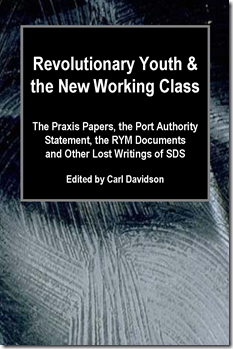
Book Review - Revolutionary Youth and the New Working Class: Lost Writings of SDS


cover-front-revyouth Edited by Carl Davidson,

Changemaker Publications

Pittsburgh PA, 2011

By Jerry Harris

Carl Davidson has done a tremendous service to anyone who studies the history of social movements or anyone interested in the 1960s rebellion. This "lost" collection of papers reveals the depth and richness of radical thinking coming out of the student movement as the war raged in Viet-Nam and militant protestors marched through the streets of America.

The most important document is the "Port Authority Statement," by SDS members David Gilbert, Robert Gottlieb and Gerry Tenney. Although at the time not widely circulated, it offers great insight into the thinking and analysis of SDS as it turned to revolutionary theory and debate. This is an impressive document. Detailed in statistical and economic analysis, grounded in revolutionary social theory, and innovative in its thinking and insights.

One of the most important sections of the paper was its class analysis with its focus on the new working class and the relationship of students to an economy shifting from manufacturing to services and technology. The documents notes that, "Modern American capitalism is characterized by rapid technological change with scientific knowledge growing at a logarithmic rate." This will result in the "elimination of unskilled labor (as) the blue-collar sector will decrease (and) jobs that require high degrees of education and training" will increase. (pages 88-89)

That analysis was made in 1966. Now read a recent article by Edward Luce from the Financial Times: "the middle-skilled jobs that once formed the ballast of the world’s wealthiest middle class are disappearing. They are being supplanted by relatively low-skilled (and low-paid) jobs that cannot be replaced either by new technology or by offshoring – such as home nursing and landscape gardening. Jobs are also being created for the highly skilled, notably in science, engineering and management. (12/11/11) Decades later the paper's main thesis still holds up.

Continuing its class analysis the Port Authority document examined the capitalist class and the debate over ownership and control. The authors focused attention on the growing trend towards paying executives with large stock rewards, merging management and ownership. Again we can turn to a recent article published in the December 2011 Monthly Review that reads, "More recently, David Harvey has argued that ownership (share holders) and management (CEOs) of capitalist enterprises have fused together, as upper management is increasingly paid with stock options." (Richard Peet) This "recent" argument now being made by a leading Marxist trails Port Authority by some 45 years.

Although the authors grasped the sweeping impact that technology would have on American workers, what they could not see would be globalization and the advent of neo-liberalism as a governing ideology. As the paper notes at the time, "Corporate liberalism implies that the dominant economic institution is the corporation and that the prevailing political and social mode is liberalism." (page 68) Of course it's understandable how such changes would be all but invisible in 1966; it's also a good reminder why political tactics and strategy must remain flexible and activists should always be willing to reevaluate their analysis.

The above are but a few of the enticing insights that are contained in page after page of these documents. As new social movements gather force throughout the world, a look into the thinking of activists from the last great social movement can help give direction to coming future battles. I would highly recommend this book to all activists and academics interesting in building a better world.

Jerry Harris, National Secretary of the Global Studies Association and author of "The Dialectics of Globalization."

Read more!

Tuesday, November 29, 2011

Do They Really Want 'Specific Demands' from the Occupiers?

By Carl Davidson
Keep On Keepin' On

I’m getting fed up with pompous pundits lecturing the ‘Occupy!’ movement for not having a set of specific demands.

A case in point: New York Time financial columnist Joe Nocera quoted at length in a story by Phoebe Mitchell in the Daily Hampshire Gazette on Nov 29.  He was speaking at the Amherst Political Union, a debate club at UMass Amherst.

Nocera starts off with the now usual tipping of the hat to the protestors:

“Nocera believes the anger caused by income inequality, a divisive issue across the country in this prolonged economic downturn, is the fuel for both popular uprisings. ‘If we lived in a country that had a growing economy and where the middle class felt that they could make a good living and had a chance for advancement and a decent life, there would be no tea party or Occupy Wall Street,’ he said.”

But we don’t live in such times, and the more interesting story is that OWS and its trade union allies are displacing the Tea Party, and energizing the progressive grassroots. Nocera, however, makes OWS the target.

“He believes that for the Occupy Movement to be successful, it must frame clear demands that outline a plan for creating jobs and refashioning Wall Street to benefit the entire country and not just a select few wealthy investors. Without a solid plan for moving forward, he said, the Occupy protestors will be continued to be viewed by Wall Street supporters as little more than “a gnat that needs to be flicked from its shoulder blades.”

A ‘gnat’ indeed. In due time, a progressive majority may well come to view our dubious ‘Masters of the Universe’ on Wall St as bothersome gnats to be flicked away.

But to get to the main point, Nocero knows perfectly well that there is any number of short, sweet and to the point sets of demands aimed at Wall Street finance capital and the Congress it works to keep under its thumb. Richard Trumka of the AFL-CIO has been hammering away at his six-point jobs program—one point of which is a financial transaction tax of Wall Street as a source of massive new revenues to fund the other five.

The United Steel Worker’s Leo Gerard has been tireless for years working for a new clean energy and green manufacturing industrial policy that could create millions of new jobs and get us out of the crisis in a progressive way.

So what happens when these demands are put forward? With our Wall Street lobbyists working behind the scene, the best politicians money can buy declare them ‘off the table.’ Nocera and others of like mind in punditocracy put the cart before the horse. OWS arose as a result of a long train of abuses, year after year of sensible, rational, progressive demands and programs swept off of Congress’s agenda like so many bread crumbs from a dining table. Not even brought to a vote. OWS and a lot of other people are fed up with being dismissed.

The pundits should watch what they wish for. The demands and packages of structural reforms will be back, much sharper and clearer, and with the ante upped by hundreds of thousands in the streets, as well as millions turning out for the polls. In fact, the solutions have always been there for anyone with ears to hear. We’ll see if our voices are loud enough to crack the ceiling at the top, and let some light shine through.

Read more!

Tuesday, October 18, 2011

Occupy Wall Street Wins: ‘We Shall Not Be Moved!’

Victory cheers in Zuccotti Park, 6am, Oct 14

Blocking Evictions, Fanning the Flames:

A Report from Occupied Wall Street

By Carl Davidson
Keep On Keepin' On

Riding the New York City subways in a rush hour is always an adventure. But experiencing the crowds of people on the downtown train to Wall St at 5:30 am, Friday Oct 14, 2011 was a special treat. The closer we got to the financial district, the more workers with union jackets poured into the cars, in a militant and upbeat mood, ready to assert their power.

I was in town for a speaking engagement at a union hall the night before, when our small group got the word of an email blast from the national AFL-CIO, "Everyone who can, get down to Wall Street by 6 am. We're going to block the Mayor Bloomberg's attempt to evict the protestors with the police." The after-meeting chatter ended quickly, since we knew we need to get some sleep for a long day ahead.

It was still pitch dark as we climbed out of the Wall St station. We could hear the noise from Zuccotti Park, but batches of cops were everywhere, putting up barricades as a kind of obstacle course. I was with Pat Fry and Anne Mitchell, both SEIU staffers and leaders of the Committees of Correspondence for Democracy and Socialism.

"Goodness, look at all the media," said Pat, noting the hundreds of reporters, together with vans and cranes erecting their cameras. When we got to the park it was jammed packed with more than 1000 young people, mostly sitting in the dark with arms linked. The incoming thousands of supporters from labor and the general public began encircling the park until they were about three deep in front of the wall all around it. Anne spotted an open space on the wall. "Let's get up here," she said, as we each got a hand lifting us into position.

From our vantage point, even in the darkness, we could see an inspiring but intense scene unfolding. The police had paddy wagons and empty buses for mass arrests trying to find positions, but getting blocked by traffic. Every few minutes, hundreds more emerged from the subway stations as additional trains rolled in. You could tell who was there from the jackets, caps and T-shirts-Teamsters, SEIU, the Transit Workers Union and many more.

"No way there's going to be an eviction," I said to my partners. "The cops are way outnumbered and outmaneuvered. All they can do is teargas the entire plaza, but then what? That would create a fight shutting down the entire financial district. They're not ready for it yet."

Inside the park, an amazingly ordered but still spontaneous 'General Assembly' was underway.  The 'human microphone' was in play, a technique developed to counter situations where amplified sound equipment was banned. A speaker would shout out a relatively short statement, and then it would be re-shouted in turn by the dozens around him or her, and reshouted again by much of the crowd, aiming their voices out into the streets. The only limitation is that you have to speak and pause as if you're being translated, but it's English-to-louder-English.

The speeches were intermixed with call-and-response chants. "Tell me what democracy looks like?" was met with the return roar, "This is what democracy looks like!" When someone wants to speak from different part of the park, they yell out "Mike check!" and when it gets repeated loudly enough by 20 or so people, they get their turn, and at any given spot, there will be a 'stack' of people lined up with something to say, managed by a 'stackeeper.' For this dramatic period at least, it worked beautifully.

Finally one speaker yelled out, "We've finally got the official word. At a meeting just a few hours ago, the city agreed to postpone the eviction. We've won!" The occupiers were jubilant--and even a good number of cops seem relieved. Soon after the announcement, one speaker was a member of New York's City Council. "You need to hear that you have more friends than you know about inside the council!" In other words, the mass pressure from below forced a split, and now there was a crack in the ceiling to be taken advantage of by the occupiers.

We stood on the wall for another hour or so, listening to a few speeches but mainly talking with friends and comrades who spotted us on our perch. Jay and Judith Schaffner, retired unionists, had driven in from the Poconos, and reported on what was happening even in the small towns of Northeastern Pennsylvania. Many activists with New York City's Labor Left Project stopped, as did people we knew from the Democratic Socialists of America and the Communist Party, USA. A good number of veterans from the old SDS of the 1960s came up and said hello: "We're everywhere!" I noted with a smile. I also had a surprising number of young people I've never met come up and say, "Hi! I'm one of your Facebook Friends!" The new media seemed to be working well.

By this time the gray light of dawn arrived. Some people were leaving the square to go to work while more were still arriving. "I don't know about you guys, but I need some coffee and a serious breakfast," said Anne. We agreed, jumped down, made our way through the police lines to one of New York's ubiquitous coffee shops. Over our eggs and sausage, we discussed the meaning of it all before Pat and Anne had to get to work.

In choosing Wall Street as their target, and taking direct action defined by moral clarity against a range of injustices, the young occupiers had opened up a new public sphere. It was a dynamic and flexible political space open to all whose issues, demands, hopes and dreams had been swept 'off the table.' An arrogant and dismissive ruling class, determined to impose more neoliberal austerity and longer wars, were in for a rude awakening. If those at the top thought the bottled up frustration and rage of millions at the bottom 'had nowhere to go,' they were now facing this new insurgency in the streets.

Young people in the 1960s had acted as a critical force, holding up a mirror to the rest of society, prodding it to respond. The Black student sit-ins in the Deep South were a prime example, as were the antiwar students on the campuses and the young alienated GIs returning from Vietnam.

But this new insurgency was different in important ways. First, the 'long wars' had fed a deep crisis abroad, feeding both the Arab Spring 'square' occupations and a long-frustrated antiwar majority at home. Second, the financial crisis had alienated millions in the working class and other strata in a deep way. The labor upsurges in Wisconsin, Indiana and Ohio revealed an angry discontent in the U.S. heartland. So instead of taking years of 'critical force' protests to create and awaken a progressive majority, the young occupiers rather quickly found that they had large and important allies.

That was evident in the rapid support they received from Leo Gerard of the Steelworkers, from Richard Trumka speaking for the AFL-CIO, from the 20,000 workers mobilized by New York's unions in a solidarity march a week ago, and finally, from this morning's dramatic intervention blocking the eviction. An important new alliance between a radicalizing youth movement and the more progressive wing of organized labor has been forged in the streets-and it was ongoing and open-ended.

It also didn't stop with labor. A number of city councils across the country, themselves suffering at the hands of Wall Street-imposed neoliberal cutback policies, passed resolutions and spoke up in defense of the occupiers. Others equivocated, and tried to restrict and disperse the actions, resulting in nearly one thousand arrests across the country. Electoral groups like the Progressive Democrats of America urged its members to go 'all out' in support of the occupations, and PDA's allies-Bernie Sanders in the Senate and the Progressive Caucus in the House-also spoke up. Even Nancy Pelosi, former Speaker of the House, gave her support. And while President Obama didn't go that far, he tipped his hat to the effort, acknowledging the validity of 'their concerns.' '

A New Popular Front Emerging

The implications of all this are deep, complex and strategic.  A new popular front against finance capital, encompassing a progressive majority of the country, is beginning to take shape. It is emerging against the neoliberal intransigence on Wall Street, against the GOP-dominated Congress and against a White House that too frequently conciliates with the right wing of both parties. It brings together many demands, many voices and several contending platforms, but all aimed against a common adversary-the "99 percent versus the one percent," the most popular theme in the protests that sums it up.

After breakfast, I headed back to the park to spend a few hours talking to people and taking it all in. There was a lot of activity re-assembling the different facilities of the occupiers that had been taken down the day before to sweep and scrub the occupied zone. The mayor had been using the sham excuse of 'unsanitary conditions' as to why he was going to clear the area. "If the mayor was serious about this," said one young guy with a broom, "he'd give us the portajohns and dumpsters we've been asking for since we started. But they're still refusing, so we do the best we can."
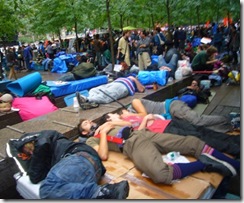
tired out The cleanup was actually very good. A large number of young people were also by now sleeping in the various sections of the park. They had covered their spaces with tarps and folded cardboard signs that doubled as sleeping pads for their sleeping bags. They had been up all night and were exhausted. All the sleeping was out in the open since the city had banned tents in the area, as well as amplified sound.

Not that the sound restriction mattered all that much. On the west end on the square was a huge drummer's circle with about a dozen people beating out a constant background of rhythms. The styles changed as one cultural grouping took over the drums from another-African American, Puerto Rican, Jamaican, women, white rockers, and various mixtures of all sorts. The drone was actually a pleasant background, giving off an energized atmosphere.

You could tell that many protestors were from a new and fresh layer of young activists. The reason? Four huge American flags were constantly being waved over the drummers. There were also a few red flags, and Earth flag and several rainbow flags-but in a more seasoned left event, especially with a large proportion of anarchists, the American flags would not likely be there. The youth also seemed quite diverse among themselves. There was one small 'Class War' corner with several dozen kids dressed mainly in black, other areas with kids mainly in tie-dyed shirts, and even one young man, very busily engaged in cleaning up the area, was dressed in his full Eagle Scout uniform, complete with all his merit badges.

The Matter of ‘Demands’

The media pundits had been criticizing Occupy Wall Street (OWS) for not having a set of specific demands. Rather the occupiers were simply underscoring vast inequalities and demanding a new world. What the pundits ignored was the fact that one reason the movement was resonating so deeply with wider circles of people was that all decent demands made over the last few years-ending the wars, Medicare for all, full employment legislation, and especially the demand to fund all reforms with a financial transaction tax on Wall Street speculators-had all been rejected, declared 'off the table' and not even allowed to come to a vote in Congress and any other government bodies. In any case, OWS actually had come up with a long list of indictments, which was widely circulated on the internet, even if it was ignored in the higher circles of power.

I spotted two students standing on the wall holding up a cardboard sign, "Education with Debt Is Not Justice! It Never Will Be!", and struck up a conversation. They were burdened with tens of thousands of dollars in debt, and weren't nearly finished with school yet. "What’s the difference between then and now?" one asked me, about being a student in the 1960s. My tuition at Penn State, I explained, was about $1500 a year and I could survive for a term on $500 for room and board, which I could make with my campus job as a janitor. If I took off to run around the country organizing against the war, no one's mortgage was at stake. Today's students have to deal with $15-20,000 per year, a severe hardship for many, and a strong motivator behind the 'Occupy!' movement.

discussion group But the occupiers were interested in everything, not just their own situation. There were several discussion circles of a dozen or so people going on simultaneously. Stopping by one, the topic was radical movements in Latin America. At another, the subject of militarism and the defense budget was being dissected. At still another, a small group of Ron Paul libertarians were trying to hold up under a barrage of friendly criticism.

Once you had an overview, it was clear that everything was fairly well organized. Right in the middle of the park were two long black chalkboards, propping each other up back to back. On one side was the entire schedule for housekeeping tasks-cleanup, food, dealing with the media, medical issues and so on. On the other side was a timetable for various events and speakers, workshop times and topics, and the times of the daily General Assembly.

Next to the schedule blackboards was the food pantry. At the center was a can for money donations, along with a suggestion to bring canned goods and fresh fruit. One might get an odd variety of things to make up a meal, but if you were broke, the price was right. All along one side of the park also was a line of lunch wagon trucks selling a variety of things. "What's best?,' I asked someone who looked like he had been there a while. "The guy with the falafel truck. Awesome!"

dishwashing The cleanup section, logically, was next to the food. Here were four large plastic bins with soapy and clear water to keep utensils and dishes sanitary. Lugging the water in and out was a chore, but it otherwise worked fairly well. Finally, next to that, was the first aid station, with a variety of bandages and such. "What's been your most serious medical problem?" I queried. "Pepper spray burns by far, after the confrontation with the cops last week."

The Struggle Continues

In the days ahead, the flexible plan seems to be to send out forays of marching demonstrators, of varying sizes, to assorted targets around the city, but keeping Zuccotti Park as a more secure base area. Today one relatively small group headed further south toward Battery Park, taking over the center of a street, but got dispersed by the cops, and a few were arrested. The following day, Saturday, saw a huge victory rally of tens of thousands in Times Square. One group, trapped on a side street by irate cops who wanted it cleared, ended up with about 70 being arrested. But the kids are becoming more streetwise, now avoiding situations like last week where about 700 got trapped in a police net on the Brooklyn Bridge and were carted off to jail.

What happens next will depend a lot on vigilance, organizing skill and the relation of forces. One ominous report in the news revealed the gradual buildup of a huge encampment of militarized police, with different sub zones encircling the entire Wall Street area. But through their determination, planning and audacity, fanning the flames of discontent, OWS has already scored a tremendous victory. Similar actions are now taking place in over 500 cities around the world, and in nearly every major city and state capital in the U.S. In one month, they have changed the political conversation in all sectors, putting finance capital on the defensive at least tactically. The latest opinion polls show a majority of Americans are supporting them to one degree or another, revealing the deep class divide between Main Street and Wall Street. If there's any attempt to shut down any of the hundreds of occupations by force, a much wider and deeper solidarity effort is likely to emerge.

[Carl Davidson is a national co-chair of the Committees of Correspondence for Democracy and Socialism, a national board member of the Solidarity Economy Network,  a writer for Beaver County Blue, the website of PA’s 4th CD Progressive Democrats of America, and a members of Steelworkers Associates. He is the author of several books, including ‘New Paths to Socialism’ available online. If you like this article, make use the PayPal button above.]

Read more!

Wednesday, October 12, 2011

A Champion of Jobs, Justice and Peace


Photo: Dwan Walker of ‘One Aliquippa’ with Rep. Conyers at award dinner

Rep. John Conyers Honored at Labor's

Human Rights Dinner in Beaver County

By Carl Davidson
Beaver County Blue

Over 400 labor and human rights leaders and activists gathered at The Fez in Beaver County's Hopewell Township Oct. 8 to honor John Conyers, the Congressman from Detroit Michigan, now serving his 23rd term as a long-time champion of labor, civil rights and civil liberties.

Sponsored by the Beaver-Lawrence Central Labor Council, the annual human rights banquet drew local labor unions, the NAACP and African American churches, and activist groups such as the 4th CD Progressive Democrats of America. The elected officials present included County Commissioners Joe Spanik and Tony Amadio, row officers Carol Fiorucci and Nancy Werme, as well as Dwan Walker and his 'One Aliquippa' organization. Walker's recent primary victory has position him to be the town's next mayor. The event was also honored by the attendance of several youth ambassadors from Aliquippa's Council of Men and Fathers.

conyers-pda-table1 "There's a high level of energy here," said Tina Shannon, PDA's president and a member of the dinner's organizing team. "Many of us have already worked together for years on Medicare for All, and in the recent 'One Nation' mobilization in Washington, DC. We've built a strong unity by working together, and it's reflected in the turnout here tonight. It'll continue as we fight for jobs"

Conyers was an excellent choice for the labor council's award. Not only is he known worldwide for his leadership in the House Judiciary Committee as a staunch defender of the Constitution and the Bill of Rights, he is also responsible for introducing some of the most progressive Bills in Congress.  HR 676 'Improved and Expanded Medicare for All' has been widely promoted here in Beaver County by Unions and Progressive Democrats, including the first Citizen's Hearing on the Bill conducted in Aliquippa featuring Dennis Kucinich as convener. The Beaver County Commissioners and the Beaver/Lawrence Labor Council have both passed resolutions endorsing the Bill. Conyers has also recently drafted another groundbreaking bill, HR 870 Humphrey-Hawkins Full Employment Act, to be funded by a financial transaction tax on Wall Street speculators.

Read more!

Sunday, September 25, 2011

‘Street Heat’ vs. Finance Capital and the Right

Solidarity Time: Young People Occupying

Wall Street Are Standing Up for All of Us

By Carl Davidson
Keep On Keepin' On

The actions of thousands of young people in New York City's financial district, simply calling themselves "Occupy Wall Street," is now entering a second week, with many camping out overnight in the area's parks. How long its will continue and whether its numbers will swell is anyone's guess, but the response of the NYPD in arresting and otherwise restricting them is already banging heads with our First Amendment rights to peacefully assemble.

"At Manhattan's Union Square, police tried to corral the demonstrators using orange plastic netting," reports the Sept 25, 2011 Washington Post. "Some of the arrests were filmed and activists posted the videos online. One video appears to show officers using pepper spray on women who already were cordoned off; another shows officers handcuffing a man after pulling him up off the ground, blood trickling down his face."

Most of the youth are students, but many are also unemployed and underemployed young workers. And a small but important grouping of staffers and activists with NYC's trade unions have also made their way downtown to spend a few hours helping out.

The students certainly have a just cause. While the denizens of Wall Street have bailed themselves out and paid themselves huge bonuses with trillions from the public treasury, these young people are saddled with a degree of crushing debt to pay for their educations that would have been unthinkable 40 years ago. If they manage to graduate, they face a financial burden large enough for a home mortgage-all before they start their first full-time jobs, assuming their lucky enough to find one that pays a living wage.

But these youth and students are fighting for more than their own immediate concerns. They have raised a whole range of demands-Medicare for All, defending social security, for passing the various jobs bills in congress, opposing racism and sexism, ending the wars, and abolition of the death penalty in the wake of the recent unjust execution of Troy Davis.

They are the cutting edge of a new popular front against finance capital.

Young rebels often manifest a moral clarity that awakens and prods the rest of us. Through their direct actions, they become a critical force, holding up a mirror for an entire society to take a look at itself, what it has come to, and what choices lay before it. The historic example is the four young African American students that sat at a lunch counter and ordered a cup of coffee in Greensboro, North Carolina back in 1960.

The Wall Street protests are thus a clarion call to the trade unions and everyone concerned with economic and social justice. While the youth are clearly a critical force here, when all is said and done, they are not the main force. That power resides in labor and in the wider communities. It's in the hands of everyone that's part of an emerging progressive majority for peace and prosperity, everyone that wants a U-Turn against the country's current path to more wars and deeper austerity.

It's time to exercise that power and lend a hand with active solidarity. More actions are in the works, including an occupation and encampment on Freedom Plaza in Washington, DC starting Oct. 6, following the 'Rebuild the Dream' DC conference focused on a renewed labor-community coalition for the 2012 election.

It's going to take more than votes to push back the right wing and its Wall Street allies. It's going to take some serious 'street heat' as well.


[Carl Davidson is a national co-chair of Committees of Correspondence for Democracy and Socialism, a national board member of the Solidarity Economy Network, and a member of Steelworker Associates residing in Beaver County, Western PA.

If you like this article, make use of the PayPal button at http://carldavidson.blogspot.com  His books are available at http://stores.lulu.com/changemaker]

Read more!

GoStats web counter