Showing posts with label socialism. Show all posts

Friday, August 09, 2013

Digging In, Reaching Out…


Student and teachers from the Convention ‘School for Young People’

CCDS 7th Convention Debates Growth

of the Left and the Progressive Majority

in Combating Austerity, War and the Right

[This report was assembled by Carl Davidson, with considerable and valuable help from Cheryl Richards and Ellen Schwartz, our recorders. Others who added a lot were Janet Tucker, Harry Targ, Ted Reich, Pat Fry, Will Emmons, Randy Shannon, Anne Mitchell and Duncan McFarland. Photos by Ted Reich]

Nearly 100 delegates, observers and friends gathered in Pittsburgh, PA for the 7th Convention of the Committees of Correspondence for Democracy and Socialism over the July 18-21, 2013 weekend. The goals of the gathering were to take stock of the political battles since their last convention in 2009, to assess the organization’s strengths, weaknesses and ongoing challenges, and to chart a path of unity and struggle for the upcoming period.

The participants came from all sections of the country: from California to Florida, from Texas to Boston, and many points in between. Almost all were deeply embedded in mass struggles—trade unions and community organizations, women’s groups, civil rights organizations and peace and justice coalitions. Many had also taken part in a variety of independent electoral battles against the GOP and the right, and everyone had been in the streets during the battles against the wars, the Occupy upsurge and for justice in the Trayvon Martin case.

Kicking off the meeting was a “School for Young People.” That innovation started a day before the main sessions of the convention. The presence of 20 young activists—men and women, of several nationalities, fresh from many battles, especially in the South—added a dynamic quality to all the discussions for the entire weekend.

“We appreciated the steps CCDS has made to accept the need for youth leadership in the socialist left and progressive movements,” said Will Emmons of Kentucky. The students saw the school as a “good first start,” and looked forward to more and better efforts in overcoming the intergenerational divide in much of the socialist movement.

The convention itself was organized into five plenary sessions and 16 workshops, with a cultural event and dinner on Saturday evening. It opened for the youth school and other early arrivers Thursday evening with the showing of the new film, “Anne Braden: Southern Patriot,” an inspiring story of the battles of Anne Braden and her husband, Carl Braden of Kentucky, in decades of battles against white supremacy and other fronts in the class struggle across the South. Filmmaker Anne Lewis from Texas was on hand to lead a discussion that followed.

All the convention’s deliberations were organized around a “main resolution,” with the various plenaries and workshops dealing with its different sections. The five plenary topics were 1) assessing the concrete conditions, 2) the terrains of struggle against austerity, 3) the climate change crisis, 4) strategic formations and the progressive majority, and 5) the quest for left unity.

Time of Day: The Opening Plenary on Concrete Conditions

“What time is it?” asked Mildred Williamson, a CCDS national committee member from Chicago, in her remarks opening the first plenary session, which was chaired by Randy Shannon of Western PA. “It's a time of economic, social, environmental, and racial injustice on steroids.” she continued, “a time of no respect for humanity.” She proceeded to spotlight the full range of current conditions with the lens showing the inter-connection of class, race and gender. “What time is it?” she repeated, “As long as Black and brown lives are thought of and treated as disposable, in a 21st century-three-fifths-of-a-person fashion, it will be impossible to achieve working class power in this country. Economic and social policies are literally destroying Black and brown lives, and simultaneously further weakening working class power…. we must fight with humility and purpose to strengthen and promote radicalized thought and action in the quest for social justice, human rights and working class power. This requires a fresh look at what it means to be ‘Left’ in this phase of capitalism.”

Williamson concluded by posing the most poignant questions to the delegates:

“What is the winning strategy to reduce the number of white working class people from voting against their own class interests, especially since fewer are unionized and fewer live in integrated communities? What will be the winning strategy to achieve left unity - and just what does that mean today? How can we build respect for youth in leadership of social justice movements while still showing simultaneous respect for elders? How do we fully move our thought and action from the multiracial unity ‘slogan’ to normalized, genuine demonstrations of respect for multiple cultures, gender expressions and sexual orientations? These questions--and more tough ones--need answers in order to chart the path forward in the quest for working class power. Let's work on them at this convention and thereafter.”

Read more!

Monday, June 03, 2013

Carl Davidson’s Sessions at the Left Forum in NYC, June 7-9, Pace University

LEFT FORUM SESSIONS

WITH CARL DAVIDSON and his related groups—the Online University of the Left, Committees of Correspondence for Democracy and Socialism, and the Solidarity Economy Network

11 Talking Points on 21st Century Socialism
Session 3     E326     Sat 03:40pm - 05:20pm

A Slide Show presentation by Carl Davidson on the core features of socialism in today's world, followed by responses and discussion. Issues will include technology, human rights, the role of markets, mixed economies and strategic allies.

Sponsoring Journal:
Online University of the Left

Speakers: Carl Davidson, Committees of Correspondence for Democracy and Socialism; David Schwartzman, DC Statehood Green Party; Dario Cankovic, Northstar.org   

--------------

Shift Change: potential and limits of worker cooperatives in building a sustainable future
Session 4     W615     Sat 05:30pm - 07:10pm

In SHIFT CHANGE, a new documentary that visits coops in the US and Mondragon, worker owners share some practical challenges of a democratic workplace, and how coops can help build a more just and sustainable society. Clips from the film will be shown, with comments from panelists, and discussion involving workshop participants about broad issues of economic democracy and a more ecological future.

Panelists include:
Gar Alperovitz, author, What Then Must We Do;
Carl Davidson, Solidarity Economy Network
Mark Dworkin & Melissa Young, filmmakers

---------------

Left Third Party Organizing: Challenges and Opportunities
Session 6     W211     Sun 12:00pm - 01:50pm

In an age of two-party domination and neoliberal hegemony, what opportunities exist for left electoral politics through third party campaigns? Why and when should leftists focus on third party campaigns, as opposed to Democratic Party primaries? Where should the left focus its electoral resources, and how might it overcome division? Should third-party politics be thought of in terms of consciousness-raising, or is the left in a position to affect public policy by taking power?

Sponsoring Journal:
The North Star
Seamus Whelan, Socialist Alternative
Tim Horras, Philly Socialists        
Carl Davidson, CCDS       
Ursula Rozum, Green Party

Read more!

Thursday, April 04, 2013

Strategic Thinking on the U.S. Six Party System

Congressional Progressive Caucus presenting its platform
"If you know the enemy and know yourself, your victory will not stand in doubt; if you know Heaven and know Earth, you may make your victory complete."
--Sun Tzu, The Art of War
By Carl Davidson Keep On Keepin' On
Successful strategic thinking starts with gaining knowledge, particular gaining adequate knowledge of the big picture, of all the political and economic forces involved (Earth) and what they are thinking, about themselves and others, at any given time. (Heaven). It's not a one-shot deal. Since both Heaven and Earth are always changing, strategic thinking must always be kept up to date, reassessed and revised.
To make a political assessment of the forces commanded by the U.S. bourgeoisie and its subaltern allies and strata, it helps to make an examination of Congress, the White House and other Beltway institutions, as well as voting trends and others political and cultural among the masses. And to get an accurate estimation, we must often tear away, set aside or bracket misleading labels and frames, as well as assess varying economic resources and voting results. We want to illuminate an intentionally obfuscated landscape, like when a flash of lightning at night does away with shadows and renders the landscape in sharp relief.
The primary conventional wisdom we want to dissect here is that the U.S. has a two-party system.  First, the nature of political parties in the US today is rather unique; they are not parties in any European parliamentary sense, where members are bound to a program or platform with some degree of discipline, and mass party organizations exist at the base. Second, the Republicans and the Democrats in the US are largely empty shells locally, consisting mainly of incumbents and staffers, and their retained lawyers, fundraisers and media consultants. There is some variation from state to state--state committeemen and women will pass resolutions and certify ballot status and positions, but there's not much of a mass character save for an occasional campaign rally. Third, at the Congressional level the two-party structure, to some degree, still allows for dividing the spoils of committee assignments, but even these are often warped by other considerations.
A few also like to argue that the US has only one party, a capitalist party, with two wings, the bad and the worse. But this is reductionist to a fault, and doesn't tell you much other than that we live in a capitalist society, which is rather trivial.
Some also hold out hope for a 'third party' that is noncapitalist. But given the 'winner take all' rules in most elections, along with the amount of money and resources required to mount credible campaigns, these are long shots, save for periods of crisis and upheaval, like the period just before the U.S Civil War, where the Whigs imploded, the Liberty Party had a role, and a new 'First Party' formed, the GOP. Another period worth a deeper look is 1944-48, when the rising forces of the Cold War and Southern racism led to a four-way race in 1948 between the Dixiecrats (Strom Thurmond), the Democrats (Harry Truman), the GOP (Thomas Dewey) and the Progressive Party (Henry Wallace).
Our Six-Party System
But today, we'll do better to get a more accurate picture of our adversaries if we set aside the labels of 'two-party system', 'Democrats' and 'Republicans' and the other nuances mentioned above.  Instead, I'll offer an alternative working hypothesis, that we live under a six-party system with two labels, and that this will give us a closer and more realistic view of the relation and balance of forces with which we have to deal. But even here, it's important to note that we are discussing 'parties' as clusters of colluding and contending blocs of interests, economic views and social coalitions, not unified and disciplined ideological formations strictly bound to a platform. The six 'parties' described here below, however, do come closer to these kinds of constructs than the larger 'two labels' they operate under.
So who are they?
The Tea Party. So far, only the most far right group has been given the label 'party' in the mass media, even though it operates as a faction within the GOP. It generally represents anti-globalist nationalism with a prominence given to the 'Austrian School' economics of classical liberalism and, in some cases, the self-interest philosophy of Ayn Rand. It also merges with paleo-conservative traditionalists, which serves as a cover for defending white and male privilege and armed militia groups. It appeals to about 10-20 percent of the electorate, with greater support in the South and West. It is currently locked in a fierce factional struggle with the other wing of the GOP. While a minority in the House overall, they dominate the GOP House Caucus, and thus, as reported widely on 24-hour news cycles, they can and do block many bills from coming to the floor. Tea Party incumbents have been aided in gaining and retaining their seats by GOP-led redistricting on the level of the states they control, breaking up districts electing Democrats and forming new one with more homogenous rightwing majorities. This was begun by Paul Weyrich of the 'New Right' under Reagan, and continues to this day
The Republican Multinationalists. These are the neoliberal moneybags of the GOP (and the neoconservative subset termed 'The War Party' by Pat Buchanan and Ron Paul from the right)-the Bushes, Cheney, Karl Rove, the Koch brothers and others with fortunes rooted in petroleum, defense industries and other US businesses with global reach. Their neoliberal economics became hegemonic with Reagan's ascendancy via the anti-Black and anti-feminist 'Southern Strategy' alliance with the forces that later came to make up the Tea Party right. The Koch brother's money also helped form ALEC, the American Legislative Exchange Council, thus allowing business lobbyists to write uniform reactionary legislation, mainly on the state level, across the country. Despite statewide gains, the GOP label's current dilemma is that the Tea Party's more inane, backward and proto-fascist views on social and cultural issues is causing the GOP tickets to lose national elections, deadlock the Congress and strain the alliance. On the other hand, if the 'Country Club' Republicans dump the Tea Party, the GOP itself may implode
The Blue Dogs. This caucus in the Democratic Party is tied to 'Red State' mass voting bases-the military industrial workers, and the Southern and Appalachian regions. They are neo-Keynesian on military matters, but neoliberal on everything else. Their 'party' frequently sides with the GOP in Congressional voting. The Blue Dog Coalition has recently shrunk from 27 to 14 members, often having paved the way to self-defeat by backhandedly encouraging GOP victories in their districts by attacking Obama and other Democrats.
The 'Third Way' New Democrats. This 'party' of the center right is mainly the U.S. electoral arm of global and finance capital, with the Clintons and Rahm Emanuel as the better known public faces. Formed to break with 'economic populism' of the old FDR coalition, and assert a variety of globalist 'free trade' measures and the gutting of Glass-Steagall banking regulations, this new post-Reagan-Mondale grouping decided to put distance between itself and traditional labor allies. While neo-Keynesian on most matters, it also 'triangulates' with neoliberal positions. Started as the Democratic Leader Council and the 'New Democrat Coaltions. John Kerry is a member of the DLC but President Obama has claimed 'no direct connection,' even though the grouping lists Obama as one of its 'rising stars' The DLC/'New Democrats' essentially speaks for some of the more powerful elements of finance capital under the 'Democratic' label.. It is the dominant view among the Senate Democratic majority.
Old New Dealers.  This 'party' is represented by unofficial wealthy Democratic groups like Americans Coming Together, plus the AFL-CIO's Committee on Political Education and others. They take a Keynesian approach to economic matters, and are often critical of finance capital and the trade deals promoted by the globalists. They are also wary of deep defense cuts that would cause layoffs among their membership base. They maintain, however, strong alliances with some civil rights, women's and environmental groups. Their main value to Democratic tickets is their independent get-out-the-vote operations, which can be decisive in many races. They also work closely with the Alliance for American Manufacturing, a business-based anti-free trade lobby that works with labor.
PDA/Congressional Progressive Caucus. While the largest single caucus in the House, the CPC 'party' is still relatively small, representing 80 out of 435 votes. Its policy views are Keynesian and, in some cases, social-democratic as well.  Its recent 'Back-to-Work Budget' serves as an excellent economic platform for a popular front against finance capital. It also largely overlaps with the Hispanic and Black Caucuses, and is the most multinational 'Rainbow' grouping in the Congress. It also includes Senator Bernie Sanders, the sole socialist in Congress, who was an initial founder of the CPC. It has opposed the wars in Iraq and Afghanistan, under the Progressive Democrats of America banners of 'Healthcare Not Warfare' and 'Windmills Not Weapons.' It has recently gained some direct union support from the militant National Nurses United and the Communications Workers of America. Many, but not all, CPC members are also members of Progressive Democrats of America, an independent PAC dubbed the 'Tom Hayden/ Dennis Kucinich' Democrats at the time of their founding in 2004. The Congressional Progressive Caucus is the closest political group the US has that would parallel some of the 'United Left' socialist and social democratic groups in European countries
What Does It All Mean?
With this brief descriptive and analytical mapping of the upper crust of American politics, many things begin to fall in place. Romney, a very wealthy representative of the Multinational GOP group, defeated all the Tea Party candidates in the primaries, and consequently, could never convince the Tea Party he was one of them, simply because he wasn't. This led to a drop in GOP voter enthusiasm that couldn't even be overcome with 'dog whistle' appeals to racism and revanchism in the campaigns.
The Obama administration, on the other hand, at its core, represents an alliance between the DLC 'Third Way' and the Old New Dealers, while also pulling along the PDA/Congressional Progressive Caucus as energetic but critical secondary allies. The Blue Dogs found themselves out in the cold from the wider Obama coalition, and shrank accordingly. Barbara Lee of PDA and the CPC, moving from a minority of one on Afghanistan at the start of the invasion, finally got a majority of House Democrats to oppose and push Obama on the wars, but to little avail in any immediate sense, being thwarted by both the DLC and the Multinational GOP.
This 'big picture' also reveals much about the current budget debates, which are shown to be three-sided-the extreme austerity neoliberalism of the Tea Party Ryan budget, the 'austerity lite' budget of the DLC-dominated Senate Democrats, and the left Keynesian progressive 'Back to Work' budget of the Congressional Progressive Caucus. The 'Old New Dealers' were caught in the middle, with only 20 or so coming over on the Black Caucus version of the 'Back to Work' budget, which was still in the minority.
While all this shows why and how Obama was able to pull together a majority electoral coalition, it also reveals why he is still thwarted on pulling together an effective governing coalition. Likewise, it shows how the Tea Party, with only 10-20 percent of the electorate, is able to water down or completely bloc common-sense measures on gun control with 70-90 percent support among the general population.
Finally, the fact that there is only one avowed socialist in Congress tells us something about our own position in the overall balance of forces. Socialist candidates are only able to draw 2% to 5% of the votes in this period, save for Sanders, and we all know that Vermont has some unique features that made it possible, not that Sanders didn't do yeoman work in pulling together a progressive majority that elected him.
In summary, here are a few things to keep in mind.  If you decide to intervene in electoral work to build independent working class grassroots organizations, you don't go 'inside the Democratic Party'. There's not much of an 'inside' there anymore. What you do instead is join or work with one of the two factions/'parties' that are left of center.  Your aim is to make either of these stronger, preferably the PDA/Congressional Progressive Caucus. Then to shift the overall balance of forces, your task is to defeat the Tea Party, the Multinational GOP, and the Blue Dogs. At present, not a single piece of progressive legislation is going to get passed without driving a wedge between the two parties under the GOP label and weakening both of them.
We have to keep in mind, however, that 'shifting the balance of forces' is mainly an indirect and somewhat ephemeral gain. It does 'open up space', but for what? Progressive initiatives matter for sure, but much more is required strategically. We are interested in pushing the popular front vs. finance capital to its limits, and within that effort, developing a socialist bloc. If that comes to scale, the 'Democratic Party Tent' is likely to collapse and implode, given the sharper class contractions and other fault lines that lie within it, much as the Whigs did in the 19th Century. That demands an ability to regroup all the progressive forces into a new 'First Party' alliance able to contend for power
An old classic formula summing up the strategic thinking of the united front and popular front is appropriate here: 'Unite and develop the progressive forces, win over the middle forces, isolate and divide the backward forces, then crush our adversaries one by one.' In short, we have to have a policy and set of tactics for each one of these elements, as well as a strategy for dealing with them overall. Finally, a note of warning from the futurist Alvin Toffler: 'If you don't have a strategy, you're part of someone else's strategy.'
Read more!

Saturday, February 02, 2013

Short Answers Given Repeatedly Dept…

By Carl Davidson

“…The beginning of wisdom in economics is understanding that there is no such thing as a fully planned economy nor fully free markets.

Under socialism, we will have a mix of the two, until the length of the working day approaches zero and the amount of labor time in any given commodity approaches zero, ie, full cybernation. Then the conditions will exist for states, markets and classes, including the working class, to 'wither away.' 

In the meantime, we do our best to apply intelligence in managing and living with them under the mixed transitional class society called socialism, the bridge between the current order and a classless society farther down the pike.”

Read more!

Tuesday, October 23, 2012

Pondering Strategy: The 4th Option

By Carl Davidson

Gregory Wilpert is an intellectual of the left now teaching political science at Brooklyn College, after some time spent in Venezuela. He recently wrote a long interesting piece on Z-Net about our electoral system, mentioning Bill Fletcher and myself in passing. He was perplexed as to finding a way forward, and spelled out these options:

In short, we could call these three positions about electoral politics, non-participation (or boycott), lesser evil voting (with or without Democratic party takeover), and third party voting.

Each of these three positions makes important points that are convincing and difficult to refute.

How can one counter the main argument of lesser-evil voting, that we have a moral obligation to prevent the worst from happening to the most oppressed? On the other hand, if that lesser evil is also involved in atrocities, as is all too often the case with the foreign policy of Democratic presidents, then wouldn’t lesser-evil voting perpetuate evil?

But doesn’t the solution of voting for a third party seems equally hopeless, since the third party candidate might just take votes from the marginally better candidate and enable the election of the even worse candidate? There seems to be no easy solution to this debate. One possible compromise solution has been to urge people to vote for the lesser evil in state where the races is close, but to vote for third party candidates in races where progressives are unlikely to make a difference in the outcome (a position that very many prominent U.S. progressives advocated in 2004 and in 2000).

Also, given that each side has convincing arguments, this helps explain why the progressive movement is so weak in the U.S.: the diversity and depth of conviction of attitudes towards electoral politics makes unity within the left nearly impossible.

What this strategy debate points to is precisely the undemocratic nature of the U.S. political system. This is the kind of debate you would expect to see in countries with profoundly dysfunctional democracies.

If the U.S. had a more democratic system, there would be a general consensus among progressives to participate in the democratic process. The reason you do not see this kind of debate in the democracies of Western Europe or of Latin America (at least not since the 1970’s in Western Europe and since the 1990’s in Latin America) is that these countries, by and large, have far more democratic political systems than the U.S. does.

I thought this was too restricted, and that there was a fourth option, and wrote this reply:

Wilpert does a fair job of summarizing the system, and I have no quarrel with his suggestions for reforms in the electoral system.

But I think there in a 4th option--the one I hold to. That is to build a 'party within a party' among Democratic voters at the base, much as PDA does, but not with the illusion that we are going to 'move the Democrats to the left.' I think Wilpert is right that this isn't very realistic Rather, the approach should be to build our strength in that context, along all the fault lines in the clusters and coalitions of forces under the Dem umbrella, until the whole thing implodes and shatters. The aim is to get rid of it, not reform it--but in a way that helps the left more than the right.

The precedent is what happened to the antebellum Whig party.

Then forces on the outside, our forces on the former 'inside,' and new emerging forces, can come together to make a new 'first' party.

Again, the precedent is the GOP, spurred by the Radical Republicans and base group tied to the First International, under Lincoln,

Of course capitalism today is not quite the same as in the crisis of the 1860s. Slavery will be replaced by finance capital, austerity and war as the organizing focus.

Others may have better ideas. If so, I'm all ears.

Feel free to post your two cents on the matter…

Read more!

Thursday, May 24, 2012

Introducing the Online University of the Left

Univ of left poster copy Check Out This Project And Prepare To Be Amazed!

By Carl Davidson
Keep On Keepin' On

Many people know the internet is full of instructional treasures for educating activists new to the left--and for the ongoing education of elder comrades as well.

One problem, however, is that these little gems are scattered far and wide, often in obscure places. It's a tedious task, even with Google and other research tools, to find and sort through them, making them handy and useful to key audiences.

Enter the `Online University of the Left,' a new `Left Unity' project initiated by the Committees of Correspondence for Democracy and Socialism. It's core orientation is Marxist, but it contains teaching resources reflecting the full range of views on the wider left. About 50 left academics are involved in the core group so far-Richard Wolff, David Schweickart, Rose Brewer, Tim Johnson, Gregory Morales, William Tabb, Ellen Schwartz, Jerry Harris, Linda Alcoff, Dana Cloud, Gar Alperovitz, to name a few.

One of the OUL's key aims is to solve this problem of scattered resources, creating a web portal that will bring much of this valuable material together in one spot in cyberspace. The link is http://ouleft.org, and you can also search for its Facebook page by name-and be sure to `like' it on Facebook, if you do. More `likes' expand the features available to it.

oul-home

The core idea is that anyone with a smartphone, a laptop, a large computer screen or, best of all, a digital projector connected to any of these, can now run any mixture of hundreds of video lectures and documentary films on a wide range of topics. Whether for individuals, small groups or large classes, it offers a multimedia dimension to revolutionary education at no cost.

That's only the beginning. One marvelous feature will be the ability to hold lectures, classes and discussion groups in real time. The participants will be able to hear and see each other via video-conferencing, permitting back-and-forth dialogue. These can also be recorded, edited for improvement and added detailed, then preserved as on-line `webinars' for future repeated use. The OUL will likely charge a small fee, or require a low-cost subscription, however, for access to this particular feature.

This raises an important question: how will the OUL be sustained financially? For the moment, it's being supported by a small grant that will launch it and keep it going for a year or so. After, that, it will have to find or create a number of revenue streams to keep it rolls. One example is the subscriptions and fees for real-time events mentioned above. Another is the `Bookstore' tab, which connects the viewer to our `shelf' at Powell's, one of the country's major unionized booksellers. If you go to Powell's through this OUL link and purchase anything there, a small percentage in commission for the sale goes to the OUL.

The site is organized into academic departments-each with dozens of video lecture and documentaries, achieves with the entire range of theory and analysis of hundred of writers, and study guides and course outlines.

Make use of it! In the future, we will also pursue the usual package of fundraising efforts-donations, small and large, grant writing, public events, benefit dinners and so on. In the meantime, lend a hand by using the `Donate' button at http://cc-ds.org.  Once again, check out the site itself at http://ouleft.org. If you want to link your own materials to it or make suggestions, contact Carl Davidson at carld717@gmail.com

Read more!

Saturday, December 17, 2011

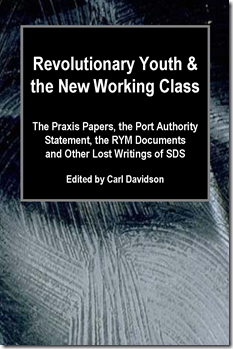
Book Review - Revolutionary Youth and the New Working Class: Lost Writings of SDS


cover-front-revyouth Edited by Carl Davidson,

Changemaker Publications

Pittsburgh PA, 2011

By Jerry Harris

Carl Davidson has done a tremendous service to anyone who studies the history of social movements or anyone interested in the 1960s rebellion. This "lost" collection of papers reveals the depth and richness of radical thinking coming out of the student movement as the war raged in Viet-Nam and militant protestors marched through the streets of America.

The most important document is the "Port Authority Statement," by SDS members David Gilbert, Robert Gottlieb and Gerry Tenney. Although at the time not widely circulated, it offers great insight into the thinking and analysis of SDS as it turned to revolutionary theory and debate. This is an impressive document. Detailed in statistical and economic analysis, grounded in revolutionary social theory, and innovative in its thinking and insights.

One of the most important sections of the paper was its class analysis with its focus on the new working class and the relationship of students to an economy shifting from manufacturing to services and technology. The documents notes that, "Modern American capitalism is characterized by rapid technological change with scientific knowledge growing at a logarithmic rate." This will result in the "elimination of unskilled labor (as) the blue-collar sector will decrease (and) jobs that require high degrees of education and training" will increase. (pages 88-89)

That analysis was made in 1966. Now read a recent article by Edward Luce from the Financial Times: "the middle-skilled jobs that once formed the ballast of the world’s wealthiest middle class are disappearing. They are being supplanted by relatively low-skilled (and low-paid) jobs that cannot be replaced either by new technology or by offshoring – such as home nursing and landscape gardening. Jobs are also being created for the highly skilled, notably in science, engineering and management. (12/11/11) Decades later the paper's main thesis still holds up.

Continuing its class analysis the Port Authority document examined the capitalist class and the debate over ownership and control. The authors focused attention on the growing trend towards paying executives with large stock rewards, merging management and ownership. Again we can turn to a recent article published in the December 2011 Monthly Review that reads, "More recently, David Harvey has argued that ownership (share holders) and management (CEOs) of capitalist enterprises have fused together, as upper management is increasingly paid with stock options." (Richard Peet) This "recent" argument now being made by a leading Marxist trails Port Authority by some 45 years.

Although the authors grasped the sweeping impact that technology would have on American workers, what they could not see would be globalization and the advent of neo-liberalism as a governing ideology. As the paper notes at the time, "Corporate liberalism implies that the dominant economic institution is the corporation and that the prevailing political and social mode is liberalism." (page 68) Of course it's understandable how such changes would be all but invisible in 1966; it's also a good reminder why political tactics and strategy must remain flexible and activists should always be willing to reevaluate their analysis.

The above are but a few of the enticing insights that are contained in page after page of these documents. As new social movements gather force throughout the world, a look into the thinking of activists from the last great social movement can help give direction to coming future battles. I would highly recommend this book to all activists and academics interesting in building a better world.

Jerry Harris, National Secretary of the Global Studies Association and author of "The Dialectics of Globalization."

Read more!

Friday, September 16, 2011

New Book: ‘…The Lost Writings of SDS’

This is a fascinating new collection of 12 essays and documents from the New Left of the late 1960s, gathered and commented on by Carl Davidson, a national leader of SDS at the time.

‘Revolutionary Youth and the New Working Class’ contains key sources illuminating a critical transition period in the American left, as well as a number of ideas still relevant.

Most important is the ‘Port Authority Statement’, actually titled ‘Toward a Theory of Social Change, and written by Robert Gottlieb, Gerry Tenney and David Gilbert. Passed around in mimeographed form, only about a third of it was ever put into print in SDS’s newspaper, until factional struggles set it aside. Meant to replace the Port Huron Statement, it is remarkable for many insights still holding up today.

The collection includes other ‘Praxis Papers,’ including three by Davidson, the Revolutionary Youth Movement documents that replied to the Weatherman faction, and the original ‘White Blindspot’ documents. About half the content has been scattered across the internet, but much of it has been newly digitized and now available in both e-book and paperback form from Changemaker Publications. Go to the site for the full contents, and contact the editor at carld717@gmail.com for bulk rates.

Read more!

Wednesday, March 16, 2011

Mondragon as a Bridge to a New Socialism


Worker-owner in Mondragon coop factory

The Mondragon Cooperatives and 21st Century Socialism:

A Review of Five Books with Radical Critiques and New Ideas

From Mondragon to America:

Experiments in Community Economic Development

By Greg MacLeod

UCCB Press, 1997

The Myth of Mondragon:

Cooperatives, Politics and Working-Class Life in a Basque Town

By Sharryn Kasmir

State University of New York Press, 1996

Values at Work:

Employee Participation Meets Market Pressure at Mondragon

By George Cheney

Cornell University Press, 1999

Cooperation Works!

How People Are Using Cooperative Action

to Rebuild Communities and Revitalize the Economy

By E.G. Nadeau & David J. Thompson

Lone Oak Press, 1996

After Capitalism

By David Schweickart

Rowman & Littlefield, 2002

Reviewed by Carl Davidson

Solidarity Economy Network

Something important for both socialist theory and working-class alternatives has been steadily growing in Spain’s Basque country over the past 50 years, and is now spreading slowly across Spain, Europe and the rest of the globe.

It’s an experiment, at once radical and practical, in how the working-class can become the masters of their workplaces and surrounding communities, growing steadily and successfully competing with the capitalism of the old order and laying the foundations of something new—it’s known as the Mondragon Cooperative Corporation (MCC).

Just what that ‘something new’ adds up to is often contested. Some see the experiment as a major new advance in a centuries-old cooperative tradition, while a few go further and see it as a contribution to a new socialism for our time. A few others see it both as clever refinement of capitalism and as a reformist diversion likely to fail. Still others see it as a ‘third way’ full of utopian promise simply to be replicated anywhere in whatever way makes sense to those concerned.

Read more!

Tuesday, July 13, 2010

Envisioning the Future, Fanning the Flames

15,000 Attend Detroit Social Forum:

High-Energy Gathering Fires Up

A New Generation of Activists in

U.S. Left and Social Movements

By Carl Davidson

Keep On Keepin' On!

When 15,000 vibrant and politically engaged people gather in one spot for five days and organize themselves into more than 1000 workshops, dozens of major plenaries and late night parties across five major cultural hot spots, no one article can claim to give a full account and get away with it.

But an event on that scale livened up Detroit, Michigan during the week of June 22-26 at the US Social Forum, when Cobo Hall and several nearby universities were buzzing with thousands of people trying to shape a new world.

I won’t even try to capture it all. I’ll just affirm the common conviction that it was a major happening on the left and a huge success, an inspiration and an affirmation of hope that progress is being made towards a better future. Then I’ll humbly offer my take on it. We’ll start with some highlights and, for those who aren’t familiar with the Social Forum movement, offer a few explanations.

The Forum started on June 22 with a massive march of thousands through the streets of a devastated and de-industrialized Detroit. “I’ve never seen anything like this, in Detroit or anywhere,” said Forum participant and Detroit resident Charnika Jett. “The sense of joy, support, and determination on the part of the people here, both Detroiters and visitors, is just incredible.”

What an amazing day!” said Allison Flether Acosta of Jobs with Justice. “We held an orientation session for local coalition folks early in the day, then joined the march with the other members of the Inter-Alliance Dialogue and more than 10,000 people for a lively march through downtown! We ended at Cobo Hall, and then convened for the opening ceremonies.”

New entry of the Trade Unions

One important new addition to the young crowd in the streets was the participation of organized labor. According to the AFL-CIO News Blog, “Newly elected UAW President Bob King joined Metropolitan Detroit AFL-CIO President Saundra Williams; Al Garrett, president of AFSCME District Council 25; and Armando Robles, UE Local 1110 president, in leading a march and rally through the streets of Detroit. Chanting ‘Full and Fair Employment Now!’ and ‘Money for Jobs, Not for Banks!’ Participants demanded Congress address the pressing jobs emergency.”

The opening events, unfortunately, were either ignored or strangely spun by the mass media. “This ain’t no Tea Party,’ said Noel Finley, in a scarce account in the Detroit News, somewhat awed by the sight of it all. “The forum is a hootenanny of pinkos, environuts, peaceniks, Luddites, old hippies, Robin Hoods and urban hunters and gatherers.” Indeed it was, with even more variety. And the diverse crowds and meetings grew stronger as the week unfolded. To make sense of it all, some history and background is in order:

Read more!

Saturday, January 16, 2010

Why Fidel Wins Over Rush and Robertson, Hands Down

 
Photo: Young Haitian Doctor Being Trained in Cuba

The Lesson of Haiti:

Reflections of

Fidel Castro

Two days ago, at almost six o'clock in the evening Cuban time and when, given its geographical location, night had already fallen in Haiti, television stations began to broadcast the news that a violent earthquake -- measuring 7.3 on the Richter scale--had severely struck Port-au-Prince. The seismic phenomenon originated from a tectonic fault located in the sea just 15 kilometers from the Haitian capital, a city where 80% of the population inhabit fragile homes built of adobe and mud.

The news continued almost without interruption for hours. There was no footage, but it was confirmed that many public buildings, hospitals, schools and more solidly-constructed facilities were reported collapsed. I have read that an earthquake of the magnitude of 7.3 is equivalent to the energy released by an explosion of 400,000 tons of TNT.

Tragic descriptions were transmitted. Wounded people in the streets were crying out for medical help, surrounded by ruins under which their relatives were buried. No one, however, was able to broadcast a single image for several hours.

The news took all of us by surprise. Many of us have frequently heard about hurricanes and severe flooding in Haiti, but were not aware of the fact that this neighboring country ran the risk of a massive earthquake. It has come to light on this occasion that 200 years ago, a massive earthquake similarly affected this city, which would have been the home of just a few thousand inhabitants at that time.

At midnight, there was still no mention of an approximate figure in terms of victims. High-ranking United Nations officials and several heads of government discussed the moving events and announced that they would send emergency brigades to help. Given that MINUSTAH (United Stabilization Mission in Haiti) troops are deployed there-- UN forces from various countries-- some defense ministers were talking about possible casualties among their personnel.

It was only yesterday, Wednesday morning, when the sad news began to arrive of enormous human losses among the population, and even institutions such as the United Nations mentioned that some of their buildings in that country had collapsed, a word that does not say anything in itself but could mean a lot.

For hours, increasingly more traumatic news continued to arrive about the situation in this sister nation. Figures related to the number of fatal victims were discussed, which fluctuated, according to various versions, between 30,000 and 100,000. The images are devastating; it is evident that the catastrophic event has been given widespread coverage around the world, and many governments, sincerely moved by the disaster, are making efforts to cooperate according to their resources.

The tragedy has genuinely moved a significant number of people, particularly those in which that quality is innate. But perhaps very few of them have stopped to consider why Haiti is such a poor country. Why does almost 50% of its population depend on family remittances sent from abroad? Why not analyze the realities that led Haiti to its current situation and this enormous suffering as well?

The most curious aspect of this story is that no one has said a single word to recall the fact that Haiti was the first country in which 400,000 Africans, enslaved and trafficked by Europeans, rose up against 30,000 white slave masters on the sugar and coffee plantations, thus undertaking the first great social revolution in our hemisphere.

Pages of insurmountable glory were written there. Napoleon’s most eminent general was defeated there. Haiti is the net product of colonialism and imperialism, of more than one century of the employment of its human resources in the toughest forms of work, of military interventions and the extraction of its natural resources.

This historic oversight would not be so serious if it were not for the real fact that Haiti constitutes the disgrace of our era, in a world where the exploitation and pillage of the vast majority of the planet’s inhabitants prevails.

Billions of people in Latin American, Africa and Asia are suffering similar shortages although perhaps not to such a degree as in the case of Haiti.

Situations like that of that country should not exist in any part of the planet, where tens of thousands of cities and towns abound in similar or worse conditions, by virtue of an unjust international economic and political order imposed on the world. The world population is not only threatened by natural disasters such as that of Haiti, which is a just a pallid shadow of what could take place in the planet as a result of climate change, which really was the object of ridicule, derision, and deception in Copenhagen.

It is only just to say to all the countries and institutions that have lost citizens or personnel because of the natural disaster in Haiti: we do not doubt that in this case, the greatest effort will be made to save human lives and alleviate the pain of this long-suffering people. We cannot blame them for the natural phenomenon that has taken place there, even if we do not agree with the policy adopted with Haiti.

But I have to express the opinion that it is now time to look for real and lasting solutions for that sister nation.

In the field of healthcare and other areas, Cuba--despite being a poor and blockaded country-- has been cooperating with the Haitian people for many years. Around 400 doctors and healthcare experts are offering their services free of charge to the Haitian people. Our doctors are working every day in 227 of the country’s 337 communes. On the other hand, at least 400 young Haitians have trained as doctors in our homeland. They will now work with the reinforcement brigade which traveled there yesterday to save lives in this critical situation. Thus, without any special effort being made, up to 1,000 doctors and healthcare experts can be mobilized, almost all of whom are already there willing to cooperate with any other state that wishes to save the lives of the Haitian people and rehabilitate the injured.

Another significant number of young Haitians are currently studying medicine in Cuba.

We are also cooperating with the Haitian people in other areas within our reach. However, there can be no other form of cooperation worthy of being described as such than fighting in the field of ideas and political action in order to put an end to the limitless tragedy suffered by a large number of nations such as Haiti.

The head of our medical brigade reported: "The situation is difficult, but we have already started saving lives." He made that statement in a succinct message hours after his arrival yesterday in Port-au-Prince with additional medical reinforcements.

Later that night, he reported that Cuban doctors and ELAM’s Haitian graduates were being deployed throughout the country. They had already seen more than 1,000 patients in Port-au-Prince, immediately establishing and putting into operation a hospital that had not collapsed and using field hospitals where necessary. They were preparing to swiftly set up other centers for emergency care. We feel a wholesome pride for the cooperation that, in these tragic instances, Cuba doctors and young Haitian doctors who trained in Cuba are offering our brothers and sisters in Haiti!

Fidel Castro Ruz January 14, 2009 8:25 p.m. Translated by Granma International

Read more!

Wednesday, August 05, 2009

Socialism and the Emerging Progressive Majority: Report on the 6th CCDS Convention

ccds-sanfran

Photo: Helmut Scholz of Die Linke, Germany; Chris Matlhako of the Communist Party of South Africa, and Angela Davis of CCDS.

It's Our Time to Move!

Socialism and the Emerging Progressive Majority

Are Key Topics at Symposium and 6th CCDS Convention

By Carl Davidson

What are the best ways to unite the progressive majority in our country around a depression-busting platform for peace, democracy, and justice? How do we do it in ways that both clarifies the vision and strengthens the components of socialism for the 21st century?

These were among the key questions 255 activists wrestled with for four days at a public Symposium followed by the 6th National Convention of the Committees of Correspondence for Democracy and Socialism (CCDS) at San Francisco's Whitcomb Hotel July 23-26. Judging from the enthusiasm and solidarity expressed during the many plenary sessions and workshops under the banner of "Building the Progressive Majority and a Socialist Future," participants found a few solid answers and a fired-up fresh start on a new round of organizing in the period ahead.


Symposium: 'Capitalism in Crisis: Socialism for the 21st Century'


A day long symposium around the theme "Capitalism in Crisis: Socialism for the 21st Century," sponsored by the Committees of Correspondence Education Fund opened the 4 days of programs on July 23rd.

Gus Newport, former mayor of Berkeley, CA opened the panel on "Building the Progressive Majority in the Age of Obama" by introducing Jack O'Dell's Democracy Charter. The Democracy Charter was the result of a decade-long project spearheaded by O'Dell, an advisor to both Dr. Martin Luther King, Jr. and Rev. Jesse Jackson's Rainbow Coalition. It is modeled on both the 1955 Declaration of the Bandung Conference against colonialism and the Freedom Charter proclaimed by the anti-apartheid forces in South Africa the same year. It outlines thirteen points for a "Second Reconstruction" in the U.S. of far-reaching and all-sided democratic reform - politically, socially, economically, and culturally.

"At the very heart of the unfolding struggle for democracy today," says the Democracy Charter, "are the issues of race, class, and gender in relation to power and decision-making. This has been a fundamental reality since the birth of this Republic." At its founding, the U.S. has "rested upon four pillars" - the genocide of Native Americans and the seizure of their lands, the enslavement of Africans and "affirmative action" for slave owners, the military seizure and annexation of one-third of Mexico, and "the exploitation of a wage-labor of the working class among the new immigrant population. "The position of women is self-evident" within all these pillars, "especially since they were denied the formal democratic right to vote until 1919."

The panel featured responses to the "Democracy Charter" by Bill Fletcher, Jr., editor of Black Commentator, Michael Eisenscher of US Labor Against the War, Jacqueline Cabasso from Western States Legal Foundation, Frank del Campo from the Labor Council for Latin American Advancement, and Steve Williams of People Organized to Win Employment Rights. Bill Fletcher, Jr. cast the Charter as a political and social guide for mass struggle.

"If we just look at these 13 points as a laundry list that needs additions or sharper definitions," he declared, "we're missing a key feature. What Jack O'Dell has done here is deliver a polemic against postmodernism, the whole trendy effort to deny the importance of strategic aims, to consign our efforts to private and disconnected stories. He reaffirms the rootedness of our unity and our common goals, here and internationally."

One recurring theme throughout the four days was "left unity." This was evident in the lineup of speakers for the Symposium roundtable conversation on "Building the Left and the Progressive Majority." In addition to CCDS leader Mildred Williamson, the panel included Judith LeBlanc of the Communist Party USA, Joe Schwartz of Democratic Socialists of America, Michael Rubin of Solidarity, Jamala Rogers of Freedom Road Socialist Organization, and Linda Burnham. The panelists discussed the importance of building the left within the current upsurge, working for left unity in struggle against the right, and the tactical issues that arise in uniting the progressive majority. The enthusiastic response to CCDS' invitation to this panel was an indicator of the seriousness of the question of left unity among these groups.

The Symposium ended with "Building Socialism in the 21st Century - An International Evening." The session opened with South African freedom songs by the popular choir Vukani Mawethu. Angela Davis moderated by stressing the importance of international solidarity in winning her own freedom in the U.S. Eric Mar, recently elected to the San Francisco Board of Supervisors, welcomed everyone and presented a resolution from the Board of Supervisors in tribute to the work of the Committees of Correspondence for Democracy and Socialism.

The presentations from the international guests gave a picture of both the successes and problems of their various struggles, placing the conference deliberations in a wider, global context. Both Chris Matlhako from the South African Communist Party and Marcos Garcia from the Venezuelan Embassy in DC gave a picture of protracted battles against neo-liberalism and their efforts to build and maintain unity on the left in their countries.

Helmut Scholz, a leader of Die Linke (The Left Party) of Germany, described the unity efforts between groups in East and West Germany that brought together its forerunner, the Party of Democratic Socialism, made up of the former East German Communists, and groupings of Left Social Democrats from the West. Their common task now, he explained, was making sure the burden of the capitalist crisis was not placed on the working class. Jackeline Rivera, an FMLN deputy to the legislature of El Salvador, was warmly received. She revealed how, in their recent electoral victory, the FMLN saw two left groups break away, and the national unity efforts that followed.

"This was really an amazing discussion," said one CCDSer. "I never expected them to go into these internal matters so frankly. But it really is necessary for reaching both a clearer picture and a higher level of unity." Appropriately, the evening included a reading of solidarity messages to CCDS from Cuba and Vietnam, and a rousing singing of "The Internationale."

"Wow, what a night!" declared East Bay activist Felicia Gustin. "An international forum on building socialism in the 21st century - moderated by Angela, with all these international guests ... talk about food for thought!"

Convention: 'Building a Progressive Majority and a Socialist Future'

Three days of workshops, discussions, debates and decision-making by CCDS members followed the Symposium. The convention was a critical step forward for the CCDS in a number of ways. It needed to adopt a new basic statement of its "Goals and Principles" to replace an original statement written when the group was founded in 1994. It especially needed to take its bearings in the new political situation following the election of Barack Obama - most of its members worked for Obama's election in one way or another, but a significant minority also worked for third party candidates.

It also needed to select a new leadership, since the four current co-chairs were retiring or stepping down. Finally, it needed to expand the participation in the organization of the younger generation on the left. Similar to many left groups with roots going back to the 1930s, CCDS has a wealth of experienced leaders reaching back 50 years, but lacks adequate membership among radicals who came into politics in the last two decades.

As the delegates and participants assembled in the well-maintained century-old grandeur of the Hotel Whitcomb, CCDS's strengths became evident. In addition to the Bay Area and Los Angeles, delegations arrived from the coal regions and river towns of Kentucky, from the rustbelt mill towns of Western PA and Ohio, from the heartland of central Indiana, Chicago and Detroit, from the Carolinas, Mississippi, Alabama, and Virginia in the Deep South, as well as New York City, and New England. Many are leaders in the African American community and most of the major trade unions. Women were on a par with men, and it was clear that CCDS was an organization with deep roots in the working class and many of the key social movements of today. A few fresher, younger faces, attending a gathering like this for the first time, offered a toe-hold for future connections and growth.

The Goals and Principles Document

The overall theme and key topic of the 6th Convention was assessing the 2008 election and building the progressive majority in the new Obama period. The importance of the interconnection of race, class, and gender within the wider class and democratic struggles has been a key feature of CCDS since it held its first gathering in 1992 in Berkeley, CA. CCDS was the organizational expression of a growing democratic socialist trend that broke from the CPUSA and drew people from other left organizations into its ranks as well.

"Obama's election and the movement around it," states the new CCDS core document, "underscored the inseparable connection of issues and constituencies in the progressive majority rooted in race, class, and gender. The backbone of that majority is the combined force of the working class, communities of color, women, and youth. Articulation of the needs and demands of those constituencies in the first place is essential to advancing and consolidating the progressive majority."

The next morning the delegates got down to brass tacks. They had a nearly twenty page declaration of the CCDS "goals and principles," to discuss, debate and approve. The draft document, posted and debated on the web for the preceding six months, had been through three revisions, and already reflected many compromises and clarifications.

Mark Solomon, an outgoing co-chair from the Boston area stressed how its core idea, the strategy and tactics of developing and unifying an emerging progressive majority, both inside and outside the electoral arena, had come to life in the course of the Obama campaign and the movements around it. While neo-liberalism had taken blows by both the outcome of the election and the financial crisis, they were far from defeated, especially in view of the rise of rightwing populism.

CCDS is still part of the ongoing alliance of pro-Obama forces at the grassroots; now we have the further task of maintaining unity against the far right in both the 2010 and 2012 elections. At the same time, Solomon explained, we had our own independent views to advance. The deep crisis of capitalism was not going to be solved in any fundamental way by the neo-Keynesians on Team Obama, even as we supported some of their initiatives, such as green jobs.

"Obviously, this brings us to the question of socialism and our socialist tasks," Solomon concluded. "This is where we think our best future lies, but for that section of the document, I'm going to turn the discussion over to Carl Davidson."

"We have two sets of tasks," I started off, "our mass democratic tasks and our socialist tasks. They are interconnected, but they are not the same. At the same time, we have to advance both of them well for both to thrive."

I elaborated by describing the problem of "last paragraph socialism," i.e. the practice of writing an article or giving a speech about one or another outrage or abuse of capitalism, and then tacking on a sentence or two at the end, proclaiming that we needed socialism. Our socialist tasks required more serious intellectual work to rescue socialism from its crisis in the last century and bring it into the present as a renewed force. This meant engaging the most advanced fighters in a process of revolutionary education and study groups, to intimately connect this work with a practice learned from working class struggle. It also meant think tanks to develop serious policy proposals on a range of structural reforms that could both engage the crisis and serve as bridges pointing to a socialist future. Finally, these tasks were not for us alone, but required collaboration with other socialist and left organizations.

The discussion was lively, with a range of amendments being offered, most of which were accepted as friendly. One exchange was around the matter of CCDS as a 'pluralist' organization, which was in its 1994 founding document, but initially missing in this one. CCDS has always been a group with a variety of trends, with no effort to impose any "democratic centralism of the old type." The new document wanted to limit the diversity to those trends within socialism and with a Marxist perspective. After some back-and-forth, "pluralism" was accepted, but within the new framework.

CCDS's attitude toward organizing a new third party, which was also more prominent in the founding statement, was debated. CCDS has a long-standing "inside/outside" policy on electoral work, which has only been defined in a general way. For a large majority of the organization, this meant working to get Obama elected in various ways. Some worked within the Democratic Party organization and others worked for Obama in independent organizations. A number of CCDSers were opposed to any Democrat and worked for Cynthia McKinney in the Green Party or the Peace and Freedom Party in California. Still others worked for the Working Families Party in New York where, because of its more progressive election laws, they could vote for Obama on the WFP ticket. Since Peace and Freedom and the Greens often have ballot status in California, third party activity is more prevalent on the West Coast.

Judging from the positive reports from the delegates' experiences with the election, as well as the documents and resolutions passed, it's clear most of the organization will be engaged in the Obama alliance, although from an independent and critical position. For those members deeply connected with the labor movement and the movements of oppressed minority communities, most will work on strengthening the left-progressive pole within the Democratic Party at the base. This will heighten the struggle against the "Blue Dog" Democrats and others collaborating with the unreconstructed GOP neoliberals. Strategically, this position is consistent with preparing the conditions for supplanting the Democrats with a popular and working-class alternative, although not always viewed as such by third party proponents. But it's also clear that the prospects for such a breakaway and wider alliance are not imminent.

"We have our platform and Obama has his," said one delegate, summing up. "They overlap, but they're not the same. We support him where he's right and we oppose and pressure him where he's wrong--and we certainly defend him against the racist assaults from the far right."

Other suggested changes dealt with strengthening arguments on climate change, adding a section on immigrants rights, clarifying the nature of civil and human rights generally, and questioning aspects of the nature of markets under socialism.

The orientation on socialism in the document will distinguish CCDS in a number of ways. First, it places the organization within the wider trend of "21st Century" socialism arising in Latin America, Europe and elsewhere. Second it places winning the battle for democracy at the center of the transition to socialism and socialist construction, especially equality for women and among nationalities. Third, it affirms a pragmatic orientation toward both markets and planning in the 'mixed economy' characteristic of a
transitional society. Fourth, it insists that 'Eco-Socialism' and the transition to a green energy economy is by far the best approach for any socialism in the coming period of climate change. Finally, it sticks to the organization's long standing tradition of socialist internationalism.

One new section deals with the importance of the "solidarity economy," such as worker and community cooperatives. These were discussed both as important structural reforms under the existing order, as well as features of a new socialism. This point serves to distinguish the CCDS as an ally of the worldwide solidarity economy movement, and a wave of new worker and green cooperatives in the U.S.

Panels and Workshops

The "Building the Progressive Majority: Race, Class and Gender" plenary discussion began a series of panel and workshop discussions. The plenary panel consisted of reports highlighting work of CCDS activists in the South, in the Heartland "rustbelt states," on the West Coast and New England and the East Coast. Randy Shannon's report on Western Pennsylvania and the dire conditions in the wake of de-industrialization was particularly moving. He described independent political work with groups like Progressive Democrats of America in raising the consciousness and unity of the working class and Black community, and then in turn ally with forces like the Progressive Caucus in the Congress to defeat the right and advance progressive planks in Obama's economic package. He stressed the importance of ending the wars and health care reform, especially HR 676 "Medicare for All."

Zachary Robinson and Shafeah M'Balia reported on work in the South, and the special role played by democratic forces opposed to the right wing. They highlighted a multi-racial, grass roots people's charter movement initiated by the NAACP in North Carolina that parallels the "Democracy Charter" and mobilized thousands to march on the capital in Raleigh earlier this year.

Paul Shannon of the American Friends Service Committee reported on the Boston Majority Agenda Project, a coalition effort to develop a call and action program for the progressive majority in Boston.

Karl Kramer discussed the immigrant rights movement and its interconnection to the battle against racism and for workers rights in the Bay Area. The question of undocumented workers' impact on the labor and social movements was the most discussed issue following this panel.

The most active participation in the convention by those attending was in two rounds of workshops, Friday afternoon and Saturday morning. The topics of the first round included the peace movement and the economy, labor, socialist education, climate change, and youth organizing. The second round included international solidarity, culture, the Southern struggle, elections, economic and social justice, and human rights.

One of the more significant was the labor workshop. It pulled together more than 45 activists working in and around many of the major unions in the country. Four veteran activists in the labor movement: Bill Fletcher, the former Education Director of the AFL-CIO; David Bacon, labor and immigrant rights journalist; Maria Guillen, SEIU; and Frank Hammer, former UAW local union president from the Detroit area spoke.

A key issue addressed by the workshop was the struggle of US workers against global neo-liberal policies of capital. Hammer said that "in a world of globalization we are all foreign workers." Key issues in the struggle against neo-liberalism highlighted by the workshop are the right to organize and defend against union busting, union democracy, the plight of undocumented workers, and the need for broad forms of struggle by workers such as working people's assemblies, unemployed councils, and municipal movements.

There was also discussion of the influence of neo-liberalism on union leadership. Referring to this problem, David Bacon stated that "we cannot defend ourselves if our only goal is to be at the table." Bill Fletcher called on the left to develop an approach to educating rank and file workers. He said the current policy of attempting to reform neo-liberalism is insufficient. Maria Guillen also raised the question of the fight for union democracy and posed the question "Where is the union leadership problem coming from?"
Another dynamic workshop dealt with youth and student organizing. Nestor Castillo, a Bay Area solidarity activist chaired, while Pete Sherman of Young Workers United, Camille Williamson of Chicago's Southwest Youth Collaborative, and Keith Joseph of the New Brunswick NJ Democrats for Change made presentations.

"It's time to get beyond a protest mode and start posing the question of power," said Joseph. His group in New Jersey, mainly activists fresh from the Obama campaign, had run 50 candidates challenging all the Democratic Party positions in the area, and to the shock of the entrenched old guard, won 23 of them. All the youth stressed the importance of the new multimedia forms of communication and tools for organizing.

Tough problems were posed in the workshop on the peace movement and the economy. Moderated by Marian Gordon, the presenters were Michael Eisenscher, Mort Frank of CCDS in Philadelphia and Judith LeBlanc of United for Peace and Justice. Eisenscher paid special attention to the need for labor solidarity between US workers and Iraqi trade unions, while LeBlanc emphasized connecting anti-war campaigns with the economic crisis. Mort Frank did an in-depth analysis of the best ways to propose cuts in the defense budget, stressing the most deadly weapons actually being used.

The workshop on socialist education took up how best to organize a national network of socialist study groups, especially the need to find popular teaching materials for reaching younger audiences. One project proposed was to organize, together with other left groups, a track of socialist panels and workshops at the US Social Forum in Detroit next summer, where more than 10,000 young people are expected.

The most contentious workshop was on the CCDS approach to elections. Jonathan Nack and myself as co-chairs, urged the participants to focus on how their practical work in elections in 2008, whether for Obama or a third party, served to build a progressive majority, rather than the traditional clash on this topic. But people wanted to clash over the old arguments anyway.

"The task of socialists in any election," said Jim Smith of California's Peace and Freedom Party, "is to contend with the bourgeoisie for power, to pose the question of socialism and carry out education around it, no matter what the prospects for winning." By supporting Democrats of any sort, he continued, people would only make matters worse. With that gauntlet thrown, the debate was engaged.

"I defy anyone here," declared Al Fishman of Detroit, "to argue that it makes no difference or is not important that John Conyers is our Congressman from Michigan." He had no takers. Western Pennsylvania activists argued for taking up building Progressive Democrats of America as an independent formation in the orbit of the Democrats that could wage struggle with both the GOP right and the "Blue Dog" Democrats collaborating with the right. At the close of the session, however, everyone united on the need for election law reforms that would be more favorable to a true multiparty system.

A pivotal workshop of the convention was the session on "Developing a Democracy Charter for the South." A large assembly of activists from seven Southern states reported on grass roots work supporting labor efforts to organize, the people's charter and assembly movements, and work around immigrants. The workshop held an in-depth discussion with Janie Campbell, President of the Charleston, SC sanitation workers union, who spoke on behalf of the sanitation workers organizing around issues of health and safety and equal treatment of city employees. The sanitation workers have been protesting harsh working conditions and an unsafe working environment.

The workshop authored a resolution supporting the Charleston sanitation workers and a resolution drawing attention to the special role of the South as a base for reactionary militarism and anti-union policies. The workshop recessed and reconvened early on Sunday morning to develop a concrete plan of work to support the Charleston workers.

Special Events

Friday evening featured a special "Welcome Reception and Tribute to Charlene Mitchell." The Tribute to Charlene Mitchell drew participants from wider circles than the convention itself, due to her decades of work in a variety of movements as well as founding CCDS. Recently disabled by a stroke, from which she is steadily recovering, she followed the entire convention closely, her smile beaming encouragement to each speaker.

The event was chaired by CCDS Chicago leader Mildred Williamson and was sponsored by the Kendra Alexander Foundation, represented by Eric Quesada. Angela Davis, Hon. Claudia Morcom, Giuliana Milanese, and Carl Bloice recalled in loving and glowing terms how Charlene had mentored them and encouraged them through various battles, personal and political.

"If it hadn't been for Charlene opening my eyes to many things and encouraging me," said Mildred Williamson, "I wouldn't be here today, nor would I have been able to achieve many of the other things in my life." Carl Bloice, in addition to personal stories, told about the wide respect Mitchell has among communists and progressives the world over. "I have a picture on my wall at home," said Bloice. "It's of a hall full of Bulgarian communists, all smiling, and right in the middle is one Black woman, Charlene."

John Case, a radio journalist from West Virginia, said "Charlene Mitchell was the first African-American woman to run for President of the Unites States, which she did in 1968 on the ticket of the Communist Party of the US. She also played an historic role in the worldwide defense of Angela Davis in 1970. Charlene has mentored many people over her long life, this writer included. It was a joy to participate in the tribute to her. Viva Charlene!"

Celebrants at this event also enjoyed a photo compilation of memorable events in Charlene's long career and a moving cultural performance by the Billie Holiday Collective. Jim Campbell and Mark Solomon presented Charlene a memento from CCDS.

Internationalism was also the theme at an early Saturday morning breakfast with the international guests, who shared more informal comments and answered questions. Helmut Scholz of Die Linke was joined by French Communist Party leader Daniel Cirera in stressing the importance of the working class response to the economic crisis in Europe.

"Most of all," said Cirera, "we must remember that this is a political crisis. To be sure, its economic impact is severe, but I don't think the capitalists are without a way out. The question is who will pay for it, where will the burden be placed, and that is a matter of political will and mass struggle." Given the fact of globalization, all agreed the left and the working class had to find ways of acting in concert globally as well.

Saturday was the evening of solidarity with Vietnam. It featured highlights of the recent CCDS sponsored tour of Vietnam and the ongoing crisis of Agent Orange. While full of enthusiasm, it had a more painful dimension. Earlier in the day, a powerful documentary film by Clay Claiborne, "Vietnam: American Holocaust" brought all the bitter horrors and memories of those years back to the surface. Claiborne was part of a CCDS Study Tour to Vietnam last year, and after presenting the film to the Vietnamese, they ran it on nationwide television.

Co-chaired by Vietnam veteran Paul Cox and Judge Claudia Morcom, the evening had a practical purpose: to launch a campaign for the US to make reparations to Vietnam for the ongoing impact of the mass poisoning of the population with Agent Orange. Morcom was one of seven international judges on the International People's Tribunal of Conscience in Support of the Vietnamese victims of Agent Orange."

The veterans and their families and friends who spoke from the floor were choked with emotion as they offered accounts not only of what they had seen that happened to the Vietnamese, but also to the veterans who were poisoned, and birth defects on their children as well. CCDS joined the campaign by acclamation.

New Leadership and Veteran Advisors

The closing task of the convention was choosing a new leadership. Charlene Mitchell, Mark Solomon, and James Campbell, were veteran fighters shaped by the struggles of the generation of the 1940s and 1950s. They, with Leslie Cagan, the longtime leader of United for Peace and Justice, had decided it was time to step down. It is hoped that each will participate as members of the CCDS Advisory Board.

The outgoing chairs nominated Pat Fry, a labor activist from New York; Carl Bloice, a writer and former labor activist from San Francisco, Renee Carter, a physician from Virginia, and Carl Davidson, a writer and antiwar activist from Western PA. Taken together, their early years represent a number of important fronts in the battles of the 1960s and 1970s, and up to the present. It was a step in the right direction, even if a small one, of a more inter-generational leadership.

The convention also had the task of electing 15 members of a new National Coordinating Committee, the CCDS interim governing body. Fifteen additional NCC members are elected by direct mail ballot after the convention, a measure designed to give voice to members who cannot attend the convention and to help insure multi-racial and geographic diversity.

In the end, four new co-chairs were elected, unopposed, although they still had to meet a "50 percent plus one" hurdle in the balloting.

The fifteen new NCC members are Ted Reich, New York; Anne Mitchell, New York; Duncan McFarland, Boston; Mildred Williamson, Chicago; Steve Willett, Oakland; Karl Kramer, San Francisco; Marian Gordon, Los Angeles; Jae Scharlin, Berkeley; Juanita Rodriguez, Portland; Marilyn Albert, Cleveland; Harry Targ, Indiana; Janet Tucker, Lexington; Ira Grupper, Louisville; Zack Robinson, North Carolina; Erica Carter, South Carolina.

All in all, the convention was satisfied and united around the new leadership team that reflected the race and gender diversity of the working class. Most of all, it was upbeat, energized and hopeful that it had a new lease on life and the political unity and resources to move ahead.

"I'm very hopeful," declared outgoing co-chair James Campbell, an African American and veteran organizer living in South Carolina going back to the 1930s. "We have a very good and timely political orientation. We have some very experienced and capable leaders on a number of fronts. And most of all, we have these new younger people coming forward, especially in the South. We're in a position for major growth, especially in view of the terrible situations posed by the crisis. It's time to move!"

----------------

[Carl Davidson is co-chair of the Committees of Correspondence for Democracy and Socialism, and also a veteran activist of the antiwar movements and the solidarity economy movement. He is a writer and author and editor of several books on these movements available at http://stores.lulu.com/changemaker . Clay Claiborne's documentary film mentioned here, "Vietnam: American Holocaust," narrated by Martin Sheen, is available at http://VietnamAmericanHolocaust.com . Finally, MP3 Audio Files on CD of all the main Symposium speeches, and the presentations and discussions of the main Convention document are available from Joseph Woodard Multimedia at http://woodard.freemanbusiness.com The text of the CCDS convention documents and the pre-convention discussion are at http://ccds-discussion.org. Finally, all socialist-minded people not in a socialist group are urged to invite speakers,
and/or join the CCDS by going to its main website, http://cc-ds.org , where donations can also be made. Or email me directly at carld717@gmail.com with any queries or comments. If you like this article, please make use of the PayPal button at http://carldavidson.blogspot.com]

Read more!

Saturday, June 13, 2009

Green Jobs and Class Struggle:


Why the Blue-Green Alliance
Matters to the Socialist Left


[Prepared as a Memo for the Working Class Studies Association Conference, June 6-8 2009, at the University of Pittsburgh.]

By Carl Davidson
SolidarityEconomy.net


1. One of the more important progressive measures launched in the first 100 days of the Obama administration is the Green Jobs Initiative within the broader Economic Recovery Act. There is substantial money allocated to it, and the appointee brought on to shepherd its development, Van Jones, is one of the few Obama appointees clearly from the left. Green Jobs is also a product of the Blue-Green Alliance, a joint effort by labor unions and environmental groups, which have funded advocacy for the program for years.

2. There are two aspects to Green Jobs, the immediate and the structural. The immediate has to do with bringing living-wage employment with a future to those who need it most, the unemployed and under-employed youth of the inner city. The structural has to do with Green Jobs being part of a larger effort to shift the country's energy system from one based on burning carbon and uranium to one based on sustainable renewables-solar, wind, wave, hydro and geothermal. All these require major upgrading of the country's infrastructure and a retooling of its manufacturing for more advanced products and production. Both aspects require a new Green industrial policy, alongside an erosion of the country's traditional military-industrial policy and more recent neoliberal market fundamentalism.

3. The neoliberal diehards in the House and Senate GOP, together with the rightwing populism stirred up by the Fox-Limbaugh-Hannity media reactionaries, are preparing an all-out attack of Green Jobs on several fronts. First, they attack the whole concept that there is any urgency to anything Green. In their view, global warming and climate change is simply a leftwing hoax used as a cover to attack the free market and promote government planning, leading to socialism. Second, they attack it as affirmative action for people of color, supposedly masking moral failure and public schools as the real reason for the problems of the inner city. Third, they are preparing a red-baiting campaign against Van Jones in particular, as part of a wider effort to red-bait Obama and deny the legitimacy of his election.

4. Green Jobs will require more than White House and Congressional Democrat support in order to survive this resistance and counter-attack. Getting a program adopted by Congress is only the first step on a long road to its deployment. Community and youth organizations, environmental group and the trade unions are facing the task of launching a social movement to see to it that Green Jobs is not gutted, delayed or otherwise sabotaged.

5. Green Jobs can be undermined indirectly as well. The program ultimately has to be deployed locally, and pass through state, county and city governments and their hangers-on. Left to their own inclinations, funds for Green Jobs may be diverted to parks or highway projects that shore up existing government worker payrolls with little new employment of those most in need. Alternately, new construction can be turned over to firms importing non-union labor, or using labor at minimum wage rather than living wage standards. Only local coalitions mobilized with some clout at the base can prevent this, and the ball is in the court of the left to organize them.

6. Green Jobs is a natural for the left to build coalitions of diversity in working-class and low-income communities. Start with organizations close to those who need green jobs most-inner city youth service agencies, neighborhood churches and their youth groups, sports groups-then approach others needed to make a collaborative work, such as trade union apprenticeship programs, community college trade skills teachers, local home building or remodeling companies looking for new projects. With this assembled, find the local political incumbents, especially at the state level, ready to go to bat for your project. Connect with Green For All, Van Jones' group, if its in a major city near you, for advice.

7. The left has its own approach to bring to the Green Jobs table, apart from being a catalytic organizer. Green Jobs can be implemented in a 'low road' way, by giving funds to contractors who hire youth at minimum wage, who in turn winterize a few public buildings, bypass the unions and dump the youth when it's over. Obviously, this is to be avoided. But there's a high road, solidarity economy approach that builds a stakeholder collaborative of businesses, unions, credit unions and school, with a strategic view of a lasting green construction worker cooperative as an outcome, together with higher-tech career paths through community college partnership with high-tech green firms. The solidarity economy, in turn, serves as a way to educate concretely about the prospects for a socialist future.

8. Green Jobs is a product of a long and complex series of working-class and youth struggles. One part reaches back to the global justice battles in the streets of Seattle more than a decade ago. The unions joined this to battle NAFTA, and the youth came out of green and global justice concerns. Both found themselves on the same sides of the barricades battling police in the streets-'Teamsters and Turtles Forever!' was a spontaneous slogan. Some in the Steelworkers Union and the Sierra Club took it further, and in a paradigm shift, began to see each other as natural allies rather than natural adversaries. The tons of steel and 19,000 machined parts in every wind turbine had to be manufactured and assembled somewhere, after all. This was formally put together and funded as the Blue-Green Alliance. The other component came from the anger of inner city youth facing jails and police harassment and brutality. Demanding jobs for youth was not new and often ignored, but when Van Jones in Oakland put out 'Green Jobs, Not Jails' to put kids to work insulating buildings and installing solar panels, he suddenly had people listening in a new way. There is more to the story, but this is the heart of it, an organic development from class struggle, labor-community alliances and youth insurgency. There will be more battles, but with this energy to build on, the prospects are very bright.


[Carl Davidson is webmaster for SolidarityEconomy.net, a national committee member of the Committees of Correspondence for Democracy and Socialism, and a coordinating committee member of the US Solidarity Economy Network. Together with Jerry Harris, he is author of 'Cyber-Radicalism: A New Left for a Global Age, available at http://stores.lulu.com/changemaker If you like this article, use the PayPal button to give support. Email him at carld717@gmail.com ]
Read more!

Saturday, May 16, 2009

100 Days: Obama's Mixed Report Card

Photo: Rightwing poster vs Obama

Obama’s First 100 Days:
The Situation and
Tasks of the Left


By Carl Davidson
SolidarityEconomy.Net

Asking for a Report Card on Obama’s first 100 days is easy enough—as long as your don’t take it too seriously.

First figure out the vantage point from which you want to grade him. Women’s Rights and Green Jobs people will measure him differently than, say, the peace movement. Then measure him with a combination of his campaign promises and how he contrasts with McCain or Bush.

This approach will easily give him a C+ or even a B, but it doesn’t tell us much other than it was a good idea to vote for him. But this is not what matters most.For the left, the wars matter most, and on these he gets a D-. He’s just barely better than Bush in Iraq, and doing worse in Afghanistan and Pakistan. If he doesn’t seize one of his caveats and reverse course, this will destroy his presidency.

On the financial crisis, he gets a C-. First, because he’s got something going that can help, such as green jobs and high speed rail, while still clinging to what makes matters worse, such as bailing out ‘nonbank banks’ and backing anti-single-payer health care scams.

On his appointments, I’m somewhat satisfied because he did what I thought he would: realign the ruling class into an anti-NeoCon bloc. Dick Cheney’s attacks and a House GOP in 100 percent opposition is the evidence of that. We got Solis and Van Jones, while all the rest is the center and center-right of the power elites.

This gets to my main point. The most important question is not what Obama’s done in 100 days, but what are we doing, ‘we’ meaning the American left. In an important way, Obama’s picks accurately reflect the relation of political forces in the country. If we, the socialists, had gotten more, it wouldn’t be because we had the clout to deserve it, especially since more than half of the socialist groups flat out opposed him.

We are not going to get anything at the top that we haven’t already won and consolidated at the base. Obama has given us a new ball game, but the ball is in our court. We have to build the serious organizations, both socialist groups and much wider coalitions and popular fronts, which can make both him and the Congress do what needs to be done. Whining and carping doesn’t help one bit. Right now, what we need is a lot of organizers bent on uniting the left and progressive forces, winning over the middle, and isolating and defeating our neoliberal and rightwing populist adversaries.
Read more!

GoStats web counter