Sunday, May 25, 2008

Battle Plans: Election Organizing 101


Photo: GOTV Team in Maryland

'How-To' for Leftists and
Progressives Allergic
to the Democratic Party
but Who Want to Back Obama


By Carl Davidson

Start where you are.

I’m assuming a neighborhood-based group. In you are not in a neighborhood based group, then join one or start one, around peace and justice issues.

Most of the people in your group will have little or no experience working an election. That’s OK, they’re going to use this election to train themselves. Also, the people in you group will know bits and pieces about the neighborhood, but not systematically, and most of the neighborhood won’t know them, either. That’s OK too, because you’ll use this election to gain more systematic knowledge, and get yourselves known, too.

Hold a meeting and make a plan. Assign someone to get precinct maps and registered voter lists. Assign someone else to find out how to become a deputy voter registrar, and then have a bunch do it. Have someone become a notary public, if no one is. Have someone else see what it takes to be a pollwatcher and election judge. Assign some people to volunteer for these posts and get trained for them. Have someone else find out who else is doing voter registration in the neighborhood. Check the churches and union halls, and introduce yourselves.


Next, divide up the precincts, and prepare for step one, ‘IDTV,’ identify the vote. You want to find out, on every block, who’s registered and who’s not, who’s against the war and who’s not, and who’s for Obama and who’s not. You make up some flyers with your take on things to take with you. The you TALK TO PEOPLE, call it the ‘mass line’ or whatever, but get outside your comfort zone. In addition to finding like-minded souls to join you, your goal is to divide the people on every block into three–those with you (pluses), those against you (minuses) and those in between (zeros).

Next step, RTV, register the vote. You don’t register everyone this time, but focus on registering the pluses and zeros who are not registered. Never tell anyone you won’t register them, though. Pay attention to younger voters especially. Do this door to door, set up tables, whatever.

Next step, ETV, voter education. Hold a public meeting, invite the new contacts, have speakers run out your view of things, and well as some with other views. Have friendly debates. Sell literature. Recruit to study groups.

Next step, close to election day, GOTV, get out the vote. By now the size of your group should be double or triple in its core. Make calls to all your pluses, then all your zeros, telling them where and when to vote. Make an election day team with ‘watchers,’ ‘runners’ and ‘passers.’ Watchers’ are in the polling place with a list of all your pluses, minuses, and zeros, and check them off as they come in. ‘Runners’ get on the phone or go to the doors on those who haven’t shown up yet, ‘passers’ stand outside the poll with little reminder cards, but mainly to make sure the other side doesn’t intimidate anyone into not voting. ‘Watchers’ are also trained in what to watch for to make sure no one is rigging the count.

Next, PTV, protect the vote. This is for pollwatchers and judges, of which you should have several. They stay with the count to make sure it’s reported properly. Finally, CTV, consolidate the vote. Have a victory party, bring speakers, literature, get new tasks to new members, preparing them for mass action to make sure whoever gets elected stops the war, and so on.

Here’s the point.

Your local group is now much larger. It’s more experienced. The neighborhood knows you. You have new allies in other groups you’ve worked with. You now not only know how to hold demos in the streets, you know how to work elections. Your knowledge of 'the masses' is several levels higher than anything you’ve done before. You’ve created a building block of what could become a component of a mass party of the people. You now don’t just talk about politics, you have something to do politics WITH. And you haven’t even had to have anything to do with local Democrats unless you chose to, and every gain you’ve made belongs to you, not to them.

In brief, you’re far more empowered than before you started–and that’s the whole point. Naturally, this isn’t the only way. Some people may just want to jump into whatever Obama group is at their school, whatever their union is doing, or whatever the local Dems are doing. Those all have something to be said for them, but that’s not the main thing those of us with a more strategic view are advocating.

In any case, doing something is better than doing nothing. At least you’ll have some practice to bring to the table when it comes to summing up experience.

Read more!

Thursday, April 17, 2008

Report from Beaver County

Mill in Old Aliquippa

Bitterness, Hope

And Obama

In Western PA


By Carl Davidson


When I heard Hillary Clinton and John McCain claiming, against Barack Obama's recent observation, that there was no 'bitterness' among working-class voters in Western Pennsylvania, I burst out laughing, 'they've got to be kidding!'

Unfortunately they weren't, and now the cable news punditry and right-wing talk radio has a new diversionary cause of the week to dump on Obama in lieu of serious discussion of policy and programs.
I'm born and bred in Beaver County, Western PA, which, in 1960, was the most blue-collar county in the entire country-steel, strip mines, and everything related to both. My grandfather died in the mill, Jones & Laughlin Steel, crushed by a crane, and another cousin met the same fate a few decades later. My parents are both in the Pennsylvania Bowlers Hall of Fame (and Barack would do well to stick to basketball!). After a long stint in New York City and Chicago, which were irresistible in my youth, I'm now back home, living in Raccoon Township.

Take it from me. There are a lot of bitter voters in these mill towns and the townships outside them. If they don't express it to the coiffured media, they do to each other. It's easy to see why. The towns are mostly empty, ravaged by deindustrialization. And the brown fields where the mills once stood are so poisoned grass won't even grow. After sitting empty for years, the first new structure to go up not too long ago on one near here was a new prison.


Does this mean it's a clear path for Obama? Not at all, it's a rough climb, full of difficulties. But he's doing better than anyone expected. None of the polls are that trustworthy, because some tell the pollsters the 'right' answer, while others, such as new youth voters with only cell phones, are hard to find. Obama's closing on Clinton, now by a five point spread. The more people see him, the more they like him. But both Democrats run neck-to-neck against McCain in November. This is not a 'safe state' for anyone, anytime.


'White male identity politics' is the unpredictable elephant in the room. I've talked with older blue collar voters who claim John Edwards was their runaway favorite, but are now leaning to John McCain, in spite of their hatred for the war. White workers generally split three ways, roughly proportional, between the three candidates.


Younger working-class voters, male and female, white or Black, are not so caught up in it, and they are Obama's ace-in-the-hole. If his campaign can get them to the polls in droves, he can win it. That's the long and short of it, and if you can get here to help, please do so. Everything counts.


The bitterness runs deep, favors no single candidate, and comes in several varieties. Retired steelworkers here had their pensions stolen by speculative capital, winning only part of them back by hitting the streets. There's also another kind of bitterness in Pennsylvania's demographics. It's now one of the oldest population areas in the country. My young nephews and nieces, even with some local college degrees or courses behind them, have a hard time finding work. Many young people have moved away to Florida or California, leaving older relatives behind.

Here in Raccoon, they're now shutting down the elementary school, claiming 500 pupils doesn't justify the expense to keep it open. It means an hour on the bus for youngsters from a perfectly good school, and, yes, many parents are bitter.


Aliquippa is the nearest town to me, known as home of Mike Ditka and Tony Dorsett. In my youth, it was a bustling blue-collar town of 20,000-some 10,000 workers in the mill, a mixture of Serbs, Italians and African-Americans. Now it's down to 6000, mostly poor and Black. They were the hardest hit of all, lacking the rural family homesteads to fall back on. Now joblessness, crime and addiction take a very bitter toll on the families still there, with nowhere to go.


Does this mean it's all bleak? No, not at all, although Hillary Clinton is just dissembling, or worse, to assert that there's no bitterness, only resilience and hope, in these towns. People here like to pull themselves up independently whenever they can, like the Scots-Irish and Germans who predominated here in the 1800s. Their class solidarity means they'll accept a hand-up, and offer one, too.

But they don't like hand-outs at all, unless you're at death's door, which is why their anti-'Fat Cat' populism also contains antipathy to some features of liberalism. It's also why Obama gets a standing ovation when he tells college students he'll help, but challenges them to give back, with community service work.


This blue-collar populism runs the political gamut-left, center and right. You can get colorful examples in the hot debates in the interactive pages of the online edition of the largest daily paper, the Beaver County Times. Pick any topic or candidate-you'll get fierce denunciations of the rich man's war for oil, combined with warnings against Hillary' 'socialism', claims that Obama's a secret Muslim, and despair that McCain's a clone of Bush.


In this lively public square, Obama or any candidate would do well to discern the main themes. Don't get me wrong. People here are open and friendly. They don't expect you to agree with them, or vice versa. But they do expect authenticity, so when you get out organizing, speak from the heart, and don't put your head higher than anyone else's, and expect the same in return.


At the top of their list is stopping the war now, since it's preventing any solutions to anything else. Next, do something about health care-single payer is best, but either Obama's or Hillary's plan rather than nothing. Then debt relief and fuel prices, although no miracles are expected here.


Finally there's creating new jobs and new wealth. This is probably most important strategically, but people have been spun so many promises, they're cynical, and Obama was right to point it out. Still he should look deeper here, and more often.

What gets people's attention are 'high road' programs like the Apollo Alliance, new 'green' industrial jobs building the infrastructure of energy independence. All those wind turbines and wave generators and whatnot have to be built somewhere, and what blue collar Pennsylvania, white and Black, knows how to do very well is build things that create high value and new wealth.

This is what gets people's attention, not rebates, handouts and McJobs. Obama's a natural on this subject, and he'd best spend less ad money on how's he's not in thrall to lobbyists, and spend more as an advocate of green industrial policy that would give these mill towns real hope for change.

[Carl Davidson is a peace and justice activist, a 'Solidarity Economy' organizer, and webmaster for 'Progressives for Obama' at http://progressivesforobama.blogspot.com.]

Read more!

Monday, April 07, 2008

Taking the War to the Election


Getting Voter
Guides Out in
Zelienople, PA


By Carl Davidson


Last weekend a handful of us decided to take our message about the war and the election to Zelienople, PA, figuring if we could do it there, we could do it anywhere.


Zelienople, or 'Zelie' as it's affectionately called around here, is one of those hundreds of 'little towns that time forgot' scattered across Pennsylvania. It's tucked away in the rolling hills and hollows bordering Beaver and Butler counties in the Western part of the state on the Connoquenessing Creek. (Say that fast and properly, and you're better than me, and I grew up here!) Population is 4000 or so, mostly working class and 98 percent white. Once rich in iron ore, the businesses now mainly service local farms.


This month all these places are in the national media spotlight as battleground areas in the upcoming Pennsylvania primary April 22.


But Zelie also has a gourmet coffee house called Beechers that serves as a public square, and they invited my brother, Howard Davidson, and his Pittsburgh Songwriters Circle, to perform. They're a mixture of bluegrass and blues artists, and if you got any more grassroots, you'd be down there in the dirt with the grubs.


'Do an antiwar song to give me a hook, and I'll bring some leaflets, voter guides on the war,' I said to him when he invited me to go along. 'No problem, I always do an antiwar song anyway,' he replied.


We get there just as he comes on stage. The place is packed, about 50 people, greying boomers for the most part, but younger families with small children, too. It's standing room only on Friday night in Zelie.

'I'd like to welcome my family,' say Howard at the close of his self-introduction. That's my brother, the peacenik, back there with the stack of leaflets about Obama, all the other candidates and the war.' I wave my clipboard. Everyone smiles, one or two tables cheer.

In all the four acts in the Songwriters Circle, everyone does songs written by themselves, with content plucked from the local air people breathe here, with both their hopes and their troubles. He does a plaintive ballad, 'Bring Him Home,' from the viewpoint of a soldier's wife, followed by a livelier 'Where is Pete Seeger Now That We Need Him.' He ends with a song the circle gave him to write, as an assignment, about 'decisions.' 'Decisions, you know, like on election day. Don't forget my brother back there with his leaflets.'


Next up is the 'Lonesome No More' band doing a terrific bluegrass rag that reminds me of Country Joe and the Fish. A few people are leaving, so I work the door. Howard grabs a stack of our voter guides and works the room, and in five minutes, everyone has one and every table is reading them. He joins the band as their bass player, and I hear a fierce and poignant song about Northern Kentucky, not too far down the Ohio from here.


I get only favorable comments from people going out at the end. 'Thanks for bringing these Obama leaflets,' one lady says, taking some more. 'They're actually nonpartisan,' I explain. 'They simply rate all the candidates on the war, and he does rather well,' 'That's fine,' she relies, 'We'll spread them around here.'

By 10pm it's all over, as the sidewalks roll up early in Zelie. But we got our message out, and a good time was had by all. Now just to keep at it, over and over, every way we can, until we end this horrible war.

Read more!

Friday, March 21, 2008

Engaging the Peace Voters


Obama Links
War & Economy
in Beaver County


By Carl Davidson

Senator Barack Obama spoke this morning, March 17, to a full house of 1700 residents of Western Pennsylvania in the athletic 'Dome' of the Beaver County Community College, one of the largest venues in the area.

It was a good day for Obama and Beaver County, both of which are embroiled in the hotly contested presidential primary.

It was also a good day for those of us working on the 'Voter Engagement' project of UFPJ and Peace Action.

When we arrived, the local Obama team had already set up a Voter Registration Table. I approached the guy in charge, a retired member of the local teacher's union, and said we were going to distribute voter guides against the war. "Against the war? You mean against the INVASION, don't you?" and added some colorful terms for President Bush. It set the tone-we were very welcome to get on with our project.

There was a last minute rush to get in, and thorough-going security, and we just made it in time.

Inside, waiting for the speech, we made a point of talking with the reporters from the Beaver County Times, one of whom we had had a relationship with on earlier stories. We discussed the debate on the war in the editorial pages, noted that this was very new for Beaver County, and agreed to talk at length later.

The crowd was obviously self-selected and mostly pro-Obama. But it was still a cross-section of the county's demographics-mostly working class (the young volunteer who opened the day used the term 'working class' like it was the most normal thing in the world, and his crowd did, too), Italian-American, Serbian-American, African American, union jackets and veterans, young and old, men and women.

The youth were lively, multinational and kept trying to get 'the Wave' going in the stands, but the old folks weren't cooperating too well. Still, they got the rhythmic chants going, 'Ba-Rack!, O-Bam-A!, It Can Be Done! It Can Be Done!'

Obama was warmly greeted, and got into his regular speech, but said he would be short. He wanted to field questions. He stressed some economic issues, since the area is a poster child for the ravages of deindustrialization. He knew who he was talking to.

But it was when he condemned the war, and declared he would end it in 2009, that he got his first and loudest ovation, followed by another, when he stressed the need not to abandon veterans on their return. This was clearly an antiwar crowd, from young high school kids to grey-haired Vietnam vets. The economy was important, as was health care, prisons, and education, but Obama himself linked them to the war, and was cheered every time.

We left quickly at the end, to position ourselves outside, with our stacks on Voter Guides. 'Make the Election about Ending the War! Take one and pass them on!' Most people snapped them up, and a few came back for more. A few, mainly African American, were dubious, and wanted to know more. 'It rates all the candidates on the war, and your guy does very well.' That would click, and they would ask for extra copies.

One group of about a dozen students was standing together reading it. We joined in, and got a good number of e-mails on the sign up sheets on our clipboards. One of the kids claimed to be a Republican. Interestingly enough, the sidebar article in the Beaver County Times later in the day was on a student who said he changed his registration to Democrat that morning, so he could get behind Obama.

Make no mistake. McCain is strong here, even if people hate the war. But we had a good day-we got our message out, we formed some positive ties on voter registration, we renewed some ties with the local media, and got a list of new youth contacts we didn't have before. Not bad for a morning's work.

Read more!

Wednesday, February 20, 2008

Fidel's Turning of the Wheel...


Report from Cuba on Fidel's Transition


[Note from CarlD: This is a down-to-earth report on the closing on an era. Fidel has been the leader of Cuba for my entire political life, and the very first demonstration I went to was a 'Hands Off Cuba' vigil of twelve of us at Penn State during the Cuba missile crisis.

Later, representing SDS, I had a chance to meet with Fidel. At the Cultural Congress of Havana in 1968, Dave Dellinger, Tom Hayden and I were whisked away to a safe house, were we sat up with Fidel late into the night, discussing everything under the sun. He wanted to know our opinion of McGovern, Dellinger wanted to know about Che and Regis Debray, Hayden and I asked to start what became the Veceremos Brigade, and Fidel bugged me to explain 'hippies' to him, and I tried my best.

He is a remarkable man, with a photographic memory, wide knowledge and keen insights. Cuba will change after him, though, as brother Raul is already looking into the socialist market economy in China and Vietnam, but will undoubtedly make any reforms 'in the Cuban way.' We should all wish Fidel and Cuba well, and double our voices against the blockcade.]


By Marc PoKempner
Havana, Cuba


Subject: Castro's resignation

I thought you all would be interested in a bit of news from Cuba. I have read some of the US reports and, understandably given the bias, they don't get it right---though they have captured some of it.

There was no "police presence" that I detected whatsoever. Everything was completely normal. The so-called "independent journalists", supported by the US and Journalists Without Borders, have been floating a lot of totally fabricated stories lately about arrests, etc.

So be skeptical of all such sources, and keep in mind that one of the express strategies of the Bush administration is to destabilize Cuba from within. The most ridiculous of these was a report last week by an "independent journalist" that a young student was yanked from his home in Las Tunas after criticizing the government in a meeting at the university. Nothing of the kind ever took place. He stood up in a meeting and voiced some concerns and criticisms in an auditorium in a meeting presided over by Ricardo Alarcon, president of the National Assembly. The meeting was taped and broadcast internally to the entire university. Nothing happened to the boy and he appeared on Cuban TV to debunk the story.

The news of Castro's had enormous impact, but also wasn't exactly a surprise. Some people may have thought that Castro would be re-elected, but most people did not given his health. The emotional impact of the announcement before the parlaimentary session next Sunday came mainly from three aspects: 1) it is an historical moment in Cuba---whatever the US media says, Castro is the respected Commander in Chief and loved or revered by the majority of Cubans. Younger Cubans may want change, which is natural, but most have respect for Castro who has shown himself to be a brilliant leader, even if they chafe under some of the overarching controls; 2) he resigned with dignity. Most of the people I spoke to praised the content of the message as fitting of a great leader; 3) there is also sadness, not so much that he is resigning---which was to be expected---but because he was not able to be president when the US finally lifts the blockade. That is, he won't be president residing over the final triumph over the US.

If there was muted response on the street, it is because Castro has been ill for a long time and the resignation was just a matter of time. But also, people have been waiting during this transition period to see what changes and improvements will be made, what direction will the country take now to solve its problems. Since there are no easy answers, it wasn't as if Castro's announcement meant dramatic changes or chaos. So, the response to the announcement was quiet and reflective.

Cubans do want some changes. Life has been hard since the 90s, and I expect there to be some reforms. But no one expects an opening to a free market economy, even if some market mechanisms are introduced and even perhaps some kinds of cooperatives in the service economy (carpentry, construction, plumbing) and perhaps even light, small-scale manufacturing (furniture, clothing, leather goods, etc.).

US policy continues to weigh heavy on Cuba's potential for development. I could write pages about the harshness of the impact. And so there aren't any easy ways leading to dramatic economic improvement (and where in the world today are there such ways). Most Cubans do not expect dramatic improvements, but they do want to see some new strategies and some problems solved.

I do expect that the requirement of "exit permits" will be lifted, but that won't solve most Cubans desire to travel since most countries do not give Cubans visas easily and most Cubans don't have the $ to buy tickets, etc. If and when that control is lifted, I doubt many countries will give asylum so easily to Cubans who use travel as a way to leave Cuba.

I also expect that some of the restrictions on Cubans access to tourist hotels will also be lifted. These restrictions were first adopted to try to stem the explosion of prostitution in the 90s when the economy hit rock bottom. Prostitution has diminished dramatically since the end of the 90s, but there is still a notion of equity that keeps the regulation in place. That is, it is hard to swallow the growing differences in income between those who earn hard currency (artists, musicians, tourism workers who get tips) and those who get money from families abroad. So, seeing these people enter the hotels when ordinary Cubans do not have the funds is problematic in an egalitarian society.

The current generation seems to be willing to accept some deviance from egalitarianism as long as there is social justice. That is, everyone has equal access to health care and education, social services and housing are improved, and everyone has access to work that pays a living wage (i.e., wages have sufficient purchasing power). This cannot be accomplished with a free-market capitalist system. The government must maintain a strong hand in the economy and development of the society.

Next Sunday, the National Assembly will meet and elect the new president of the Council of State, which I assume will be Raul Castro, and the other members of the Council. This will be an important signal of who is in the inner circle of leadership--kind of like the cabinet. Raul will undoubtedly remain Commander in Chief of the armed forces, but there could be a new minister of the armed forces.

Marc PoKempner, photojournalist http://www.pokempner.net ph: 773.525.4567 cel: 773.505.4568 Chicago, Illinois, USA Member: ASMP - American Society of Magazine Photographers

Read more!

Sunday, February 17, 2008

What Is A Knowlege Worker?

ECONOMISTS STRUGGLE
WITH RUSTY TOOLS
IN TODAY’S WORLD


By Alvin and Heidi Toffler

Economists around the world are belatedly admitting out loud that much of what they have been telling governments, businesses,
investors and students has been increasingly mistaken and misleading.

For some, this is old news, especially for economists themselves,who have long made fun of their errors. Their forecasts are so bad that Robert Reich, an economist and secretary of labor during the Clinton presidency, has suggested that "economic forecasters exist to make astrologers look good."

What is new is their increasing willingness to admit that the tools
they have been using for a century or more – theories and assumptions originally designed for probing smokestack economies – are becoming more and more irrelevant or useless for analyzing today's knowledge-hungry, no-longer-industrial economies.


With the U.S. in the lead, Asian countries racing to catch up and
Europe struggling to keep pace, advanced economies are shifting from
the reliance on Second Wave assembly lines and muscle power to Third
Wave brain power. This transition is typically symbolized by computers,
the Internet, mobile phones, digital production lines, networks,
ad-hocratic organization, heavy investment in research and development
and other knowledge-intensive tools and methods.


Put all these changes together with corresponding changes in
institutional boundaries, and the roles of managers, employees,
consumers and prosumers, and it is evident that we are inventing
something new on the face of the earth – a revolutionary wealth system.


Economists first caught sight of this as far back as 1962 when
Fritz Machlup of Princeton published a prescient book called "The
Production and Distribution of Knowledge in the United States." It
showed that even then the U.S. economy was becoming more and more
dependent on knowledge.


In the 1960s, the polymathic Kenneth Boulding and a small number of
other economists began showing an interest in the economics of
knowledge. But within their profession these leading minds were
intellectual outriders whose ideas were usually pooh-poohed or ignored.
As a result, even as many economies grew more and more dependent on
knowledge, conventional economists continued to rely on industrial-age
measures, models and notions.


In the 1970s and 1980s, we, along with other futurists and
economists, repeatedly called attention to the growing gap between the
emerging revolutionary economy and the obsolescence of mainstream
economics. Yet little was done to correct the problem.


In consequence, as knowledge – admittedly hard to measure – grew
more and more important, the picture of reality presented to
businesses, governments and key international organizations – right on
down to the World Trade Organization and the U.N. – grew more and more
detached from reality, reaching a point at which the discrepancy could
no longer be ignored.


The gap is now so wide that Business Week recently devoted a
lengthy cover story to it, detailing many of the distortions and
mischaracterizations of trade, unemployment and fiscal and monetary
policy that result from continued reliance on wildly out-of-date
theories and data. Nor is the problem just an American phenomenon.
Similarly poor numbers and models are used by economists in most of the
rest of the world, too.


A key reason why economics has not kept up with the changing
economy is the sheer difficulty of properly defining and measuring
knowledge and knowledge work. Who, for example, is a "knowledge
worker"?


Many estimates about the workforce, present and future, for
example, focus on the most easily quantified employee categories. The
result is a very narrow notion of who is, and who is not, engaged in
knowledge work.


A widely propagated categorization scheme suggests that to be a
knowledge worker one needs to be a scientist or an engineer, a
mathematician, an information technology specialist, a teacher or a
member of one of the professions. The assumption is that if we tally
these up, we have identified the "knowledge labor force." From that, it
is presumed, we can calculate their contribution to gross domestic
product and many other variables.


But this is crude at best and misleading at worst, radically
underestimating the extent of knowledge work in the real economy and
the number of workers doing knowledge work, as we'll see next.


Part 2:

Many economists are belatedly struggling to catch up with the increasing importance of knowledge in advanced economies.


Even among the most sophisticated, the true role of knowledge in
the creation of wealth is still, for the most part, underestimated. And
economists still don't grasp the often-hidden aspects of knowledge
work.


Economists will have to subdivide knowledge into subtypes. Not all
knowledge is the same or has the same potential for creating wealth.
And building a knowledge economy doesn't require that every worker,
today or tomorrow, will need the cognitive or analytic skills of the
proverbial "rocket scientist."


Thus, economists must recognize that even many jobs categorized as
low skill – and therefore not counted in the "knowledge work" category
– have, in fact, a knowledge component. By ignoring that component, the
amount of knowledge work in the economy is radically underestimated.


Car mechanics may still install a new tire or a windshield wiper.
But, according to the U.S. Department of Labor, their work has changed
"from mechanical repair to a high technology job. As a result, these
workers are now usually called 'technicians.' . . . Technicians must
have an increasingly broad base of knowledge about how vehicles'
complex components work and interact, as well as the ability to work
with electronic diagnostic equipment and computer-based reference
materials." What percentage of these jobs consists of knowledge work?


What about farmers? Even the poorest peasants in history have
always needed knowledge about seeds, soil and weather. Today, in the
U.S., various agriculture organizations representing corn, cotton and
soybean growers have teamed up with the National Aeronautics and Space
Administration to teach "precision farming" made possible by data from
satellites and high-flying aircraft.


According to NASA, the farmers learn "where fertilizers are needed
– and where they're not needed. They discover pests – and spray only
infested areas. It's a remarkably 'green' approach to farming."
Precision farmers use GPS receivers, farm equipment with computerized
controllers and other digital equipment. As one farm-equipment dealer
puts it, today "it would help to have a college education just to
figure out the benefits in running the tractors."


Are farmers knowledge workers? Full-time or part-time?


Many other classes of employees also do part-time knowledge work.
Waiters punch orders into a computer, which not only sends instructions
to the kitchen, but provides data useful for purchasing, scheduling and
many other purposes. It has even been suggested that golf caddies are
"a simplified example of a knowledge worker" because "good caddies do
more than carry clubs. . . . A good caddie will give advice to golfers,
such as, 'The wind makes the ninth hole play 15 yards longer."'


If the definition of knowledge work is realistically broadened to
encompass part-time knowledge work, the role of knowledge in the
overall economy becomes far more important than current statistics
suggest.


The extent of knowledge work in advanced economies would be still
further enlarged if economists recognize that there are many
economically essential forms of knowledge. These include tacit
knowledge, personal insight, the ability to care for the ill or elderly
with warmth and gut intelligence, a talent for leadership, persuasive
expression, adaptability, a gift for timing and many other skills that
are primarily social, cultural and psychological. These skills were
seldom required for repetitive tasks on yesterday's assembly line but
are extremely valuable, especially in tomorrow's service sector.


Not all of these carry the same weight or have the same effect on a
company's bottom line or on the national economy, and they are even
harder to define and quantify.


Yet another way of categorizing knowledge work is according to
whether it is being generated, stored, exchanged or transformed. Or by
the different degrees of abstraction required by different jobs – from
data entry all the way up the abstraction ladder to research scientist,
financial "quant" or corporate strategist.


Knowledge workers in the same firm also perform different
functions. Some are good "knowledge importers" – they bring knowledge
from outside the firm, from customers, critics, competitors and others.
They are good gatherers. Others are "knowledge exporters" – they bring
data, information and knowledge to the outside world from inside the
organization. They might be publicists or salespeople, for example.
Others are "knowledge relayers" – they pass data, information and/or
knowledge back and forth within the firm. Still others can be regarded
as "knowledge creators."


Our knowledge about knowledge is so poor that we all – not just
economists – are unprepared for what lies ahead. One forecast that is
reasonably safe is that economists, trying to answer questions like
these, will devote more and more attention to the work being done in a
new branch of their own profession – neuroeconomics, the study of how
the brain itself works when making economic decisions.


With or without help from that quarter, however, until economists
understand all these dimensions of knowledge work, they will continue
to drastically underestimate not only the contribution of knowledge
work to the money economy, but the role it plays in the truly
revolutionary wealth system emerging on the planet.


Read more!

Tuesday, February 12, 2008

Getting Organized, Getting Engaged:


Independent Antiwar Intervention
in the 2008 Election Campaigns


By Carl Davidson
Keep On Keepin’ On

February 13, 2008

If our peace movement wants to make some far-reaching gains in the 2008 election cycle, it doesn’t have much time to waste. Super Tuesday is over, the remaining campaigns will end in November, and critical events are moving at a rapid pace.

Most important, ending the war in Iraq needs to be a greater part of everyone’s political decisions in 2008 than it is now.

In mid-February, we’re down to four main candidates, plus the Greens—two Republicans who promise to win the war, whatever the cost, even if it takes decades, and two Democrats who promise to end it, with less than desirable timelines and qualifications.

Large numbers of Americans critical of the war have decided to enter this arena in one way or another—but they are not necessarily part of the one million or so who have taken to the streets to date. Most have not. The most obvious is the insurgent wave of youth taking up Barak Obama’s cause, seeing him as their favored instrument to end the war and advance other progressive causes. They may make other choices later, but they have chosen to enter the fray this way, whether anyone else thinks it’s the best way or not.

Yet we, the more seasoned core of the antiwar movement, are not as engaged as we could be. Tom Hayden has elsewhere argued forcefully—‘After Super Tuesday, Time for Peace Movement to Get Off the Sidelines’--on why the peace and justice movements need to deploy more of its forces. At the risk on repeating some of his points, I’ll focus on some of the key ways it can actually be done, although just about any way would be better than doing nothing.

Political Intervention. With all the various ‘plans’ regarding Iraq being floated, it’s important that the peace movement stake out its position, and the one shared by the antiwar majority among the people themselves, of immediate withdrawal of all US forces from Iraq and their return home. Every candidate of every party needs to be directly confronted with this at every public forum. While there are important differences among them, not one of those remaining completely shares this perspective. They are either lagging behind the electorate or opposing it. Those who claim to want to end the war, at whatever level they are contending, need to be openly informed that they only gain support by taking a stronger stand.

Ballot Intervention. We can also directly put issues on the ballot, as well as into the discussion. Near West Citizens for Peace & Justice, for example, put a cutoff of funding for the war on the ballot at its township level in a working-class suburb of Chicago in the recent primary, where it won by 77 percent. Since electoral law varies, this may not be practical in some areas, but wherever it can be done, it’s a great nonpartisan, non-endorsing tool to bring antiwar votes to the polls.

Expanding the Electorate. This is already shaping up to be an historic election with a record-breaking turnout, if for no other reason than the likelihood of the ‘White Guys Only’ sign being taken from the Oval Office. Growing numbers want to be part of that history, and not just watch it. Still, the sharper the differences are drawn with the unabashed defenders of prolonging the war, the greater the potential turnout. But it has to be organized. Some new voters register themselves, but many do not until they are encouraged, especially among young people. The antiwar movement has everything to gain from registering voters in a nonpartisan fashion, so that the contact list with the new voters belong to it, rather than any party. Most states make it easy for volunteer organizations to get new registrations on their own and turn them in. There’s nothing standing in our way but our own lack of initiative.

Shaping and Informing the Electorate. A few years back the average voter was a 60-year-old retired economically liberal but socially conservative blue collar woman in a ‘white’ working-class suburb. But everything changes, especially in times of crisis, and there’s no law of the universe or even demographics that says it has to remain that way. Expanding the electorate comes in many flavors—the promoting more war and injustice crowd certainly works on expanding it in their direction, and there’s no reason we can’t do it our way. Moreover, an electorate more educated on the war—disabused of notions that Iraq caused 9/11 and other such lies and illusions—is more likely to vote rationally on the war, and to make educated selections among the candidates on their own, with an assist from wide distribution of candidate position survey and score cards, candidate night debates, and so on.

Identifying the Antiwar Electorate. Knowing that a majority of the electorate is critical of the war is one thing. It’s quite another to know all the names and addresses of voters in your precinct who are opposed to the war, support the war, or waver in between. The additional information is empowering to those who hold it, and there’s no reason it shouldn’t be in the hands of our neighborhood-based peace and justice groups. But you have to do old-fashioned, door-to-door organizing to get it. Fortunately, a voter registration drive in an election cycle is an excellent way to do it. And it’s an additional plus that the same information is more than useful for mass mobilizations and other projects beyond Election Day.

Mobilizing the Electorate. Potential voters who are registered and antiwar but don’t make it to the polls don’t help much. There’s no reason we can’t organize nonpartisan GOTV—Get Out The Vote—events, not only ourselves, but with all our allies among churches, schools and unions. This way the relationships and ties belong to you after the election, not to any party. No one’s campaign reaches far enough into every corner; there’s always work to be done in areas where it’s not crowded but important to us nonetheless. Again, you can get your antiwar voters to the polls without endorsing anyone. They’ll figure out what to do.

Protecting and Securing the Vote. Perhaps I’m biased by my years in Chicago, but, yes, this is crucial to know how to do. Getting all sorts of voters to the polls doesn’t help much if you can’t get a fair and reliable count. There’s lots of justified concern about electronic machines these days, but in the 1980s, I went through an excellent three-hour training on ‘100 things to watch for’ to prevent stealing the vote when all the ballots were paper. (One was to look for long, sharpened fingernails on those handing out ballots. A wink from the precinct captain would get an unfavorable person’s ballot ‘nicked’ for later removal). It’s definitely worthwhile getting a number of people trained and positioned as poll watchers and election judges, for the future as well as the present.

Staking Claim to the Vote. It’s not very convincing to politicians or anyone else for us to claim a positive gain from an election we had nothing to do with, save for cheerleading on the sidelines. But to the degree we can reasonably claim responsibility for favorable results and turnouts in one battle, it enhances our independent ‘clout’ in future battles, inside and outside the electoral arena. It enhances our ability to ‘counter-spin’ the outcomes and post-election battles from those who would marginalize us. Most important, no matter who is elected, the need for an ongoing, independent and election-savvy organization is going to be more needed than ever in the dangerous ‘end game’ to Bush’s disaster in Iraq.

There are different sets of rules for doing all the above, depending on whether your local group or coalition is a 501C3, a 501C4, a straightforward public interest group with a bank account and no tax exempt status, or just an ad-hoc group of volunteers. If you are in doubt as to what can or can’t be done, and have a status that needs defending, consult a lawyer with some experience on the topic. But don’t fall for the claim that you can’t do anything.

There’s a lot that can be done, preferably completely independent of any party or campaign. If your imagination fails, you can always get to the organizations of the candidates or party of your choice, but do it now. You don’t want to tell your grandchildren that you sat on the sidelines in the Election of 2008.

[Carl Davidson is author, together with Marilyn Katz, of ‘Stopping War, Seeking Justice,’ available at lulu.com/changemaker. He was founder and director of Peace and Justice Voters 2004 in Chicago, and a member of the steering committee of United for Peace and Justice. See carldavidson.blogspot.com for more information.]

Read more!

Tuesday, January 22, 2008

Rust to Renewal: Churches & Third Wave Change


Rust to Renewal:
A Case Study of the Religious
Response to Deindustrialization

Joshua D Reichard
Vision Publishing, 2007
180 pp, pb $12.99


Reviewed by Carl Davidson


"Rust to Renewal", as this book’s title implies, is about the decline of American steel towns in the 1970s and 1980s, the responses of their communities—most importantly, their churches—and whether there is still hope for the future in these places.

These are critical topics even in 2008, especially with an economic recession and growing unemployment on the horizon, along with debates over what does or does not constitute a proper ‘stimulus’ to the economy.

Author Joshua Reichard uses Youngstown, Ohio and the surrounding Mahoning River Valley as his case in point; and the story he tells may seem old news to many people still residing there. The Youngstown area, moreover, was only part of a wider region, stretching from Wheeling, W VA, through Pittsburgh, PA to Cleveland, OH. This was the country’s steel heartland, and by the end of the 1980s, some 100,000 steel mill jobs were permanently abolished, with great distress to those concerned..
Back in 1977, on ‘Black Monday,’ after being told repeated lies and given false hopes, thousands of Youngstown area steelworkers were summarily fired. The mills were shut down, and a community lost what it perceived as a decent future.

The workers, however, and their community allies, mainly churches, were hardly passive. During a series of protests, they formed the Ecumenical Coalition, which, together with the local Steelworkers Union, had considerable clout, at least for a time, and they forced the owners into negotiations. To make a long story short, they tried to buy out the failing mill, take it over, reorganize production, and run it themselves. They took the battle all the way to Jimmy Carter’s White House, but abruptly lost, sabotaged mainly by Beltway federal bureaucrats and rival steel bosses.

If you’re looking for a detailed critique of where the Ecumenical Coalition and the steelworkers went wrong, settling old scores, you won’t find it here. But if you think it important that workers and community allies waged a valiant battle, and want to look to the future with some fresh ideas to deal with ongoing problems, this slim volume is a good place to start.

It needs to be said that Reichard has been bitten by the ‘Toffler bug,’ a condition this reviewer shares. He’s read ‘The Third Wave’ by Alvin Toffler, a book published in 1980 but still reading like it was written yesterday about today. Toffler has analyzed modern society from the perspective of the revolution in the means of production wrought by microprocessors, where he posits a ‘second wave’ era of smokestack industry in decline, while a ‘third wave’ society based on high-technology is on the rise. That’s very condensed, but suffice it to say that, according to Toffler, smaller numbers of ‘knowledge workers’ replace larger numbers of unskilled and semi-skilled industrial workers, even in the new high-tech manufacturing firms that survive and thrive in the ‘third wave.’ Reichard explains:

“While the American steel industry lost 350,000 jobs in the 1980s and 1990s, it was simultaneously technologically advanced and more productive. (Youngstown Vindicator, 11/11/2003). Manufacturing productivity was $7634 higher per worker in 1998 than it was in 1979 and nonmanufacturing productivity was $461 per worker lower…” (‘Ohio’s Competitive Advantage’, E. Hill, Cleveland State University, 2001).

Finally, Toffler doesn’t just apply this revolution in the productive forces to the world of work, but broadly, against the entire culture of second-wave civilization.

As a sociologist as well as a faith-based activist, Reichard tries to apply a wide range of Toffler’s hypotheses to the Youngstown case, not only about the old battles, but mainly looking forward. What’s of particular interest is his application of the ‘third wave-second wave’ analytical tools to the city’s churches. Here he breaks some original ground in his discussion of Catholics and main-line Protestants as second wave and in decline, while Protestant evangelicals are third wave, dynamic and rising. Briefly, according to Reichard, looking at evangelicals as simply right wing and opposed to economic and social justice misses the mark, at least in the story of Youngstown and the Rust Belt. He elaborates, quoting J Straub in the March 23, 2006 Monthly Review:

“The left has all but abandoned these places where the factories closed and unions died…a right-wing network of churches and businesses offered exactly what the CIO once did: both short-term material gains for members and a militantly transformative vision of the world.”

Reichard’s perspective contains a number of benchmarks. First, he understands that unions and employees can’t win these battles, or even advance their interests, on their own, isolated from allies. Second, he understands that ‘the church’ is not just buildings and sermons divided up by creed and congregation. It’s the community of the faithful throughout the locality, and that community includes union members and their neighbor’s side-by-side with many others in the community. The church, then, can provide both common ground and a launching pad for broad alliances.

What vision and values hold sway among the community of the faithful thus becomes a matter of critical importance. Digging deeply into this, and trying to provide some guidance, makes up the heart of the book. To see where Reichard’s strengths and weaknesses lie, it helps to take a step back, and raise some broader questions.

Reichard sees a transition to third wave civilization as inevitable; what he wants to do is make it as harmonious and painless to the greatest numbers as possible. That’s fine, but the devil is in the details. Third wave civilization, like those before it, has a range of interests and views, running the gamut from far right to far left. Class struggle still exists, even if it’s manifested in odd and different ways.

In today’s policy discussions, it’s helpful first to segment the business community into two camps, ‘low road’ and ‘high road,’ or roughly, speculative capital vs. productive capital, regardless of their ‘wave’ status. Low roaders are focused only of the quarterly bottom line, are anti-union, and usually don’t care much for the environment, their community or even their customers. They would buy stressed industries to gut them, and then use the proceeds to gamble in derivatives. High roaders make money the old-fashioned way: they produce a quality product for satisfied customers, and reward their workers, and raise their skills and input, so they’ll continue doing the same, and part of the reward is everyone gets to live in a healthy, sustainable environment.

Reichard hints at this distinction early on, when he raises the competing development models of Youngstown, OH versus Allentown, PA. Allentown is the more successful by far, and the quote on the topic cited by the author even uses the ‘high road’ terminology.

“Allentown can be characterized as having adhered to the high road which has involved the transformation of existing companies to make them competitive on a global scale, attracting inward investment of high-skill jobs and the emergence of a strong entrepreneurial sector. Youngstown, on the other hand, has suffered from an inability to develop a coherence approach to attracting inward investment, a lack of entrepreneurship, and the inability of major local employers to transform in ways that benefit the community.’ (‘Why the Garden Club Couldn’t Save Youngstown, S. Safford, MIT, 2004, p. 27)

Reichard really doesn’t elaborate on this, even though it’s critical to where he wants to go. He wants more than worker-run or community-run second wave industries; he wants ethical concerns to be a component of the new and emerging marketplace.

But this is why the ‘high road-low road’ approach is so important. The distinction is drawn exactly by making wider human values central to economic development. Economies, after all, are made up of people, and it would be distorting and self-defeating to push human values out of the picture as some annoying ‘externality.’ ‘High Road’ values are rooted in respect for the environment (economies as subsets of the ecosystem), solidarity, democracy, community citizenship—all these form the core of the ‘solidarity economy’ emerging as a new development model, locally, nationally and globally. Reichard is entering this arena by a different door, as a pastor seeking to meet the economic justice concerns of his flock within the framework of the spiritual mission of the church. To do so, he has to identify and first do battle with a number of theological trends that block the way, rather the competing economic models others have to deal with.

Applying Toffler as a starting point, Reichard’s analysis of Mainline Protestants and Catholics as ‘second wave’ and Evangelicals as ‘third wave’ contains more than a grain of truth, but also has some serious limitations. Most established religions, for instance, rest on a value that reaches back to the ‘first wave,’ to feudalism and even earlier—the value of submission. With the Protestant revolt, the values of self-cultivation, self-salvation, or, to use Reichard’s term, ‘individualistic piety’ began gaining the upper hand over submissiveness. The practice of early Scots-Irish Presbyterians staying on their feet while praying, refusing the ‘papist’ practice of kneeling, comes to mind.

But the mainline churches do largely reflect the corporate structures and hierarchies of smokestack industrialism, even in their ‘collective bargaining’ and ‘electoral’ approaches to gaining any implementation of the social gospel of reform. Likewise, the evangelical movement would be nowhere near as strong as it is today had it ignored the revolutions in mass communications. Radio, television, the internet, computerized direct mail—all these are tightly integrated into the evangelical ministries. They make use of third wave technologies far more than their mainline rivals. Personal salvation, likewise, dovetails neatly with hacker libertarianism.

What’s missing here, however, is a broader picture of third wave religion and spirituality in the U.S. Taken as a whole, third-wave spirituality also has a substantial left or liberal wing in the rise of the New Age. This trend has self-cultivation at its core without the older dualist feudal trappings of a Creation submitting to a Creator. Overlapping with this is the multiculturalist rise of practices in the U.S. of Hinduism, via yoga, and Buddhism, via meditation and the ecological politics of its ‘socially engaged’ trend. The several organized centers of secular humanism also belong in this ‘left wing’ of third wave spirituality.

Reichard doesn’t have to go too far from Youngstown to see this up close. Cleveland’s favorite son (or problem child, depending on your viewpoint) is Congressman Dennis Kucinich, raised a Catholic, but now clearly influenced by the New Age, and a staunch fighter for the rights and concerns of the Rust Belt working class nonetheless.

The reason this is problematic in this context is that Reichard wants to make ‘Transformational Christianity’ the centerpiece of his resolution of tension between second wave and third wave Christians. This may be proper within that realm, but that’s only one sector across the whole range of the culture and religions of the third wave. The ecumenical alliances he projects would do very well to look beyond Christendom for partners.

Reichard uses a number of sociological instruments to explain the possibilities and obstacles to his faith-based coalition building. These are at once very useful and a little distracting; it’s evident that the book started as an academic document, and all the citations sometimes get in the way of easier reading. Suffice it to say that hardly anyone is written off; it’s mainly a matter of finding the right approach to win them over

But getting a keener grasp of today’s solidarity economics would serve his project well. The regional success of tens of thousands of workers taking control and ownership of 200 firms in the Mondragon region of Spain is the obvious place to start, but there are others in North America and elsewhere around the world. Likewise with the political depth and toughness required to build what the Gramscians call the ‘counter-hegemonic alliance.’ This is actually what Reichard is calling for, even if he’s not aware of it, and it would help considerably in not repeating the outcomes of an earlier era.

[Carl Davidson is a veteran activist and writer with the peace and justice movement, and currently working with the US Solidarity Economy Network (www.ussen.org) His daily blog and other links are at http://carldavidson.blogspot.com. This book can be purchased at http://www.rusttorenewal.com/buy.htm
Read more!

Monday, January 14, 2008

Debating Iraq In Blue-Collar America

Beaver County Times

Letters on the War

Painting: 'Night Shift, Aliquippa'
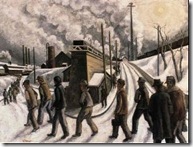
NightShiftAliquippa6

[This is a lightly edited selection of a thread of letters over several recent months debating 'Bring the Troops Home' in the main newspaper of Beaver County, PA. Situated on the border of West Virginia and Ohio, in 1960 it was noted as the most 'blue-collar' county in all of the U.S. It still is in many ways, although now it is the poster child for unstrained globalized deindustrialization. Many of its mill towns are now nearly ghost towns, which has done wonders for the environment, but has taken its toll on the people. As the last letter notes, the County is solidly against the war, but not necessarily for the same reasons as a college town. I have my home base here now, and jump into the debate about a third of the way down --CarlD ]

Bringing the Troops Home

Lonzie Cox - Thursday, December 27, 2007 7:15 AM EST

In March 2006, The Times printed a letter from an officer who was writing from Camp Victory Iraq.  He was writing to express his feelings toward those of us who were against the invasion of Iraq and would go so far as to demonstrate against the resulting war.

He felt that not supporting the war was the same as not supporting the troops.

I responded that the best way to support the troops was to bring them home safely as soon as possible.Last week, I saw a letter to the editor from him and noticed he's back home from Iraq.  Great.  That's all anyone wants - to get the troops home and the war over.

+++ SWV wrote on Dec 27, 2007 8:38 AM:

" We all want the troops home and the war won.  Unfortunately, Iraq is only one battle in the war on terror.  It won't be over for many, many years.  "

+++ Gary Seevers wrote on Dec 27, 2007 8:49 AM:

" I agree!  It's time to bring home the troops!!  The U.S cannot win this war!  Iraq is infested with Muslim terrorists!  It will never end.  If the U.S kills 5,000 terrorists, there will be 5,000 more coming at them!  If the U.S kills bin Laden, someone else just as wicked will take his place.  It's a never ending war!  BRING THEM HOME

+++ LMAO wrote on Dec 27, 2007 9:23 AM:

" Gary Seevers,  go hide from your fears and those you feel you can not beat.  Your defeatist attitude demonstrates why you probably have achieved so little in life.  If it is too hard for you your probably quit and run.  I am guessing your parents made excuses for you everytime things got tuff for you as a kid.  Now and more importantly you have probably created coward children that you probably make excuses for, and teach them it is easier to run and hide from things that are too tuff to take on.  What a baby.  If I was your kid I would be ashamed but fortunately I am not, I simply see you as a coward.  "

+++ Gulf War Vet wrote on Dec 27, 2007 11:52 AM:

" Bring the troops home after crushing the insurgents and organized terrorism?  Absolutely.  Bring them home before that, and the war will come home with them.  "

+++ Ron wrote on Dec 27, 2007 3:17 PM:

" Ok Mr Democrat a little history: WWII FDR (Democratic) began our involvement in that war by attacking Germany, Germany did not attack us, Japan did.  Truman(Democratic) ended that war and began another in Korea.  North Korea never attacked us.
John Kennedy(Democratic) began our involvement in Vietnam, Johnson turned it into an unmanageable mess.  North Vietnam never attacked us.  Clinton(Democratic) began our conflict in Bosnia, Bosnia Never attacked us. Janet Reno(Democratic) spent far more time liberating the Branch Davidian Compound in Waco that the 3rd ID did to take Iraq.  George Bush took less time to liberate two countries that it took Hilary Clinton to find financial records pertaining to her involvement in the Rose Law Firm. So when you want to point fingers,  look in the mirror and the finger is pointed back at you.  "

+++ Tommy S.  wrote on Dec 28, 2007 1:19 AM:
" Bring them home and don't stop there, bring ALL the US troops home from every foreign country and shut down the bases there.  Our involvement overseas gets us into trouble and its bankrupting us.  Our government is too big, too expensive and too dangerous.  "

+++ Rich wrote on Dec 28, 2007 3:29 AM:
" This blog has become infested with deranged Righty cranks since the new format was started.  There were Righty cranks on here before the change for sure, and they were wacky enough, but these new guys seem positively delusional.  By the way Ron, for your info Hitler declared war on America.  Read up on it sometime.  And are you referring to the day that idiot stood on the aircraft carrier and declared "Mission Accomplished" as the day he won the Iraq war?  Shame on you schmuck.  "

+++ James Lucci wrote on Dec 28, 2007 1:05 PM:
" Way to go Cox, keep spouting the party line.  I guess during the Cold War, your motto was better Red and than dead.  We all want to see our troops home but we want them to be victorious.  I believe the surge is in Iraq is working although you don't know it by the media reporting and we need to give Gen Petreous a chance.  I understand that Iran has cut back on the terrorists they were supporting.  I also believe there are troops now returing.  Thepictures I see on local TV when a unit comes home is one of gladness and never have I heard an interviewee say anything bad about the war.  In fact, since the army raised the age limit, I have an acquaintance who is a preacher that has applied for a commission to go to Iraq as a chaplain and his family supports him.  How much longer do you think the Vietnam war last ed thanks to the efforts of Hanoi Jane, Kerry, et al?  "

+++ Digger wrote on Dec 29, 2007 2:52 AM:
" Enlistment in our selective service is way down since the war began.  Our soldiers have not openly disgraced this war because it is their duty to serve our country.  I disagree with the involvement of our troops in this unjustified war declared by a fruitcake who falsified his facts.  I do not see any of you supporting our veteran's claimants demanding full medical benefits for your veteran.  As diligently as you so claim to be why are you not demanding your president & congress issue full medical insurance policies for life to our veterans?  No guts but love the glory as long as you don't have to fight.  I've supported full medical from day one; an excellent savings for any employer to hire a VET.  They are fighting for our freedom; it is the least we can demand our politicians give back.  The fruitcake attempting to show how knowledgeable he was in history: Japan attacked Pearl Harbor on December 7, 1941, Roosevelt answered the attack with his "a date which will live in infamy" speech and a formal declaration of war.  Germany then declared war on us not us on Germany.  "

+++ Russ wrote on Dec 29, 2007 12:40 PM:

Rich: RE: " This blog has become infested with deranged Righty cranks..." - to you, EVERYONE who doesn't accept every word of yours as Gospel is a neo-Con, Dittohead, etc., even if their only crime is NOT hating Bush as much as you do.  RE: "And are you referring to the day that idiot stood on the aircraft carrier and declared "Mission Accomplished" as the day he won the Iraq war?" - The original mission, driving Saddam from power, WAS accomplished.  The new mission began when al Quaida started the civil war, by blowing up Shiite and Sunni mosques to turn the rival factions against each other.  Neither Bush nor anyone else were prepared for that, which was a big mistake.  RE: " Shame on you schmuck." - I see you haven't lost your flair for name-calling in lieu of actual debating skills.  Happy new year!  "

+++ Carl Davidson wrote on Dec 30, 2007 10:00 AM:
" 'Victory' is Iraq is a delusion, held by Bush and the NeoCons, to justify a war for oil.

The bin Laden crew entered Iraq AFTER us, to torment both the people there and our troops.  The people of Iraq can deal with them, but AFTER we leave.  And we can deal with the criminal enterprise of theocratic terrorism best through global collective security, not endless 'wars on terror' that produce the opposite of their proclaimed aim.

The longer we stay, the worse is will get and the harder we'll fall.  Bush has sold enough lies; don't buy any more.  Bring all the troops home now.  "

+++ Duke wrote on Dec 30, 2007 10:23 PM:
" I laugh at these "patriotic" Republicans waving their Chi-com made American flags saying they support the troops.  If Republicans really do support the troops then they would demand a draft to give those serving a needed break from that hell hole.


But asked why no member of their family is serving, they'll say "but my child has a good job." Yes, in a Republican's eyes, serving in the military has nothing to do with obligation or duty to one's country, but an employment opportunity for the middle class.


Yea, Republicans support the boys over there, but not one would be good enough to date their daughter.  "

+++ Rich wrote on Dec 31, 2007 11:23 AM:
" Russ.  You must have lost track of the sequence of official lies put out by Bush and the Neocons to excuse their pointless, preventable war.  The "Original Mission" as you call it, wasn't specifically to topple Saddam; the original reason they gave for the invasion was that Iraq had WMD's and nuclear materials and had ties to el Qaida, and that there was no alternative but to invade immediately.  It wasn't until after the invasion, when those reasons were found to be untrue and had actually been fabricated by the Bush administration, that they decided the actual reason we invaded was to rescue the Iraqis from a ruthless dictator and to spread democracy. 

That's been pretty much the standard operating procedure of this administration; to lie, then blunder, then lie your way out of the blunder.  If Bushies like you and Ron are going to persist in defending that indefensible buffoon for the damage he's done to this country, at least try to get basic historical facts straight.  And don't complain when you earn only contempt from others for your dogged devotion to the worst president in US history.  Happy New Year.  "

+++ Jonathan wrote on Jan 2, 2008 10:43 AM:
" AMEN Big Dah...The DUMBOCRATS can't accept the fact that the Iraq war is going good and success is being seen.  They will bash Bush for everything under the sun.  This war will go down as one of the biggest successes' this country has ever had.  These dumbocrats won't say 2 cents when their dumbocrat leaders like Onorato [local pol] solves problems by raising taxes instead of controlling spending.  i.e.  drink tax and rental car tax.  Typical liberal policies tax and spend, tax and spend and tax and spend.  Wake up you DUMBOcrats "

+++ Russ wrote on Jan 3, 2008 4:30 PM:
" Rich - I stand by my statement.  The "Original Mission" WAS to topple Saddam.  The RATIONAL behind the mission was the WMD threat, which pretty much everyone agreed was real (including the Clintons, Kerry, Kennedy, Biden, etc.).  France, Russia, the UK and the UN concurred, based on their separate intelligence (are you going to accuse Bush of doctoring THEIR intel too?).  Saddam had WMD, and used them to massacre the Kurds and Iranians.  It was NOT up to us to prove he still had them - IAW the '91 cease-fire terms that HE agreed to, it was up to HIM to prove he'd destroyed them.  Meanwhile, while it's true the Shiites and Sunnis have had bad blood for eons, work on a power and revenue-sharing deal among them and the Kurds was underway until al Qaida successfully ignited the civil war with their bombings (remember when they started, how Sunni and Shiite leaders appealed to followers NOT to react with violence?).  Finally (one more time), people might take your "Daily Kos" opinions more seriously if you'd quit calling everyone who disagrees with you a "Bushie"!  "

+++ Carl Davidson wrote on Jan 3, 2008 6:51 PM:
" Russ, how do you prove you don't have something?

The bottom line is you can't.

'Proof' of a negative is practically impossible, especially if its of a fact, as in 'the WMD could have been taken elsewhere, and hidden anywhere on the planet...and so on, which we've all heard.

Listen to Alan Greenspan if you don't believe me.  This war is about oil, and the strategic control of the proceeds from it.  All the convoluted analysis you present is beside the point.

If it was about going after the perpetrators of 9/11, we'd have a completely different policy focused on the Afghan-Pakistan border region, but our macho bigwigs are rather impotent there, since the Pakistanis have nukes.

No, the invasion of Iraq was a big Neocon diversion, and, thank goodness, most people now see through it.  Bring all our troops home now.  "

+++ Russ wrote on Jan 3, 2008 9:04 PM:
" Carl - Great letter with great points!  You're a far better debater than Rich, who presumes anyone who dares defend Bush is a "Bush lover" (hey, I sometimes defend the Clintons too; does that make me a "Clinton lover"?).  Anyway, I agree with Greenspan's comments, specifically his later ones to clarify the one you cited: it IS largely about oil, and the need to keep control of it from those who hate us.  Imagine if Hugo Chavez were appointed Prime Minister of OPEC, or if al Qaida toppled the Saudi royal family.  We'd be in a world of hurt, and Rich would be blaming Bush (who you'd think was running for re-election, to hear some of these Democratic presidential candidates!).  As for bringing the troops home now, they probably would've been home months ago if al Qaida hadn't started their bombing campaign.  If they were smart they would've laid low until we left, THEN started their rein of terror.  As for the current high oil prices, which even OPEC wants to be lower (more long-term profits for them), we seem to be at the mercy of weasel Commodities speculators.  Cheers!  "

+++ Russ wrote on Jan 3, 2008 9:22 PM:
" Carl - Regarding "proving we don't have something", that's easy.  Russia and the US having been doing it for years, as part of our bilateral dismantling of our nukes and chemical weapons under supervision of inspectors.  All Saddam had to do was cooperate with the UN inspectors and he'd still likely be in power.  Instead he played his stupid shell games, trying to show the Arab world he was still the Big Man there.  He very possibly DID destroy the WMDs (which would've been easy for him to prove), but he still wanted Iran and the other neighbors to fear and respect him (per his alleged confession during his final incarceration).  In the end his bluff cost him his sons' and his own life, and cost us thousands of Coalition military members and untold Iraqi civilian lives.  Still, if al Qaida hadn't thrown their monkey wrench into the works, our troops would pretty much all be home, thousands of lives would've been spared and Iraqi oil revenues would be rebuilding the country (let's NOT get into Halliburton, please!).  Cheers!  "

+++ Carl Davidson wrote on Jan 4, 2008 9:09 AM:
" Russ, you forget that the inspectors concluded there was no evidence of continuing WMDs, and that invasion was unwarranted, Ask Hans Blitz or Scott Ritter, or read their books.

As for al-Qaeda, I think they want us there.  They came in afterwards, to wage 'the war of the flea' against us, using our troops for training, target practice and propaganda purposes.  They don't have much support in Iraq otherwise.  If we leave, the Iraqis themselves will be in a better position to toss them out.

That's why this war has been such a disaster.  It's never had a 'just cause', which means, in the Islamic world at least, a world of 1.2 billion people, the just cause is seen as resisting us, and bin Laden and his crew win that political point, even with any ups and downs on the battlefield.

If you think these guys are losing, just look at Pakistan, and ask what happens if their allies come to power their.  Once that was a remote possibility, now not so remote.

And I'm not the only one making these points.  One former top CIA guy, tossed by Bush, did so in Foreign Affairs recently.  "

+++ Gary wrote on Jan 4, 2008 9:12 AM:
" LMAO, Everyone knows the United States can't win the war in Iraq.  Do you realize how hard it is to go into someone else's land and try to defeat the bad guy?  American soldiers are committing suicide just to escape this misery George W.  Bush has created.  If you think it is bad now..  Just wait until the United States gets involved with Iran.  Then we are heading for a whole new trouble.  And the war would not follow us home if we had tighter boarder security!!!  Start with (A) before you go to (B) "

+++ Rich wrote on Jan 4, 2008 9:16 AM:
" Anyone reading this blog who still wonders if there's any doubt that Bush's invasion of Iraq was a terrible mistake should Google the title "Iraq war timeline".  You'll find accounts from a wide variety of news and media sources which all tell the same basic story; that Bush rushed us into an unnecessary, preventable war.  Russ.  You ignore too many hard facts while drawing your revisionist picture of events. 

The UN weapons inspectors said in early March 2003 that they would need a few more months to confirm that Iraq had no WMD's, which would rule out the need for an invasion.  Bush used the absurd excuse that it would be too hot for the troops if we waited until summer to invade.  As for the chaos that ensued post-invasion, it's well known that Bush ignored the General's advice that a much larger US force would be needed.  With no plan by the US in place to consolidate a military victory, Iraq fell into rioting and mob rule.  The idea that everything was coming up roses until el Qaida showed up is ridiculous.  PS.  Anyone who supports or excuses Bush gets my contempt, not a debate.  "

+++ RR wrote on Jan 7, 2008 9:26 AM:
" One of the biggest decisions Bush got right was going on the offense against terrorism.  Every one of the current Republican presidential candidates give Bush credit for going on the offense against terrorists except for Ron Paul who is really a Libertarian.  When terrorists attack the U.S.  they can expect a response.  No President is perfect as there was some mismanagement and not enough troops initially but Bush adjusted and now conditions have improved dramatically in Iraq and our troops will come home victorious.  We have had no further attacks on U.S soil since 911.  The best defense is a good offense and Bush got that right.  "

+++ Russ wrote on Jan 8, 2008 1:19 PM:
" Rich - Anyone can Google "Iraq war timeline" and find revised timelines to support both our viewpoints - just pick and choose.  My position is based on following events in real time, as they happened during my former day job (where I had a vested interest in the outcome).  RE: your comment "Anyone who supports or excuses Bush gets my contempt, not a debate." - Please re-read the Comment Rules below.  This is a DEBATE forum, not a CONTEMPT forum.  I recommend you check three of my favorite far-Left sites, 'Daily Kos', 'Huffington Post' and 'Democratic Underground'.  There you'll find many people like yourself, united by a blinding hatred of Bush that renders them incapable of any objective reasoning.  There's more bile and hatred there than ANYTHING I've ever heard from Limbaugh, Coulter or Savage!  My favorite line from one DU poster: 'Even if (Bush) finds a cure for cancer I'll still hate him!'.  Meanwhile, to CPT Matt - Thanks, and may God be with you and your colleagues!  "

+++ Russ wrote on Jan 8, 2008 1:30 PM:
" Carl - I HAVE read Hans Blix and Scott Ritter, with all their self-contradictions.  I remember being especially baffled by Ritter's abrupt 180-degree reversal, until it was revealed he'd accepted $400,000 in laundered Iraqi 'Oil for Food' money.  It's obvious you and I will always disagree on this topic, but at least we agree we want the troops back ASAP.  The only difference is if we do it "your" way, the terrorists can once again claim the drove us out (as in Lebanon and Somalia), and all our troops would've died in vain.  Let's not give up just yet - I've got too many friends still over there who want to win this thing, without having their hands tied behind their backs by politicians!  "

+++ Rich wrote on Jan 8, 2008 5:09 PM:
" Russ.  Any US president who sends this country into a preventable war deserves to be hated, and should be held accountable for committing such an offense.  Our troops started dying in vain the day Bush sent them into that quagmire with a bad plan, inadequate equipment, and no justifiable reason for being there.  Leaving them there now, still in harms way, doesn't justify anything.  As for your claim of having a position based on actual events, I'd like to know which events those were.  They couldn't include anything about the reasons Bush gave for his blunder, which all turned out to be lies.
Concerning your displeasure with my lack of civility when dealing with people like you...  too bad.  You enable that abomination with your support of his crimes, and deserve the contempt you get.  "

+++ Carl Davidson wrote on Jan 8, 2008 8:46 PM:
" You make my point, Russ, that it's impossible to prove a negative, since you believe even the inspectors can't be trusted, Ritter or Blix.

But you have an assumption that you would do well to question, that our military is omnipotent, ie, it can win any war, any time any place -- so long as it's not stabbed in the back by politicians.

I'm looking at things differently.  Everyone has their limits, including our military.  That's why is important that the politicians use them wisely, in self-defense and for a just cause.  Bush squandered them for an unjust cause that had nothing to do with self-defense, and we're still paying the price.  A positive outcome in Iraq is the Iraqi peoples' national independence and their control of their own wealth, including their oil.  As long as that's not our goal--and it's not, read the oil law we're trying to impose on them--there is no victory to be had.  That's why we need to yank them out now, before it gets worse, and dump the bill on the politicians who really sold us out and stabbed our troops in the back, Bush, the Neocons and their oil buddies.  "

+++ Rich wrote on Jan 8, 2008 10:51 PM:
" Russ.  Thanks for sparing me any more of your disjointed reasoning and cockeyed rationale for condoning Bush's blunder.  You must have applied that same style of thought to your last comment, seeing my comment as somehow proving your point.  Yikes!  Anyhow… FYI.  I did two tours in Vietnam, so you can also spare me the snotty remarks about who did or didn't serve their country.  "

+++ Russ wrote on Jan 9, 2008 9:49 AM:
" Rich - First, I stand corrected.  My apologies, and kudos for your service!  Second, why do you have so much trouble understanding that I've been trying to help you gain some credibility around here, instead of being branded a "troll" (someone who refuses to participate in civilized debate, and engages in name-calling and verbal grenade-tossing instead)?  Also, you consistently call anyone who remotely defends ANYTHING Bush (who I have major issues with, BTW) does a "Bushie" or "Bush Lover". 

Okay - Clinton defied the UN and dragged NATO into Bosnia.  Millions around the globe took to the streets, calling Clinton a tyrant and chanting "Death to America".  Our troops died, and many are still there.  It turns out the "genocide" numbers were WAY overstated, and that the real motivation might have been poll numbers (a "Wag the Dog" scenario).  Yet after some initial skepticism (as with Iraq), I ultimately concluded our going into Bosnia was a "just" cause.  Now, does this make me a "Clinton lover" deserving of your contempt?  Or are all of your opinions affected by your seething hatred of Bush?  "

+++ SSgt Aaron P.  wrote on Jan 9, 2008 7:10 PM:
" I am a Staff Sergeant of Marines and a three time Iraqi War Veteran.  Personal opinions are personal opinions, but I have walked by a war protest in my uniform and.....believe me, they are definitely against the troops.  Most of them are either hippies who miss the 60's or wannabe hippy kids that wish they were born early enough to burn a flag and spit on a troop.  I want us to all come home when the job is over, and judging by my last tour to Western Iraq it will not be too much longer.  Then what will the Democrats cry about when we win?  "

+++ Rich wrote on Jan 9, 2008 9:45 PM:
" To Russ.  No need to apologize to me because I happen to be a veteran.  Any negative feedback I get on here for my caustic approach is deserved.  As far as engaging in a civil discussion with those who still agree with Bush about his war… or anything else about his presidency, there's no point.  We are polarized, period.  There are 70% of us who see him as the worst president in US history and can't stand the sight of him, and the other 30% of you who apparently are blind to reality.  I figure calling names makes sense under these circumstances.

To Staff Sgt Aaron P.  You got it way wrong if you think your welcome home from the Iraq war in any way resembles what Vietnam vets got in the sixties.  I see only praise, gratitude, and positive attitudes from all sides, both pro-war and anti-war, concerning returning troops.  Stop complaining about those who want to see this unnecessary war brought to an end and your fellow Marines returned home safely.  Find out that your real enemies are those who sent you into harm's way for no good reason.
"

+++ Carl Davidson wrote on Jan 12, 2008 8:17 AM:
" To SSgt Aaron: You'll find all sorts of people, including Iraq vets and Vietnam vets, at antiwar protests.  At the last vigil at the Beaver Courthouse, we had 'Vets for Peace' there, but not one hippy, unfortunately, since they're welcome, too.

By the way, no antiwar hippy, or anyone else, ever spit on any returning GI in the 1960s.  It's a right wing myth, an urban legend.  A friend of mine, the national chair of Vietnam Vets vs the War, has offered $500 out of his own pocket to any vet who will tell him when and where he was spat upon.  He's done this countless times on mass media, and never had a taker.  Just think about it--when returning, where did the GIs actually disembark from, and wasn't the first thing they did was to jump into their civvies?

Military families are an important part of this antiwar movement.  They hate the lies even more than the rest of us.  People understand service and sacrifice for a just cause, but for control of oil?  "

+++ AOL wrote on Jan 12, 2008 10:51 PM:
" I have a nephew who is currently serving his 2nd tour in Iraq.  He is a Sergeant for the Army.  He himself has said that this war is a waste.  But is we are going to bring the troops home..  we need to bring them ALL home.  Leaving minimal troops there will be like signing their death warrant.  He has told us stories...  and some are pretty gruesome.  He stated to us several times how him and his army buddies HATE Bush and feel they are fighting a loosing battle.  However he said he will do the job that he was sent there to do.  We are VERY PROUD of our SOLDIER....  I hope they ALL come home...  I feel we are making the Iraqi's madder the longer we stay.  We can stay there for another 100 years and the war will still not have been won.  Come on guys...The Iraq's did not cause 9-11.  Bin Laden did...  he is an Iranian.  So WTF...  Bush is making good on the promise he made to his dad.  Something he couldn't finish himself.  "

+++ Majority rules wrote on Jan 13, 2008 9:42 PM:
" This is not a military state.  The majority of Americans want the troops home now.  Case closed.  "

Read more!

GoStats web counter