


Early textile mill with women workers
INDUSTRY ON THE BACKS OF SLAVES. Returning to our journey through the remarkable book, 'The Half Has Never Been Told,' we turned to Chapter Nine, entitled 'Backs.'
The author once again draws us to his main theme: the development of capitalism in the US is best understood as proceeding on the backs of slaves and the backs of ethnically cleansed Native peoples of the West. He challenges and undermines the more common story of capitalism developing with a self-contained free-labor North, while the South was a sluggish and disconnected backwater.
The industries that first expanded in the North were ship building to move cotton and slaves to market, iron and metal working to supply tools to the slave labor camps, and finally, textile mills to weave cotton into cloth here, rather than to have to supply the slaves and others with clothing imported from England.
The author gives two simple examples of a hoe and an axe, the metal part of them. Move 200,000 slaves to the Deep South and Southwest, and you have to put a tool in their hands. Where do the axe heads come from? From the rapid expansion of iron works in Connecticut. Likewise with the guns of the overseers and slave catchers, soon to be followed by iron steam engines, both for the textile mills and the new railroads to move cotton and other goods to markets more readily. All of this was mainly driven from the demands for tools come from the vast clearing and plowing of land for the cotton plantations. What was happening in the North was driven mainly from the South.
The growth of new industries to supply slavery was rapid. In 1850, 500,000 Americans labored in manufacturing. In ten years, it was 1.2 million. Immigrant labor poured in from Europe, 1.5 million in the 1840s alone.
But the author's argument is not undialectical. Once an industrial power arose in the North, it acquired its own 'sectional interests' that contended with slave capital. In the level of politics, this would be played out in the ongoing tug-of-war over whether new states and territories would be 'free' or 'slave.'
This began making waves with the 'Wilmot Proviso,' a measure attached to a bill concluding the Mexican War, by Pennsylvania Congressman David Wilmot, that none of the territories acquired in the war would be open to slavery, thus following in the earlier pattern of the Northwest Ordinance.
The measure was stymied, but the long debate over it factionalized the two major parties, the Whigs and the Democrats. The Whigs started with two factions, 'Cotton Whigs' and 'Conscience Whigs', and grew into more. The Democrats at first gathered into the 'Barnburners' of Martin Van Buren and the 'Hunkers,' siding with the slave Democrats in the South. These tensions would grow even greater and into more factions and parties in the period ahead. More to come.
Read more!
Wednesday, February 25, 2015
‘The Half Has Never Been Told’ Comment Eight


Friday, May 09, 2014
Jackson Rising: An Electoral Battle Unleashes a Merger of Black Power, the Solidarity Economy and Wider Democracy

Photo: Closing session of Jackson Rising
By Carl Davidson
SolidarityEconomy.net
Jackson,MS - Nearly 500 people turned out over the May 2-4, 2014 weekend for the ‘Jackson Rising’ conference in Jackson, Mississippi. It was a highly successful and intensive exploration of Black power, the solidarity economy and the possibilities unleashed for democratic change when radicals win urban elections.
The gathering drew urban workers and rural farmers, youth and the elderly, students and teachers, men and women. At least half were people of color. About 50 were from the city of Jackson itself, and most were from other Southern states. But a good deal came from across the country, from New York to the Bay area, and a few from other countries—Quebec, South Africa, Venezuela and Zimbabwe.
The major sponsors included Malcolm X Grassroots Movement, the Federation of Southern Cooperatives, Praxis Project, Southern Grassroots Economies Project, US Solidarity Economy Network, and the US Social Forum. Funding came from Community Aid and Development, Inc., Mississippi Association of Cooperatives, Coalition for a Prosperous Mississippi, Fund for Democratic Communities, Ford Foundation, Wallace Action Fund, Surdna Foundation, and the Rosa Luxemburg Foundation.
But to grasp the meaning and significance of this meeting, a step back to see how it began—and why it almost didn’t happen—is required.
The conference was the brainchild of Jackson’s late Mayor Chokwe Lumumba and one group of his close supporters, the Malcolm X Grassroots Movement (MXGM) soon after he was elected on June 4, 2013 and had placed his people in a few key city positions. They had initiated the conference, which was then endorsed by the city council, to help shape and economic development plan for the city and the outlying Black majority rural areas, known as the ‘Kush.’--hence the name of the overall project, the ‘Jackson-Kush Plan.’
Chokwe Lumumba was rooted in the Black revolutionary organization, the Republic of New Afrika (RNA), which claimed the Black majority areas of several states in the Deep South. He was one of its leading members, and a widely respected civil rights attorney. The RNA also had an economic outlook, a form of cooperative economics through the building of ‘New Communities’—named after the concept of ‘Ujamaa’, a Swahili word for ‘extended family,’ promoted by former Tanzanian President Julius Nyerere. The new mayor connected this core idea with the long-standing role of cooperatives in African American history, the experience of the Mondragon coops in Spain, and the solidarity economy movement that had emerged and spread from the Third World in recent decades. Together, all these ideas merged in the mayor’s project, ‘Cooperation Jackson.’
Lumumba’s election had taken Jackson’s political elite off guard. Making use of the Mississippi Freedom Democratic Party to run as an independent in the Democratic primary, he defeated the incumbent and forced a runoff. Given that Jackson is an 80% Black city, he then won overwhelmingly. So when he died suddenly of heart failure Feb 25, 2014, with his supporters in a state of shock, his opposition moved quickly to counterattack. The MXGM, the Peoples Assembly and other pro-Chokwe groups now had two tasks, trying to get Chokwe’s son, Chokwe Antar Lumumba, elected mayor while continuing to plan the conference, but with city support on hold.
Lumumba, 31 years old, lost to Tony Yarber, 46% to 54%. Chokwe Antar received over 65% of the Black vote, but the turnout had dropped. The Yarber team immediately moved to fire all the Choke sympathizers from city government, and tried to sabotage the conference. Local rightwing web publications attacked it as “thinly veiled communism.”
A Tale of Two Cities
What is behind this antagonism? Jackson is indeed a tale of two cities, on the cusp of two competing visions. Given its demographics, any mayor is likely to be Black, but what that can mean is another matter. Just driving around the city gives you a quick glimpse of the problem. While the largest city in the state and the Capitol, replete with major government buildings, the city is eerily quiet and empty. There are a few upscale areas, but also large areas of older, wood-framed housing of the unemployed and the working poor. There are huge fairgrounds, but little in the way of basic industry.
So two paths emerged. One was neoliberal, and aimed at exporting as much of the Black poor as possible, in order to open up wider areas from gentrification attracting the better-paid servants of the businesses that served government. The other was progressive, the Jackson Cooperation plan, which aimed at growing new worker-owned businesses and new housing coops that worked in tandem with the Black farmers of the ‘Kush.’ It also stressed democratized city services, while creating new alternative energy and recycling startups and also taking advantage of the city’s position as a major regional transport hub. It’s a conflict not unique to Jackson and shared by many cities around the country. Here’s the four points summing up ‘Cooperation Jackson’:
- Cooperation Jackson is establishing an educational arm to spread the word in their communities about the distinct advantages and exciting possibilities of mutual uplift that business cooperatives offer.
- When Mayor Chokwe Lumumba was still in office, Cooperation Jackson planned to establish a “cooperative incubator.” providing a range of startup services for cooperative enterprises. Absent support from the mayor’s office, some MXGM activists observed, a lot of these coops will have to be born and nurtured in the cold.
- Cooperation Jackson aims to form a local federation of cooperatives to share information and resources and to ensure that the cooperatives follow democratic principles of self-management that empower their workers. We’ve always said “free the land,” observed one MXGM activist. Now we want to “free the labor” as well.
- Finally Cooperation Jackson intends to establish a financial institution to assist in providing credit and capital to cooperatives.
The conference project thus found itself in the eye of a storm. But with luck and some judicious tactics, one key figure, Jackson State University President Carolyn Meyers, decided to stick with MXGM and allowed the conference to continue its plans on her campus, using the huge Walter Patton Center and two classroom buildings. A last minute fundraising blitz pulled in enough resources to squeeze through and make it happen.

Opening plenary: John Zippert, Jessica Gordon Nembhard, Ed Whitfield, Kali Akuno
When the hundreds of registered participants poured into the huge hall Friday evening and saw it filling up, one could sense the excitement and rising spirit of solidarity amidst diversity. The opening plenary keynote speakers included Jessica Gordon Nembhard of the US Solidarity Economy Network (SEN), Wendell Paris of the Federation of Southern Coops (FSC) Land Assistance fund, Cornelius Blanding, Special Projects Director of the FSC, Ed Whitfield of the Southern Grassroots Economies Project based in North Carolina, and Kali Akuno of Jackson’s MXGM.
Gordon-Nembhard started off. A professor at John Jay College in New York, she recently published Collective Courage: A History of African American Cooperative Economic Thought and Practice, a groundbreaking study on the topic.
“Courage is a word I had to use,’ she explained. ‘Everywhere I turned, from the early efforts of free Blacks to buy others in their family out of slavery, to the Underground Railroad, to burial societies and other clandestine forms of mutual aid; it took courage to motivate all these cooperative forms of resistance to slavery and white supremacy, from the beginning down to our own times.”
She gave the example of Fannie Lou Hamer in the battles in Mississippi in the 1960s, well known as a founder of the Mississippi Freedom Democratic Party. “But do we know her as a coop member, a group that sustained her when she was denied an income. As Ms. Hamer put it, ‘Until we control our own food, land, and housing, we can't be truly empowered.’”
Wendell Paris who, as a young SNCC worker mentored by Ms. Hamer, continued the theme: “Land is the basis for revolution and it is important for us to hold on to our land base." He described the workings of the Panola Land Buyers Association in Sumpter County Alabama. “Freedom isn’t free. In the training to run coops successfully, you learn more than growing cucumbers. You learn organizing and administration, the training ground for taking political offices.”
At different times during introductions, or even in the remarks of speakers, the chant, ‘Free the Land!’ would rise from the participants, accompanied by raised fists. This came from the RNA tradition, referring to an older battle cry of self-determination for the Black areas of the Deep South. It clearly still had resonance, and was often followed with ‘By Any Means Necessary!’
The opening session was closed out by comments from Ed Whitfield and Kali Akuno. “All successful enterprises produce a surplus,” said Whitefield, "and our empowerment runs through retaking the surplus we have created, and putting it to uses that best serve us. We're not here making excuses. We're here making history. As long as we accept the current economic structures and approaches to development that flow from those structures and paradigms, we can’t get out of bondage.”

But the municipal battle, Akuno concluded, would be difficult, given the neoliberal, repressive and pro-gentrification policies of the new team in charge.
All the items presented by the opening speakers expressed the common theme of the conference organizers—Political power in the hands of the Black masses and their allies, then anchoring and using that power to shape and grow a cooperative economic democracy that would serve the vast majority. It was both a tribute to Chokwe Lumumba and an expression of his vision. Winning it, however, would not come easy.
The next day, Saturday, was a different story. Here space was opened up for more than 30 diverse workshops, spread out over three time slots, with two more plenary sessions. Topics included the influence of Mondragon, community land trusts, Black workers and the AFL-CIO, the communes in Venezuela, mapping the solidarity economy, coops on a global scale, waste management and recycling, working with legislatures, and many more. No one report can cover them all, but here’s the flavor of a few.
Mondragon and the Union Coop Model.
What were the nuts and bolts of Spain’s Mondragon Coops (MCC), and how could unions serve as allies in creating similar enterprises in the U.S.? This was the question posed at an excellent workshop with three presenters: Michael Peck, the U.S. representative of Mondragon; Kristen Barker of the Cincinnati Union Coop Initiative; and Dennis Olson, of the United Food and Commercial Workers.
Peck began with a brief overview of MCC and its 120 coops and their accomplishments. The key point: In MCC, workers own their labor, but rent their capital, rather than the other way around. “But sometimes," he noted, "you can tell more about something by look at one of its failures than all its successes."
He was referring to the fact that a major MCC coop, FAGOR, which made kitchen appliances, recently closed down. “The housing market in Spain and Europe collapsed, and without new homes, new appliance sales sink Plus there was tough price competition from Asia.” MCC had carried FAGOR for several years, but could no longer justify it. Despite anger, “the vote of the workers to close it was unanimous.” In the regular world, the workers would get their pink slips, and be on the street.
But Mondragon was different. “MCC first set up a solidarity fund with every worker donating 1.5% of their salary, adding up to some 15 million Euros,” he explained. “This was to cushion the transition. Then it worked to reassign all the FAGOR workers to other coops, which it has now accomplished for the large majority.” Peck added that Mondragon would continued creating new coops both in Spain and around the world, and the true test was not that some would eventually close, which was natural, but what happened when they did.

Kristen Barker, right, at Our Harvest Coop
Kristen Barker then gave the workshop an enthusiastic account of how a small group in Cincinnati, armed with only a few good ideas, had over four years moved to a point where three substantial coops were opening in the city and several more were in the works.
“We were really inspired when we heard of the agreement between Mondragon and the United Steelworkers,” said Barker. “Our effort also stands on the shoulders of the Evergreen Coops in Cleveland. To date, Evergreen has launched three co-ops, Evergreen Laundry, Ohio Cooperative Solar that offers energy retrofits and solar panel installation, and Green City Growers that grows high end lettuce for hotels and restaurants in Cleveland. They have dozens of potential cooperatives in the pipeline. We are partnering with the major players of this initiative including the Ohio Employee Ownership Center for our unique project."
The first three coops in Cincinnati, Barker added, were Sustainergy, a building trades coop to retrofit buildings to better environmental standards; the Cincinnati Railway Manufacturing Cooperative, which will make undercarriages for rail cars, and partnered with both the United Steel Workers and the local NAACP; and Our Harvest, a food hub coop which starts with local farms and takes their produce to a central site for packaging and marketing. It’s partnered with the UFCW union and other agricultural groups. Dennis Olson explained how the UFCW was particular helpful in connecting growers through the distribution centers to the unionized grocery chains, as opposed to Wal-Mart.
“We only had a small study group to start—some community organizers, some Catholic nuns, a few union people,” concluded Barker. “But we did a lot of research, made partners and got the word out in the media. Soon we had more people calling with more ideas, like coop grocery stores in ‘food desert’ areas, jewelry makers’ coops and so on. We started getting some interest from the city, and now things are taking off.”
Starting Coops in Jackson and the ‘Kush’
This session was chaired by John Zippert of the Federation of Southern Cooperatives. He started with an excellent short summary of ‘Cooperatives 101,’ but quickly turned to drawing out the workshop participants on their concerns. Most were Black women from Jackson—one was interested in whether an African hair care products and services was possible; another wanted to start a coop of home health care workers. One man from Memphis said he had a small business distributing African products to small Black stores in the surrounding states, but he was getting on in years. How could he turn it into a coop that would live after him? Everyone shared ideas and legal options

“Well, I don’t do cotton anymore, not much cotton in Mississippi these days,” he explained. ‘I do many vegetables, and sweet potatoes are a good crop. But it’s one thing for a farmer to grow and dig sweet potatoes. It’s quite another to have the equipment to scrub them, cut them into French fires, and then bag and store them, while getting them quickly to your markets. That’s where the value of the coop comes in. We can pool our resources for these things, and it makes a big difference. We’d be in bad shape without the coop.”
Waste Management, Recycling and City Politics
The politicss of garbage was the main topic here. Chaired by Kali Akuno, this workshop gave the most insight into what was going on in Jackson as a new and backward regime was replacing that of Chokwe Lumumba. “Waste Management serves the city poorly,” said Akuno. “It often ignores our neighborhoods. It does no recycling; it dumps the waste in a landfill in a small city to the North of here, gives them a payment, and that’s the end of it.”
Akuno explained they had a different plan. Since a large part of the city budgets deal with services like these, they wanted to break them into smaller pieces so local contractors or coops could bid on them, then recycle the waste into a revenue stream. In addition to helping the environment and employment, it would keep the money circulating locally.
“Another piece was setting up an incubator to foster the development of cooperatives,” Akuno added. “The government can’t run the co-ops. It won’t build them, but it can set the table. For most of the past 20 years, even though there has been a succession of black mayors, 90-95 percent of contracts to people who don’t live in Jackson. It was all about hiring people in Jackson.”
“Now everything is going to be a fight,’ he added. “Even if your plan is reasonable and sustainable, it won’t matter if it’s stepping on the wrong toes.”
Saturday also included two mealtime plenary sessions, one, at lunch, featuring the diverse organizations taking part, and the other, at dinner, giving everything an international dimension.
The lunch plenary included Omar Freilla of Green Workers Cooperatives, Steve Dubb of the Democracy Collaborative, Michael Peck of Mondragon USA, Ricky Maclin of New Era Windows, and Saladin Muhhamad of Black Workers for Justice and MaryBe McMillian, Secretary Treasurer of the North Carolina AFL-CIO.
“Community cooperatives,” said Steve Dubb, “can be considered part of a long civil rights movement that fights for both racial and economic justice. For example, Dr. Martin Luther King in the last year of his life helped launch the Poor People’s Campaign for an Economic Bill of Rights. The return of cooperatives to the movement, as illustrated by what’s happening here, is a welcome development.”
MaryBe McMillian stressed the importance both of labor and the concentration of forces in the South. “Why organize in the South? Because what happens in the South affects the entire nation." Speaking for Black workers, Saladin Mummamad added, ‘We need power not just democracy; we need power that shapes what democracy looks like. When plants shut down workers, should seize control and turn them into cooperatives.”
The evening session started with a tribute to Chokwe Lumumba by his son, Chokwe Antar Lumumba. “We are victorious because we struggle. I'm not afraid of the term revolutionary. We need to be as revolutionary as the times require. Free the land! The struggle my father started is not over, but only beginning. It continues, by any means necessary.”
Also featured were Francoise Vermetter of Chantier in Quebec, Pierre LaLiberte on the International Labor Organization in Switzerland, Mazibuko Jara of AMandela! Magazine in south Africa, Elbart Vingwe, Organization of Collective Cooperative in Zimbabwe, Omar Sierra, Deputy Counsel General of Venezuela-Boston, and Janvieve Williams-Comrie, Green Worker Coops in the U.S.
"Freeing the land has given our people a new sense of belonging," said Omar Sierra, of Venezuela. “Chokwe Lumumba extended his solidarity to us in a time of need. Our people are saddened by his passing, and will not forget him.”
William Copeland, a cultural organizer from Detroit. Summed up the spirit of the crowd: “These presentations demonstrate the international significance of the Black Liberation Movement and Southern movement building.”
On Sunday morning, those who hadn’t had to leave early for the airport, gathered in a large session of the whole that closed out the weekend. One after another, people stood up and testified to how their consciousness had been altered by their discussions and new experiences over the weekend. Emily Kawano of the Solidarity Economy Network made the point of understanding that the projects ahead, while including coops also reached beyond them to other forms, such as participatory budgeting, public banks and alternative currencies. Finally, at an auspicious moment, an African American women rose and in a strong church choir voice, began singing an old civil rights anthem, “Organize, organize, organize!” Everyone was on their feet, hands clapping, fists raised, and interspersing ‘Free the Land! with the chorus. It couldn’t have had a better closing moment.
Read more!Friday, August 09, 2013
Digging In, Reaching Out…

Student and teachers from the Convention ‘School for Young People’
CCDS 7th Convention Debates Growth
of the Left and the Progressive Majority
in Combating Austerity, War and the Right
[This report was assembled by Carl Davidson, with considerable and valuable help from Cheryl Richards and Ellen Schwartz, our recorders. Others who added a lot were Janet Tucker, Harry Targ, Ted Reich, Pat Fry, Will Emmons, Randy Shannon, Anne Mitchell and Duncan McFarland. Photos by Ted Reich]
Nearly 100 delegates, observers and friends gathered in Pittsburgh, PA for the 7th Convention of the Committees of Correspondence for Democracy and Socialism over the July 18-21, 2013 weekend. The goals of the gathering were to take stock of the political battles since their last convention in 2009, to assess the organization’s strengths, weaknesses and ongoing challenges, and to chart a path of unity and struggle for the upcoming period.
The participants came from all sections of the country: from California to Florida, from Texas to Boston, and many points in between. Almost all were deeply embedded in mass struggles—trade unions and community organizations, women’s groups, civil rights organizations and peace and justice coalitions. Many had also taken part in a variety of independent electoral battles against the GOP and the right, and everyone had been in the streets during the battles against the wars, the Occupy upsurge and for justice in the Trayvon Martin case.
Kicking off the meeting was a “School for Young People.” That innovation started a day before the main sessions of the convention. The presence of 20 young activists—men and women, of several nationalities, fresh from many battles, especially in the South—added a dynamic quality to all the discussions for the entire weekend.
“We appreciated the steps CCDS has made to accept the need for youth leadership in the socialist left and progressive movements,” said Will Emmons of Kentucky. The students saw the school as a “good first start,” and looked forward to more and better efforts in overcoming the intergenerational divide in much of the socialist movement.
The convention itself was organized into five plenary sessions and 16 workshops, with a cultural event and dinner on Saturday evening. It opened for the youth school and other early arrivers Thursday evening with the showing of the new film, “Anne Braden: Southern Patriot,” an inspiring story of the battles of Anne Braden and her husband, Carl Braden of Kentucky, in decades of battles against white supremacy and other fronts in the class struggle across the South. Filmmaker Anne Lewis from Texas was on hand to lead a discussion that followed.
All the convention’s deliberations were organized around a “main resolution,” with the various plenaries and workshops dealing with its different sections. The five plenary topics were 1) assessing the concrete conditions, 2) the terrains of struggle against austerity, 3) the climate change crisis, 4) strategic formations and the progressive majority, and 5) the quest for left unity.
Time of Day: The Opening Plenary on Concrete Conditions

Williamson concluded by posing the most poignant questions to the delegates:
“What is the winning strategy to reduce the number of white working class people from voting against their own class interests, especially since fewer are unionized and fewer live in integrated communities? What will be the winning strategy to achieve left unity - and just what does that mean today? How can we build respect for youth in leadership of social justice movements while still showing simultaneous respect for elders? How do we fully move our thought and action from the multiracial unity ‘slogan’ to normalized, genuine demonstrations of respect for multiple cultures, gender expressions and sexual orientations? These questions--and more tough ones--need answers in order to chart the path forward in the quest for working class power. Let's work on them at this convention and thereafter.”
Read more!Monday, June 03, 2013
Carl Davidson’s Sessions at the Left Forum in NYC, June 7-9, Pace University
LEFT FORUM SESSIONS
WITH CARL DAVIDSON and his related groups—the Online University of the Left, Committees of Correspondence for Democracy and Socialism, and the Solidarity Economy Network
11 Talking Points on 21st Century Socialism
Session 3 E326 Sat 03:40pm - 05:20pm
A Slide Show presentation by Carl Davidson on the core features of socialism in today's world, followed by responses and discussion. Issues will include technology, human rights, the role of markets, mixed economies and strategic allies.
Sponsoring Journal:
Online University of the Left
Speakers: Carl Davidson, Committees of Correspondence for Democracy and Socialism; David Schwartzman, DC Statehood Green Party; Dario Cankovic, Northstar.org
--------------
Shift Change: potential and limits of worker cooperatives in building a sustainable future
Session 4 W615 Sat 05:30pm - 07:10pm
In SHIFT CHANGE, a new documentary that visits coops in the US and Mondragon, worker owners share some practical challenges of a democratic workplace, and how coops can help build a more just and sustainable society. Clips from the film will be shown, with comments from panelists, and discussion involving workshop participants about broad issues of economic democracy and a more ecological future.
Panelists include:
Gar Alperovitz, author, What Then Must We Do;
Carl Davidson, Solidarity Economy Network
Mark Dworkin & Melissa Young, filmmakers
---------------
Left Third Party Organizing: Challenges and Opportunities
Session 6 W211 Sun 12:00pm - 01:50pm
In an age of two-party domination and neoliberal hegemony, what opportunities exist for left electoral politics through third party campaigns? Why and when should leftists focus on third party campaigns, as opposed to Democratic Party primaries? Where should the left focus its electoral resources, and how might it overcome division? Should third-party politics be thought of in terms of consciousness-raising, or is the left in a position to affect public policy by taking power?
Sponsoring Journal:
The North Star
Seamus Whelan, Socialist Alternative
Tim Horras, Philly Socialists
Carl Davidson, CCDS
Ursula Rozum, Green Party
Thursday, May 02, 2013
Nearly 500 Celebrate May Day in Pittsburgh with a Colorful and Festive March and Rallies

By Carl Davidson
Beaver County Blue
Nearly 500 workers and community actvists marched through the streets of Pittsburgh's South Side May I celebrating the international workers holiday. The main theme of the event was linking a defense of worker's rights with immigrant rights, and backing the passage of a just and comprehensive immigration reform bill in Congress.
 'Everyone here is an immigrant or the sons and daughters of immigrants,' declared Leo Gerard, USW President, speaking from the back of a truck. 'We can't separate worker's rights and immigrant rights, they're one and the same.!
The main organizers of the celebration were Fight Back Pittsburgh and United Steel Workers Local 3657. The United Federation of Teachers, the United Electrical Workers, SEIU, IBEW, the USW's 'Women of Steel' and other unions also took part.
This was the first May Day event backed by Pittsburgh unions in some years, and it was also promoted nationally by Richard Trumka of the AFL-CIO. It marks the beginning of a more militant response by labor against austerity and in defense of wider democracy for all of its allies.

The day started with a rally at the UFT headquarters, followed by a mile-long march along Carson Street, ending with another rally, with music and food, at the IBEW headquarters.

Community organizers from One Pittsburgh and the resident groups also played an important role, bringing out Latinos, Middle Eastern and African immigrants. Activists from Beaver County’s Progressive Democrats of America, Beaver County Peace Links and Committees of Correspondence for Democracy and Socialism also took part.

Saturday, February 02, 2013
Short Answers Given Repeatedly Dept…
By Carl Davidson
“…The beginning of wisdom in economics is understanding that there is no such thing as a fully planned economy nor fully free markets.
Under socialism, we will have a mix of the two, until the length of the working day approaches zero and the amount of labor time in any given commodity approaches zero, ie, full cybernation. Then the conditions will exist for states, markets and classes, including the working class, to 'wither away.'
In the meantime, we do our best to apply intelligence in managing and living with them under the mixed transitional class society called socialism, the bridge between the current order and a classless society farther down the pike.”
Read more!Saturday, November 10, 2012
Lessons for 21st Century Socialism from Buddhism
Buddhism and ecology both refuse to separate the human and natural worlds – and demand that we act accordingly

Vultures at a Tibetan sky burial ritual in Dari county in northwest China's Qinghai province 27 November 2009. Photo by Alex Lee/epa/Corbis
By David P Barash
Aeon Magazine
Nov 5, 2012 - Once, while waiting for a wilderness permit at a ranger station in North Cascades National Park, Washington state, I overheard the following message, radioed into headquarters by a backcountry ranger: ‘Dead elk in upper Agnes Creek decomposing nicely. Over.’ This ranger was not only a practical and profound ecologist, she also possessed the wisdom of a Buddhist master. The ‘over’ in her communication seemed especially apt. For Buddhists, as for ecologists, all individual lives are eventually ‘over’, but their constituent parts continue ‘living’ pretty much for ever, in a kind of ongoing process of bio-geo-chemical reincarnation.
People who follow ecological thinking (including some of our hardest-headed scientists) might not realise that they are also embracing an ancient spiritual tradition. Many who espouse Buddhism — succumbing, perhaps, to its chic, Hollywood appeal — might not realise that they are also endorsing a world view with political implications that go beyond bumper stickers demanding a free Tibet.
Plenty of us recognise that Buddhist writings and teachings — especially in their Zen manifestation — celebrate the beauty and wisdom in the natural world. A monk asks a master: ‘How may I enter in the Way?’ The master points to a stream and responds: ‘Do you hear that torrent? There you may enter.’ Walking in the mountains, the master asks: ‘Do you smell the flowering laurel?’ The monk says he does. ‘Then,’ declares the master, ‘I have hidden nothing from you.’
Part of this sensitivity to nature is a Buddhist grasp of suffering, whose existence constitutes the first of Buddhism's Four Noble Truths. It is no coincidence that Henry David Thoreau, America's first great environmentalist, was also a student of Indian religion and the first translator of the ‘Lotus Sutra’ into English. In this classic teaching, Shakyamuni Buddha compares the ‘Dharma’ — the true nature of reality — to a soothing rain that nourishes all beings.
The pioneering ecologist Aldo Leopold wrote that to have an ecological conscience is to ‘live alone in a world of wounds’. The Buddha urged his followers to be sensitive to the suffering of all sentient beings. His First Precept is to commit oneself to ahimsa, or nonharming. The Mahayana Buddhist ideal is to go further, and to become a bodhisattva, an enlightened individual who vows to relieve the suffering of all beings. In the ‘Metta Sutta’, Theravada monks and lay adherents vow to practise loving kindness: ‘Even as a mother protects with her life her child, her only child, so with a boundless heart should one cherish all living beings.’ And here is the first verse of ‘The Bodhisattva Path’, by Shantideva, a revered eighth-century poet: ‘May I be the doctor and the medicine/And may I be the nurse/For all sick beings in the world/Until everyone is healed.’
For Buddhists and ecologists alike, we are all created from spare parts scavenged from the same cosmic junk-heap
Read more!Sunday, October 28, 2012
GOTV in Aliquippa: Walking with Walker
Tough times in Western PA’s Aliquippa
By Carl Davidson
I door-knocked on the streets of Aliquippa for getting out the vote yesterday, Saturday Oct 27. My walking partner was our new mayor, Rev. Dwan Walker.
People complain about discouragement and analyze every which way, but it looks different down here on the ground.

I wish I could say the same of some of my other friends and people I know. Let’s ‘get ‘er done,’ comrades and friends, then take it from there.
Read more!Tuesday, October 23, 2012
Pondering Strategy: The 4th Option
By Carl Davidson
Gregory Wilpert is an intellectual of the left now teaching political science at Brooklyn College, after some time spent in Venezuela. He recently wrote a long interesting piece on Z-Net about our electoral system, mentioning Bill Fletcher and myself in passing. He was perplexed as to finding a way forward, and spelled out these options:
In short, we could call these three positions about electoral politics, non-participation (or boycott), lesser evil voting (with or without Democratic party takeover), and third party voting.
Each of these three positions makes important points that are convincing and difficult to refute.
How can one counter the main argument of lesser-evil voting, that we have a moral obligation to prevent the worst from happening to the most oppressed? On the other hand, if that lesser evil is also involved in atrocities, as is all too often the case with the foreign policy of Democratic presidents, then wouldn’t lesser-evil voting perpetuate evil?
But doesn’t the solution of voting for a third party seems equally hopeless, since the third party candidate might just take votes from the marginally better candidate and enable the election of the even worse candidate? There seems to be no easy solution to this debate. One possible compromise solution has been to urge people to vote for the lesser evil in state where the races is close, but to vote for third party candidates in races where progressives are unlikely to make a difference in the outcome (a position that very many prominent U.S. progressives advocated in 2004 and in 2000).
Also, given that each side has convincing arguments, this helps explain why the progressive movement is so weak in the U.S.: the diversity and depth of conviction of attitudes towards electoral politics makes unity within the left nearly impossible.
What this strategy debate points to is precisely the undemocratic nature of the U.S. political system. This is the kind of debate you would expect to see in countries with profoundly dysfunctional democracies.
If the U.S. had a more democratic system, there would be a general consensus among progressives to participate in the democratic process. The reason you do not see this kind of debate in the democracies of Western Europe or of Latin America (at least not since the 1970’s in Western Europe and since the 1990’s in Latin America) is that these countries, by and large, have far more democratic political systems than the U.S. does.
I thought this was too restricted, and that there was a fourth option, and wrote this reply:
Wilpert does a fair job of summarizing the system, and I have no quarrel with his suggestions for reforms in the electoral system.
But I think there in a 4th option--the one I hold to. That is to build a 'party within a party' among Democratic voters at the base, much as PDA does, but not with the illusion that we are going to 'move the Democrats to the left.' I think Wilpert is right that this isn't very realistic Rather, the approach should be to build our strength in that context, along all the fault lines in the clusters and coalitions of forces under the Dem umbrella, until the whole thing implodes and shatters. The aim is to get rid of it, not reform it--but in a way that helps the left more than the right.
The precedent is what happened to the antebellum Whig party.
Then forces on the outside, our forces on the former 'inside,' and new emerging forces, can come together to make a new 'first' party.
Again, the precedent is the GOP, spurred by the Radical Republicans and base group tied to the First International, under Lincoln,
Of course capitalism today is not quite the same as in the crisis of the 1860s. Slavery will be replaced by finance capital, austerity and war as the organizing focus.
Others may have better ideas. If so, I'm all ears.
Feel free to post your two cents on the matter…
Read more!Monday, October 22, 2012
Beaver County and the ‘Cracker’ Debate
Potential site for major new ‘cracker’ plant near Monaca in Beaver County, PA
By Carl Davidson
Our county was was hit hard and early by globalization and the export of jobs. Our towns were largely formed around mills, and when the mills were closed in the 1980s, the towns were stressed to the extreme. Many workers moved away or retired, and those remaining in the towns themselves were largely poor and Black with few options.
Now with the new natural gas boom creating by dubious and dangerous deep underground ‘fracking’ explosions, Shell Oil wants to build a new 'ethylene cracker’ plant that turns natural gas into plastics. Fewer than 1000 people would work in the new $1.2 billion facility, but 10,000 people would be hired over five years to build it, and perhaps another 7000 more for new plastic manufacturing plants draw to be created alongside it.
For the county, it means two things. First, a complete turnaround for employment and new small business and new orders for the tube mill still running. Second, since hundreds of new ‘fracking’ gas wells would be needed to feed the ‘cracker,’ there is serious danger to the county’s water supply and many other health and environmental issues.
So we have a big ongoing debate. Are you for or against the ‘cracker.’ Are you opposed to fracking? Or do you just want to tax and regulate it? And what about clean and green energy?

Natural beauty of our townships soon to be ‘fracked.’
The issue keeps coming up in various forums, including our Beaver County Marcellus Awareness Committee page on Facebook. I had posted some pictures to it showing the natural beauty of our area, which led some to say it could all be ruined by the ‘cracker’. Here’s my brief reply:
'Beauty' looks one way out in the townships. But in the deindustrialized mill towns along the rivers, you see something else--the impact of joblessness is not so pretty. You have to view these things strategically, meaning the whole, not just the part, the future, not just the present, and who are the key engines of change as your allies, if not the unemployed and underemployed. In order to unite the many to defeat the few, you have to find ways to unite people who disagree on many things--no easy task, but it's demanded of us.
Query to me: Why haven't jobs come to Beaver County? The skilled left the area for better jobs and now the perfect storm. I do not know the percentages of skilled or college grads or even people who only have a high school diploma or just a GED in Beaver County.
CarlD: The lack of opportunity means we already have exported a good number of our youth, or at least those with options and prospects. We are demographically now one of the oldest counties, if not the oldest, even though we still have many distressed young people among us, under-employed and unemployed. We have the means to create skills--BCCC, Robert Morris, Geneva and Penn State Beaver--and we have done so.
But I know younger folks in my own family, educated, who have moved away for lack of new industry. For those remaining, the fracking jobs, the trucker jobs related to it and the construction jobs related to the 'cracker' are viewed by them as a Godsend, or potentially so.
Our task is first, to defend clean water, and second figure out a positive way to deal with this developing industry. I doubt that it's going to be stopped, but it can be modified and a share of the profits from it can be diverted toward green renewables in the longer run. The devil is in the details, of course, but I don't think we do well simply to avoid those details with an abolitionist stance not likely to get very far and likely to separate us from real friends. Even people working at building a 'cracker' have an interest in clean water…
Don’t look for this debate to be resolved easily. The opinion and suggestion box is now open! Feel free to comment.
Read more!Tuesday, August 14, 2012
What to Do in November, and Beyond
The 2012 Elections Have Little To Do With Obama's Record … Which Is Why We Are Voting For Him

The 2012 election will be one of the most polarized and critical elections in recent history.
By Bill Fletcher, Jr. and Carl Davidson
Progressive America Rising via Alternet.org
August 9, 2012 - Let’s cut to the chase. The November 2012 elections will be unlike anything that any of us can remember. It is not just that this will be a close election. It is also not just that the direction of Congress hangs in the balance. Rather, this will be one of the most polarized and critical elections in recent history.
Unfortunately what too few leftists and progressives have been prepared to accept is that the polarization is to a great extent centered on a revenge-seeking white supremacy; on race and the racial implications of the moves to the right in the US political system. It is also focused on a re-subjugation of women, harsh burdens on youth and the elderly, increased war dangers, and reaction all along the line for labor and the working class. No one on the left with any good sense should remain indifferent or stand idly by in the critical need to defeat Republicans this year.
U.S. Presidential elections are not what progressives want them to be.
A large segment of what we will call the ‘progressive forces’ in US politics approach US elections generally, and Presidential elections in particular, as if: (1) we have more power on the ground than we actually possess, and (2) the elections are about expressing our political outrage at the system. Both get us off on the wrong foot.
The US electoral system is among the most undemocratic on the planet. Constructed in a manner so as to guarantee an ongoing dominance of a two party duopoly, the US electoral universe largely aims at reducing so-called legitimate discussion to certain restricted parameters acceptable to the ruling circles of the country. Almost all progressive measures, such as Medicare for All or Full Employment, are simply declared ‘off the table.’ In that sense there is no surprise that the Democratic and Republican parties are both parties of the ruling circles, even though they are quite distinct within that sphere.
The nature of the US electoral system--and specifically the ballot restrictions and ‘winner-take-all’ rules within it--encourages or pressures various class fractions and demographic constituency groups to establish elite-dominated electoral coalitions. The Democratic and Republican parties are, in effect, electoral coalitions or party-blocs of this sort, unrecognizable in most of the known universe as political parties united around a program and a degree of discipline to be accountable to it. We may want and fight for another kind of system, but it would be foolish to develop strategy and tactics not based on the one we actually have.
Read more!Thursday, May 24, 2012
Introducing the Online University of the Left
 Check Out This Project And Prepare To Be Amazed!

By Carl Davidson
Keep On Keepin' On
Many people know the internet is full of instructional treasures for educating activists new to the left--and for the ongoing education of elder comrades as well.
One problem, however, is that these little gems are scattered far and wide, often in obscure places. It's a tedious task, even with Google and other research tools, to find and sort through them, making them handy and useful to key audiences.
Enter the `Online University of the Left,' a new `Left Unity' project initiated by the Committees of Correspondence for Democracy and Socialism. It's core orientation is Marxist, but it contains teaching resources reflecting the full range of views on the wider left. About 50 left academics are involved in the core group so far-Richard Wolff, David Schweickart, Rose Brewer, Tim Johnson, Gregory Morales, William Tabb, Ellen Schwartz, Jerry Harris, Linda Alcoff, Dana Cloud, Gar Alperovitz, to name a few.
One of the OUL's key aims is to solve this problem of scattered resources, creating a web portal that will bring much of this valuable material together in one spot in cyberspace. The link is http://ouleft.org, and you can also search for its Facebook page by name-and be sure to `like' it on Facebook, if you do. More `likes' expand the features available to it.

The core idea is that anyone with a smartphone, a laptop, a large computer screen or, best of all, a digital projector connected to any of these, can now run any mixture of hundreds of video lectures and documentary films on a wide range of topics. Whether for individuals, small groups or large classes, it offers a multimedia dimension to revolutionary education at no cost.
That's only the beginning. One marvelous feature will be the ability to hold lectures, classes and discussion groups in real time. The participants will be able to hear and see each other via video-conferencing, permitting back-and-forth dialogue. These can also be recorded, edited for improvement and added detailed, then preserved as on-line `webinars' for future repeated use. The OUL will likely charge a small fee, or require a low-cost subscription, however, for access to this particular feature.
This raises an important question: how will the OUL be sustained financially? For the moment, it's being supported by a small grant that will launch it and keep it going for a year or so. After, that, it will have to find or create a number of revenue streams to keep it rolls. One example is the subscriptions and fees for real-time events mentioned above. Another is the `Bookstore' tab, which connects the viewer to our `shelf' at Powell's, one of the country's major unionized booksellers. If you go to Powell's through this OUL link and purchase anything there, a small percentage in commission for the sale goes to the OUL.
The site is organized into academic departments-each with dozens of video lecture and documentaries, achieves with the entire range of theory and analysis of hundred of writers, and study guides and course outlines.
Make use of it! In the future, we will also pursue the usual package of fundraising efforts-donations, small and large, grant writing, public events, benefit dinners and so on. In the meantime, lend a hand by using the `Donate' button at http://cc-ds.org. Once again, check out the site itself at http://ouleft.org. If you want to link your own materials to it or make suggestions, contact Carl Davidson at carld717@gmail.com
Read more!Thursday, April 26, 2012
USW Report: A ‘Union Model’ Plans to Bring Worker Coops to the Ohio Valley

Michael Peck, Mondragon Cooperative delegate in North America, speaking at recent USW press conference in Pittsburgh
Steelworkers Announce 'Union Model' for
Bringing Worker-Owned Coops to the U.S.
By Carl Davidson
Beaver County Blue
The United Steel Workers and the Mondragon Cooperative Corporation-the largest industrial union in the U.S. and the world's largest network of worker-owned cooperatives respectively-held an upbeat press conference at USW headquarters in Pittsburgh March 26, announcing new progress in their innovative two-year-old partnership.
"For American workers, the traditional corporate model for organizing production and producing jobs has broken down," stated Tom Conway, USW International Vice-President for Administration. "It's simply not fair, and we're not afraid to try something different."
For those unfamiliar with Mondragon, 'something different' was inspired by the Steelworkers investigation into the Mondragon cooperatives (MCC) in Spain's Basque country. MCC is a 50-year-old thriving and ongoing experiment in radical democracy consisting of some 120 worker-owned cooperatives involving nearly 100,000 workers and allied with another 130 allied coops in the region, with revenues in 2011 of some $24 billion.
The MCC coops operate one the basis of one worker, one share, one vote-and no one outside MCC holds any shares. It is the leading edge of the Spanish industrial economy.
The USW took note of MCC after a successful effort with the cutting edge Spanish wind turbine firm, GAMESA, to build three innovation green energy factories in Pennsylvania. While not part of Mondragon, GAMESA and MCC shared a common representative in the U.S., Michael Peck, who then took a USW team to Spain to visit MCC.
Leo Gerard, the USW's president, has long been an advocate for a 'clean energy and green manufacturing industrial revolution' as a progressive way out of the current economic crisis. But given the conflicted and deadlocked Congress on such matters, little is being done on the matter trough traditional channels. Hence the turn toward the Mondragon partnership.
After the initial announcement of the joint effort in the fall of 2009, little was heard about any progress on the matter. Yesterday's press conference, however, revealed what was going on behind the curtains. There were three major projects underway.
The first was the production of 'Sustainable Jobs, Sustainable Communities: The Union Coop Model.'
Read more!Wednesday, February 01, 2012
Occupy Pittsburgh Teach-In: Feb 4

From Occupy Wall St. to Occupy the Hood:
Building Power for the 99%
Saturday, Feb 4, 2012
Start: 02/04/2012 12:00 pm
End: 02/04/2012 5:30 pm
Will be held at Community Empowerment Association Training & Culture Center, 7120 Kelly St. in Homewood (accessible by the 67, 69, 71C, and all East Busway (P) buses - www.portauthority.org)
Join Occupy Pittsburgh for our second teach-in, organized by the Occupy the Hood, People of Color and Education Work Groups.
We hope to bring together the social and economic justice community in Pittsburgh, from all neighborhoods, acitivist concentrations, backgrounds, life circumstances and political viewpoints. By speaking together and sharing experiences and insight, we hope to strengthen the community that the Occupy has caused to take shape - in all our diversity of experience.
12 Noon: Lunch
!2:30 pm: Opening Plenary: From Occupy Wall Street to Occupy the Hood: Building Power for the 99%
Speakers: Helen Gerhardt & Carl Redwood, facilitators: Guillermo Perez
Two Rounds of Workshops
1:45-3:15 p.m. - workshop session #1
3:15-3:30 p.m. - break
3:30-5:00 p.m. - workshop session #2
5:00-5:30 p.m. - group debrief
There will be at least 10 workshops. Half will be presented by the Occupy the Hood/People of Color Work Group and half by the Education Work Group
Workshop Session #1 (1:45-3:15)
1. Who are the 99%?
(facilitator: Nicholas Rushin)
This is a discussion about the workings of class, oppression and exploitation through a materialist and historical perspective. We are the 99% fighting against the 1%, but how do the 1% and the 99% get to be the 1% and 99%? Where does wealth come from and who creates it? How does class affect political struggles? And how is class different and similar to other forms of oppression like sex and race?
2. The Disparity & Education of Black Students
(facilitator: Vickki Ayanna Jones)
This workshop will recognize, develop & repair the damage that has been done to our children in the educational system & Black people in general.
3. Healthcare for the 99%: Ending Race-Based, Class-Based, All-for-Profit Care
(panelists: Scott Tyson, Physician, PUSH/ Healthcare4ALLPA; Ed Cloonan, Save Our Community Hospitals & Western Pennsylvania coalition for Single Payer; Sandra Fox, Western PA Coalition for Single Payer; Residents from Braddock and surrounding areas, Footage from Tony Buba, Save Our Community Hospitals)
This workshop will consist of film footage and a panel of speakers who will tell the story of how UPMC created race- and class-based barriers to health care with its demolition of Braddock Hospital and building of a surplus hospital for Monroeville. Speakers will also discuss how and why they fought back, from street theatre to a civil rights lawsuit. What are the roots of this problem in U.S. healthcare and what would alternative system look like?
4. Impact of Mass Incarceration
(facilitator: Khalid Raheem, president/CEO of the National Council for Urban Peace and Justice; Steering Committee member of the Formerly Incarcerated and Convicted Persons Movement; member of Occupy the Hood Pitstburgh)
This workshop will explore the prison industrial complex as it pertains to mass incarceration of black males.
5. Gentrification and Our Right to the City
(facilitator: Carl Redwood)
This workshop will share information about the Right to the City Alliance organizing against gentrification using an urban human rights framework. The workshop will explore the forces behind gentrification and provide historical context for the issues we face. Through discussion we will examine how gentrification has impacted our neighborhoods and help us begin to look beyond our current reality to envision the rights we are fighting for.
5. Bringing Occupy Pittsburgh to the Neighborhoods: Outreach Strategies and Initiatives
(NAMES, DESCRIPTION To Come)
Workshop Session #2 (3:30-5:00)
1. "Why Dismantle and Not Reform?" The Call of Occupy the Hood Pittsburgh
(facilitators: J.O. Yejide KMT & Bekezela Mguni)
This workshop will discuss why the Occupy movement needs radical approaches to change vs. reform of the current economic system in order to meet the needs of people of color and to ensure an equitable and humane future for all.
2. What are the Alternatives to Corporate Power?
(PANELISTS - Jackie Smith, Carl Davidson, etc)
So far the Occupy movement has helped draw public attention to what we're against, but what are the alternatives? This workshop will invite organizers from the region to present ideas that have been developed and tested in communities around the world to show that another world is possible. We will explore publicly-owned banks, community-supported agriculture; community currencies and barter systems; Davidson will present on the Mondragon co-operatives in Spain, and other forms of what is known as the "solidarity economy." Finally, campaigns that are working to counter corporate power to make room for community-based economic initiatives will be discussed.
3, Organizing within Marginalized Communities
(faciliators: Calvin Skinner & Kyndall Mason)
A workshop dedicated to successful strategies to do organizational outreach in marginalized communities with an emphasis on outreach to African-American and members of the LGBT communities.
4. Organized Labor & Occupy: Waging Class War on Two Fronts
(facilitators: Paul Le Blanc & Guillermo Perez)
Thanks to the Occupy movement, the issue of income and wealth disparity in the U.S. and the damage it's doing to our democracy are now front and center in the national discourse. Since its inception the Occupy movement has received considerable support from organizations affiliated with another national movement, organized labor. In this workshop we hope to engage union and Occupy activists in a discussion of how these two movements diverge and intersect and the ways we can work together to advance a common agenda.
5. Economic Disparities: Occupying Solutions for Black Communities
(Nazura Asaseyeduru)
This workshop will challenge the power structure of banks & government as it pertains to economic disparities for People of Color. Thus, participants will look at solutions in which Black communities have to be creative, innovative & self-determining.
Sponsors: Occupy the Hood (PghOccupythehood@riseup.net or call 412-244- 0298) &Occupy Pittsburgh (occupypittsburgh.org) and it'sPeople of Color & Education Working Groups
Read more!Saturday, December 17, 2011
Book Review - Revolutionary Youth and the New Working Class: Lost Writings of SDS
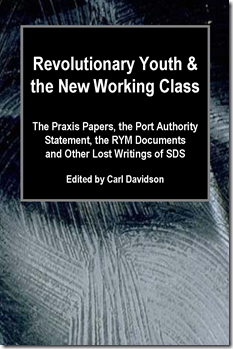
Pittsburgh PA, 2011
By Jerry Harris
Carl Davidson has done a tremendous service to anyone who studies the history of social movements or anyone interested in the 1960s rebellion. This "lost" collection of papers reveals the depth and richness of radical thinking coming out of the student movement as the war raged in Viet-Nam and militant protestors marched through the streets of America.
The most important document is the "Port Authority Statement," by SDS members David Gilbert, Robert Gottlieb and Gerry Tenney. Although at the time not widely circulated, it offers great insight into the thinking and analysis of SDS as it turned to revolutionary theory and debate. This is an impressive document. Detailed in statistical and economic analysis, grounded in revolutionary social theory, and innovative in its thinking and insights.
One of the most important sections of the paper was its class analysis with its focus on the new working class and the relationship of students to an economy shifting from manufacturing to services and technology. The documents notes that, "Modern American capitalism is characterized by rapid technological change with scientific knowledge growing at a logarithmic rate." This will result in the "elimination of unskilled labor (as) the blue-collar sector will decrease (and) jobs that require high degrees of education and training" will increase. (pages 88-89)
That analysis was made in 1966. Now read a recent article by Edward Luce from the Financial Times: "the middle-skilled jobs that once formed the ballast of the world’s wealthiest middle class are disappearing. They are being supplanted by relatively low-skilled (and low-paid) jobs that cannot be replaced either by new technology or by offshoring – such as home nursing and landscape gardening. Jobs are also being created for the highly skilled, notably in science, engineering and management. (12/11/11) Decades later the paper's main thesis still holds up.
Continuing its class analysis the Port Authority document examined the capitalist class and the debate over ownership and control. The authors focused attention on the growing trend towards paying executives with large stock rewards, merging management and ownership. Again we can turn to a recent article published in the December 2011 Monthly Review that reads, "More recently, David Harvey has argued that ownership (share holders) and management (CEOs) of capitalist enterprises have fused together, as upper management is increasingly paid with stock options." (Richard Peet) This "recent" argument now being made by a leading Marxist trails Port Authority by some 45 years.
Although the authors grasped the sweeping impact that technology would have on American workers, what they could not see would be globalization and the advent of neo-liberalism as a governing ideology. As the paper notes at the time, "Corporate liberalism implies that the dominant economic institution is the corporation and that the prevailing political and social mode is liberalism." (page 68) Of course it's understandable how such changes would be all but invisible in 1966; it's also a good reminder why political tactics and strategy must remain flexible and activists should always be willing to reevaluate their analysis.
The above are but a few of the enticing insights that are contained in page after page of these documents. As new social movements gather force throughout the world, a look into the thinking of activists from the last great social movement can help give direction to coming future battles. I would highly recommend this book to all activists and academics interesting in building a better world.
Jerry Harris, National Secretary of the Global Studies Association and author of "The Dialectics of Globalization."
Read more!Friday, September 16, 2011
New Book: ‘…The Lost Writings of SDS’

‘Revolutionary Youth and the New Working Class’ contains key sources illuminating a critical transition period in the American left, as well as a number of ideas still relevant.
Most important is the ‘Port Authority Statement’, actually titled ‘Toward a Theory of Social Change, and written by Robert Gottlieb, Gerry Tenney and David Gilbert. Passed around in mimeographed form, only about a third of it was ever put into print in SDS’s newspaper, until factional struggles set it aside. Meant to replace the Port Huron Statement, it is remarkable for many insights still holding up today.
The collection includes other ‘Praxis Papers,’ including three by Davidson, the Revolutionary Youth Movement documents that replied to the Weatherman faction, and the original ‘White Blindspot’ documents. About half the content has been scattered across the internet, but much of it has been newly digitized and now available in both e-book and paperback form from Changemaker Publications. Go to the site for the full contents, and contact the editor at carld717@gmail.com for bulk rates.
Read more!Wednesday, March 16, 2011
Mondragon as a Bridge to a New Socialism

Worker-owner in Mondragon coop factory
The Mondragon Cooperatives and 21st Century Socialism:
A Review of Five Books with Radical Critiques and New Ideas
From Mondragon to America:
Experiments in Community Economic Development
By Greg MacLeod
UCCB Press, 1997
The Myth of Mondragon:
Cooperatives, Politics and Working-Class Life in a Basque Town
By Sharryn Kasmir
State University of New York Press, 1996
Values at Work:
Employee Participation Meets Market Pressure at Mondragon
By George Cheney
Cornell University Press, 1999
Cooperation Works!
How People Are Using Cooperative Action
to Rebuild Communities and Revitalize the Economy
By E.G. Nadeau & David J. Thompson
Lone Oak Press, 1996
After Capitalism
By David Schweickart
Rowman & Littlefield, 2002
Reviewed by Carl Davidson
Something important for both socialist theory and working-class alternatives has been steadily growing in Spain’s Basque country over the past 50 years, and is now spreading slowly across Spain, Europe and the rest of the globe.
It’s an experiment, at once radical and practical, in how the working-class can become the masters of their workplaces and surrounding communities, growing steadily and successfully competing with the capitalism of the old order and laying the foundations of something new—it’s known as the Mondragon Cooperative Corporation (MCC).
Just what that ‘something new’ adds up to is often contested. Some see the experiment as a major new advance in a centuries-old cooperative tradition, while a few go further and see it as a contribution to a new socialism for our time. A few others see it both as clever refinement of capitalism and as a reformist diversion likely to fail. Still others see it as a ‘third way’ full of utopian promise simply to be replicated anywhere in whatever way makes sense to those concerned.
Read more!Tuesday, August 17, 2010
What To Do About Blue Dogs? Report from Beaver County PDA

How to Deal with the Blue Dog
and Still Defeat the Republicans—
PDA Breakfast Meeting Discusses the 2010 Election
by Carl Davidson
About 40 seasoned Progressive Democrat activists from the 4th CD gathered on Aug. 7 at the Candlelight Lounge in Economy, PA for a two-hour breakfast discussion. The hot topic of the day was the District’s Blue Dog Congressman, Jason Altmire, and what to do about him in the upcoming election and beyond.
It was not an easy question. The people in the buffet line putting tasty scrambled eggs, sausage and home fries on their plates were a cross section of Beaver County’s best political fighters—steelworkers, trade union organizers, African-American community leaders, retirees, postal and construction workers, teachers, social workers and day care workers, and a few candidates and local elected officials. Almost all of them had worked very hard four years ago to replace the GOP’s right-winger, Melissa Hart with Jason Altmire in Congress. While there was little naiveté about politicians in this dining room, they had still expected more from Altmire, especially given the distressed condition of the working class and small business in the area.
“We all know what we’re here for,” said Tina Shannon, the President of the 4th CD’s Progressive Democrats of America, as she opened the meeting. “Most important is we want everyone to speak their minds so we can figure out how to work together on this. The floor is open.”
Read more!Friday, August 13, 2010
Tuesday, July 13, 2010
Envisioning the Future, Fanning the Flames
15,000 Attend Detroit Social Forum:

High-Energy Gathering Fires Up
A New Generation of Activists in
U.S. Left and Social Movements
By Carl Davidson
When 15,000 vibrant and politically engaged people gather in one spot for five days and organize themselves into more than 1000 workshops, dozens of major plenaries and late night parties across five major cultural hot spots, no one article can claim to give a full account and get away with it.
But an event on that scale livened up Detroit, Michigan during the week of June 22-26 at the US Social Forum, when Cobo Hall and several nearby universities were buzzing with thousands of people trying to shape a new world.
I won’t even try to capture it all. I’ll just affirm the common conviction that it was a major happening on the left and a huge success, an inspiration and an affirmation of hope that progress is being made towards a better future. Then I’ll humbly offer my take on it. We’ll start with some highlights and, for those who aren’t familiar with the Social Forum movement, offer a few explanations.
The Forum started on June 22 with a massive march of thousands through the streets of a devastated and de-industrialized Detroit. “I’ve never seen anything like this, in Detroit or anywhere,” said Forum participant and Detroit resident Charnika Jett. “The sense of joy, support, and determination on the part of the people here, both Detroiters and visitors, is just incredible.”
“What an amazing day!” said Allison Flether Acosta of Jobs with Justice. “We held an orientation session for local coalition folks early in the day, then joined the march with the other members of the Inter-Alliance Dialogue and more than 10,000 people for a lively march through downtown! We ended at Cobo Hall, and then convened for the opening ceremonies.”
New entry of the Trade Unions

One important new addition to the young crowd in the streets was the participation of organized labor. According to the AFL-CIO News Blog, “Newly elected UAW President Bob King joined Metropolitan Detroit AFL-CIO President Saundra Williams; Al Garrett, president of AFSCME District Council 25; and Armando Robles, UE Local 1110 president, in leading a march and rally through the streets of Detroit. Chanting ‘Full and Fair Employment Now!’ and ‘Money for Jobs, Not for Banks!’ Participants demanded Congress address the pressing jobs emergency.”
The opening events, unfortunately, were either ignored or strangely spun by the mass media. “This ain’t no Tea Party,’ said Noel Finley, in a scarce account in the Detroit News, somewhat awed by the sight of it all. “The forum is a hootenanny of pinkos, environuts, peaceniks, Luddites, old hippies, Robin Hoods and urban hunters and gatherers.” Indeed it was, with even more variety. And the diverse crowds and meetings grew stronger as the week unfolded. To make sense of it all, some history and background is in order:
Read more!


