


[The editors--Carl Davidson, Jerry Harris, David Schweickart--are based in Chicago.]
If you haven't viewed SolidarityEconomy.Net recently, check out our new format and content.
It's interactive--you can comment of all articles. Latest articles include worker-controlled factories in Venezuela and Sy Hersh an others on growing war danger with Iran.
We're a 'think tank without walls' that brings a fresh approach to the left. Marxists who appreciate the market, the socialist market economy, a global perspective, the tradition of Bukharin, Gramsci, and Gorz, as well as the importance of the information revolution, will feel right at home. Others are likely to be intrigued, and bound to learn something new. solidarityeconomy.net
If you like what you see and want to help out, hit the 'donate' button
Carl Davidson, Chicago
http://solidarityeconomy.net
*****
19 Sep 2006
by Anonymous Poster
"Marxists who appreciate the market"
Isn't that an oxymoron?
Why bother calling yourselves Marxists?
Christians who appreciate Witchcraft
Anarchists who appreciate hierarchy
Sydicalists who appreciate Stalinism
Marxists who appreciate the Market
*****
19 Sep 2006
by Anonymous Poster
Anonymous: that's a misinterpretation of Marx, who viewed the market as a necessary step towards a better society. Moreover, Marx didn't have a problem with the market, persay, since the market is not a trait inherent to capital. It is perfectly plausible to see a socialist, cooperative - or maybe even a communist - society operating within market exchange (whereby supply and demand would still affect prices) while eschewing the exploitative exchange-relation between capital and labor.
*****
19 Sep 2006
by Carl Davidson
I agree with AP.
The Communist Manifesto starts off with an appreciation of how the market was transforming the world.
Besides, a careful reading of Marx reveals three markets: a labor market, a capital market, and a market in goods and services.
The market socialism we advocate does away with the labor and capital markets--workers runs their factories and divide the profits among themselves as they see fit, ie, no wages. Factories are leased and the payment is a capital assetts tax, then distributed to community-owned and run banks for grants to innovative or needed projects. The only old-fashioned buyer-seller market left is for comsumer goods, which is much more efficient, and even democratic, than a 'central plan.'
Read David Schweickart's 'After Capitalism' for detailed explanations.
Markets preceded capitalism and will be around for a good while afterwards. Prior to markets, plunder and pillage, and sometimes barter, were the main means of exchange. That's why markets are an achievement of human civilization, although certainly not the pinnacle or end. They persist as long as scarcity persist over abundance. When abundance is the norm, then markets, states, hierarchies, classes have the means to fade into history.
But if you abolish consumer markets now, under socialism or capitalism, you only do it a the point of a gun, a la Pol Pot or Stalin, and give birth to a 'black' market at the same time.
So, no it's not an oxymoron. A number of folks ASSERT that it is, but the assertions unravel with a little argument, reason and practice.
*****
by Kurt
Carl,
So you advocate 'doing away with the labor and capital markets' by nationalizing and collectivizing the means of production and distribution. Of course you are aware that this complete violation of property and individual rights can only take place by mob rule (as proposed by our anarchist friends) or state-sanctioned expropriation (as proposed by our Marxist friends). Both are exercises of violence that only and always lead to a radically inefficient, brutally corrupted and antagonizing central economy. Most of us want to keep an economic system based on private property rights, accumulation of wealth and voluntary exchanges of goods and services. Yet, there’s no contradiction with free-market Capitalism if a number of law-abiding individuals voluntarily merge capital and skills in order to form a collective (e.g. Kibbutz). In other words, try your social and economic engineering experiments on yourself, Carl.
See, I am not surprised that you advocate the elimination of capital and labor markets and, thus, replace demand and supply with fixed prices. Do you really think that the perpetually failing planned economy will finally work? Are you that naïve?
*****
20 Sep 2006
by Carl Davidson
Set aside the old mindset, Kurt. As they say where I come from, 'there's more than one way to skin a rabbit.'
First, enable and assist workers to take over abandoned factories, bankrupt factories, and factories seized for violations of the law or the tax code. You can get trucks and other capital equipment this way at the police pound auction every week, why not factories?
Second, assist worker coops in having first dibs buying out factories with aging owners with no successors, but no offspring interested in taking them over. You'd be surprised how many of these are out there.
Third, a huge portion of the Fortune 500 are already owned in large part by union pension funds, which, in turn, means, legally speaking, owned titulary by the workers themselves. Now a law transforming union pension fund ownership into public ownership with a proviso the firms be leased locally, with the workers that work them first in line--that's not too far a stretch, is it? Especially if a majority of stockholders approve it?
Finally, set an inheritance tax code whereby its more in an owners interest to have the workers buy him out than to pass it directly to his or her heirs.
Now when workers are owners, and divide profits among themselves, there's no wage labor, and hence, save for very minor things like hiring babysitters, no labor market. Now the lease payment for their factors--call it a capital assets tax--goes to locally publically owned banks , save that needed for national and global infrastructure, which even then is contracted locally. The principle of subsidiarty is employed. No centralized 'GOSPLANs', here, for sure, but captial markets are radically transformed.
But there's no 'fixed prices' at all, not even guidelines, for consumer goods. The workers at each firm charge what they think is best, and compete with other firms, worker-owned or otherwise.
Under Economic Democracy, Worker-owned factories sink or swim on their ability to hold market share, make a quality product that people want to buy, and keep happy customers. There's no 'they pretend to pay us, so we pretent to work.' But there's also no 'expand or die' pressure. Adding more workers to a firm to make more profit just means the profit pie is sliced into more slices-- no pressing reason to expand into 'Giantism' wrecking the environment.
Read the book, then tell me what you think.
Now, of course, these are options. Should an old-fashioned insurrectionary crisis be thrust upon us by fascist-minded warmongers who abandon the law and start a civil war against ordinary folks, then, as a matter of self-defense and survival, things may be resolved another, more direct way, where the old state order crumbles and a new one has to emerge with a 'radical rupture,' as the Old Mole warned.
But I'm sure you'd never resort to those sorts of law-breaking means to defend a dying order, would you?
The founders originally considered 'life, liberty and property' in the first draft, but wisely thought better to amend it, in the fnal draft, to 'life, liberty and the pursuit of happiness.'
Interesting foresight on their part, don't you think?
*****
20 Sep 2006
by Anon
I think the ParEcon's got ya both beat.
Side-note to Kurt - the planet is dying.
*****
21 Sep 2006
by Carl Davidson
To 'PareEcon' believers, go to either Z-Net, for the four part debate between Albert and Schweickart on PareEcon vs Economic Democracy, or read Schweickart's stuff on our site, and see if you still think the same way. Better yet, read 'After Capitalism' by Schweickart. Even if you don't agree with it, it's the one you have to deal with these days.
*****
21 Sep 2006
by Anonymous Poster
Carl, thank you for the clarifications.
"Of course you are aware that this complete violation of property and individual rights can only take place by mob rule (as proposed by our anarchist friends) or state-sanctioned expropriation (as proposed by our Marxist friends)."
Kurt you are such dweeb...
--end--
Read more!
Wednesday, September 27, 2006
Left 'Think Tank without Walls' -- Check out SolidarityEconomy.Net


Friday, September 15, 2006
Venezuela: A Bridge to the Socialist Market Economy?
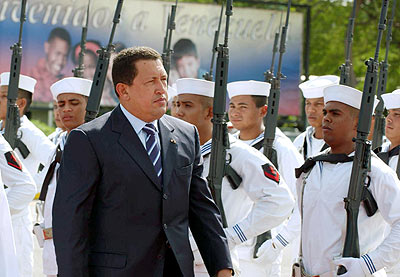
[The following article offers some practical insights into the 'Economic Democracy' theoretical model of market socialism presented in David Schweickart's book, 'After Capitalism.' For more info, go to www.solidarityeconomy.net --CarlD ]
Can the Bolivarian Process Achieve Socialism?
Five Worker-controlled Factories in Venezuela
Tuesday, Sep 05, 2006
By: Sharat G. Lin
Venezuelanalysis.com
Beyond the misiones and the Bolivarian process (el proceso Bolivariano) of empowering working people and the poor, two of the most significant initiatives of the Bolivarian revolution in Venezuela have been the restarting of closed factories under workers’ co-management with the state, and the rapid expansion of the cooperative sector of collectively-owned and collectively-operated enterprises. For it is these transitions in the social relations of production that will play a pivotal role in determining the future of the Venezuelan state – whether it develops along a capitalist, state capitalist, statist, socialist, or some as yet undetermined path. Case studies of five worker-controlled factories in Venezuela were presented in a documentary film by Dario Azzellini and Oliver Ressler, 5 Fábricas – Control Obrero en Venezuela (81 minutes, Spanish, 2006). While these factories illustrate some optimistic beginnings, it is necessary to view them in historical context in order to understand their socio-economic potential.
Historical background
President Hugo Chávez won his first election in December 1998 on the radical platform of his party, Movimiento Quinta República (Movement of the Fifth Republic, also commonly written Movimiento V República or MVR). In a 1999 referendum, voters approved a new constitution, renaming the country República Bolivariana de Venezuela. The election of 2000, re-elected Chávez and placed many members of the MVR into the National Assembly. At the grassroots level, supporters of the Bolivarian process organized themselves into open participatory assemblies called Círculos Bolivarianos (Bolivarian Circles).
However, Chávez faced fierce opposition from the private media (dominated by wealthy capitalist families), industrialists, bureaucrats in the oil industry, large landowners, and many shopkeepers and professionals (elements of the petty bourgeoisie). Government attempts in 2001 to assert more control over the state oil company, Petróleos de Venezuela, S.A. (PDVSA), led to a general work stoppage organized by the opposition in December 2001. This was followed by a coup attempt in April 2002 in which businessman Pedro Carmona Estanga proclaimed himself president of an interim government with the support of a section of the military, press, business community, and labor bureaucracy. Carmona was then president of the Venezuelan Federation of Chambers of Commerce (Federación de Cámaras y Asociaciones de Comercio y Producción de Venezuela, also known as Fedecámaras). Chávez was ousted from the presidential palace (Palacio de Miraflores) for two days until well over a million of his supporters stormed out of the barrios to surround the palace demanding his reinstatement. With the people’s backing, civil authorities, troops and palace guards loyal to Chávez reinstated him.
The traditional labor federation, Confederación de Trabajadores de Venezuela (CTV) has been considered to be the leading trade union body in the country. Claiming to represent over 1 million workers, CTV has consistently supported the opposition and opposition-led general strikes. In December 2002, CTV joined forces with Fedecámaras (!) to lead a prolonged anti-government strike in the oil industry from December 2002 to February 2003. The strike slashed oil exports, sending the country into a steep recession. A resolution of the crisis and end to violence was negotiated in May 2003 with the mediation of the Organization of American States (OAS), calling for a recall referendum on Chávez’s presidency. In August 2004, Chávez won the referendum with 59 per cent of the votes cast. While elements of the opposition and the U.S. government challenged the validity of the count, the OAS and the Carter Center certified the fairness of the vote. (Former U.S. president Jimmy Carter, one of hundreds independent foreign election observers, stated that in his opinion the vote in Venezuela was fairer than the voting process in Florida in the 2000 U.S. presidential election.)
The oil strike of 2002-2003 symbolized the quasi-class divide within PDVSA itself in which white collar professional employees largely supported the opposition strike to oust Chávez and blue collar workers largely supported him. While the Venezuelan economy suffered two successive years of disastrous 9 per cent declines in GDP in the years of the oil strike, a positive outcome of the turmoil was that the oil workers and government wrested control of PDVSA from the former opposition management. Some 18,000 executives and professionals out of PDVSA’s 46,000 employees were fired in the process for their role in the strike to bring down the economy and the government. But, the resulting new PDVSA has been substantially restructured and now provides nearly $4 billion in direct annual funding for social projects, bypassing the separate state programs funded indirectly by oil revenues.
In 2002 and 2003, it was acknowledged that the CTV leadership had received training and financial support from the U.S.’s National Endowment for Democracy (NED) through the AFL-CIO’s Solidarity Center, long known as conduits for U.S. government funding (mainly from USAID and State Department) with the objective of co-opting trade union bureaucrats in developing countries to collaborate with management by fostering 'skilful collective bargaining.' In 2000, a new trade union federation was formed, Frente Bolivariano de Trabajadores (FBT), and in 2003, the Unión Nacional de Trabajadores (UNT) was established. Over time, many unions have severed their ties to the CTV and affiliated with the UNT or the FBT. No longer held back by the CTV’s corrupt leadership and its ties to the old business elites, UNT- and FBT-affiliated workers were at last freed to demand their just labor rights and act in the interests of the working class and poor.
Until the August 2004 referendum, industrialists had hoped to unseat Chávez by one means or another. As it became clearer that each successive attempt was destined to fail, industrialists, businessmen, and wealthy landlords accelerated the flight of capital out of the country. One aspect was the draining of value from fixed capital assets by taking out oversized loans collateralized against those assets, ostensibly for reinvestment in factories, and then fleeing the country with the money in hand. Thus, the year 2004 saw an upsurge in industrial bankruptcies with owners seeking to close down 'sick' factories and idle thousands of workers. This flight of capital continues to accounts for the 10-20 per cent differential between the official exchange rate valuation of the Venezuelan currency, the Bolívar, and its black market value, despite an economy that grew at a healthy 8.3 per cent in 2005 and rising foreign exchange reserves ($31 billion at the end of 2005) bolstered by elevated crude oil prices.
With the Bolivarian government seeking to develop '21st century socialism', it offered financial support to workers willing to organize into cooperatives. Recognizing that restarting idle factories could generate new jobs and add to national output, in July 2005, Hugo Chávez announced in his weekly television program, Aló Presidente, that 136 closed factories were to be evaluated for possible expropriation. However, the ambient economic system remained overwhelmingly capitalist, and the relations of exchange remained fully market capitalist. In this context, Chávez recognized the need to work within the legal framework of the constitution and bourgeois law in order to maintain continuity of production and avoid a collapse in private investment. Article 115 of the Constitution of the Bolivarian Republic of Venezuela guarantees the right to property, but allows for expropriation by the state only for reasons of public benefit or social interest and only with timely payment of just compensation. Thus, although labelled as 'expropiación', seizure of private capital without compensation and defaulting on private bank loans was not supported by the government. Instead, the state served to negotiate terms of transfer, typically putting up a major share of the capital with which to pay off external debts and restart production, and mandated the transfer of full legal title to workers’ cooperatives. Under worker-state 'co-management' schemes, it was understood that the state will gradually reduce its equity share as revenues from factory production would enable workers to collectively increase their share capital over time.
Although the term 'cooperativa' is more widely used than 'colectivo' in Venezuela, it is generally associated with de facto workers’ control and statutory workers’ ownership. Thus, it implies a collective in Marxist terminology, rather than merely a cooperative of shared efforts, facilities, and resources. These worker-controlled factories provide some insight into the actual functioning of the Bolivarian process in the incremental transformation of the social relations of production.
Alcasa (Aluminio del Caroní, S.A.)
Ciudad Guayana, Estado Bolívar
Alcasa was founded on 14 October 1967 as a state enterprise. It produces aluminium by operating a carbon plant, foundry plant, and rolling mill employing 2700 workers. In 2004, Alcasa was reorganized as a worker-controlled cooperative under a scheme of cogestión ('co-management') with the Venezuelan government. The state share of the ownership will decline over time as the workers’ cooperative generates the revenue to increase its equity share in the company. The workers’ cooperative is part of a larger umbrella cooperative that operates primarily in the mining and metellugical industries – Corporación Venezolana de Guayana.
Carlos Lanz is president of Alcasa. In an interview in one of the films by Dario Azzellini and Oliver Ressler, Lanz says that he is the only employee who does not come from among the workers of the company. Rather, he represents the state, being on loan from the Venezuelan central government to Alcasa to help ensure a smooth and successful transition from bureaucratic state ownership to workers’ co-management. This is understandable from the standpoint of the Venezuelan government, since the success of the transition in such a large enterprise will inevitably have a demonstration effect, positive or negative, on future attempts to transform capitalist and state capitalist relations of production into a collective socialist ones.
Lanz demonstrates clarity in his understanding of the mode of production. He says that in the Soviet Union, industries, farms, and other enterprises were nationalized, but management did not pass on to the workers. (Here he refers to the 1930s, not the workers’ seizures of factories and the subsequent establishment of workers’ soviets after the 1917 Bolshevik Revolution.) He calls this 'state capitalism' or 'bureaucrat capitalism'. He, thus, differentiates worker co-management ('socialism from below') from the top-down Soviet model consolidated during the Stalin period. He further acknowledges the challenges of creating nuclei of '21st century socialism' within the context of a capitalism mode of production in Venezuela and in the world.
Caigua, C.A.
Altagracia de Orituco, Estado Guárico
When the private management of this small factory lost interest in running it, the company fell into arrears in payment of wages. When the workers learned that management was planning to sell off the remaining raw materials – tomato pulp – stored in the factory, the workers demanded to take over the plant. The government supported this transition financially and by facilitating the paperwork for legalization of the transfer of title. On 7 July 2005, control and ownership was handed over to the workers’ cooperative under a co-management scheme. The factory produces bottled tomato ketchup under the brand name Guárico and employs 58 workers. Its products are sold through the state distribution system for poor families, Misión Mercal through its extensive network of Mercal food stores.
Invepal (Industria Venezolana Endógena de Papel)
Morón, Estado Carabobo
Formerly the privately-owned paper company Venepal, the company had been in financial difficulty since the late 1990s. Conflict with the workers and the government sharpened when management joined in the oil industry shutdown in 2002-2003. But the resulting losses only worsened Venepal’s financial condition until it declared bankruptcy in 2004, and laid off its 900 workers in September of that year. However, 350 workers stayed on, demanding to take over operation of the factory and threatening to occupy it if the government did not take action.
In January 2005, with an injection of $7 million in state funding, a new worker-owned company was formed with the slogan 'hecho en Venezuela'. Named as the Venezuelan Endogenous Paper Industry (Invepal), the new company sought to replace wood pulp imported from Chile with entirely domestic raw materials from the Venezuelan states of Anzoátegui and Monagas. This was part of the material component of a national program of desarrollo endógeno (endogenous development). [The social component of desarrollo endógeno has been the encouragement of open participatory democracy from below in the running of all local organizations and collective enterprises.] The 350 workers of Invepal restarted production in March 2005, producing white copy paper and paper notebooks.
But more importantly, Invepal will be co-managed by a joint team of workers and state representatives. Initial equity ownership was divided between workers (51%) and the Venezuelan state (49%). Revenues from production would be used by the workers to gradually buy out the state’s share until the state retained only a symbolic 1 per cent 'golden' share. Guidance in setting up a cooperative under worker ownership and worker management was being provided by joining the umbrella Cooperativa Venezolana de Industria de Pulpa y Papel (Covinpa).
Following the concept of 'empresas de producción social' (factories of social production), Invepal feeds many poor local school children in the company cafeteria and supports community development projects that are not otherwise funded by government programs. In other words, the surplus value of production is directed not into retained profits, but rather into social use value for the benefit of the local community.
Recently, however, there have been controversies over Invepal’s moves to hire temporary contract workers without admitting them into the cooperative. This underlines some of the challenges of operating a collective enterprise in the context of a market-oriented capitalist economy.
Cacao Agro-industria
Península de Paria, Estado Sucre
This enterprise was reportedly the first to be converted to workers’ control in the Bolivarian process. It produces chocolate liquor which is sold as chocolate butter and chocolate non-fat solids to manufacturers of finished chocolate products. It includes a laboratory for testing the quality of incoming raw materials and outgoing products.
The cooperative actually consists of two member cooperatives. Unión de Productores de Cacao (Uproca) consists of 3600 cacao cultivators. Chocomar operates the factory with 96 workers. Each member cooperative elects 16 members to a joint 32-member assembly. Each also elects 4 members to a joint 8-member management team that coordinates day-to-day operations. All workers participate in the general body meetings to discuss long range plans and policies. One agreed-upon long-range plan is to gear up for production of finished chocolate products, such as chocolate pastries, bons bons, and chocolate candies.
Textileros del Táchira
San Cristóbal, Estado Táchira
Formerly a privately-owned capitalist enterprise, the former owners looted the company with bad debts until it went into bankruptcy in 2004. In order to save the factory and their jobs, the workers organized into a cooperative to reopen the factory in 2005. The factory performs cotton spinning and weaving, and employs 118 workers. All workers, no matter what position or skills they hold in the factory, earn the same salary. The company uses a portion of the revenues to provide social benefits directly to the community.
Can socialism be achieved in Venezuela through the Bolivarian process?
The first three years of Hugo Chávez’s presidency, 1999-2001, were mainly preoccupied with consolidating political power in the face of a resentful opposition that had become accustomed to its historical monopoly over political power. The general strike of December 2002 – February 2003 marked a watershed by paving the way for workers to struggle for control of productive forces and take over factories in the wake of the Bolivarian coup in PDVSA management. According to the agency charged with promoting and registering cooperatives, the Superintendencia Nacional de Cooperativas (SUNACOOP), while there were 877 registered cooperatives before 1999, only 127 new cooperatives were formed in 1999 and 2000. In 2001-2002, growth of the cooperative sector resumed with the formation of 3,434 new cooperatives. From 2003 to June 2006, it accelerated with the establishment of 127,143 new cooperatives. Thus, between 2001 and 2006, the number of state-worker co-managed enterprises and production collectives grew from a negligible percentage to approximately 6 per cent of the total labor force of 12.3 million (2005 estimate). Taking collective and state enterprises together, enterprises potentially conforming to a socialist mode of production still engage only a small fraction – less than 10 per cent – of the workforce. The economic significance of this sector is magnified by PDVSA, which alone accounts for on the order of one-third of GDP (depending on the fluctuating international price of crude oil), but its contribution to employment remains modest. Thus, the ambient mode of production in Venezuela remains overwhelmingly privately-owned businesses, dominated economically by capitalist enterprises. The relevant questions are several.
First, while worker co-managed factories may be viable in a growing economy, will they remain competitive in times of economic contraction in the context of an ambient capitalist mode of production? When the rules of exchange are driven by market forces of supply, demand, and manipulations of access to technology and finance by the much larger capitalist sector, the deck could easily be stacked against socialist enterprises. The counterweight to capitalist technology and finance is, of course, the political and legal authority and financial clout of the Bolivarian state. But the prospects for future transitions to socialist production will depend in part on the success of the current collective experiments and their long-run economic viability. Already internal conflicts within and between some cooperatives threaten to derail development of the cooperative sector. But no transition in anything so fundamental as the ownership and control of the means of production has ever been smooth and without conflict. One factor that may work in Venezuela’s favor is that there is no hurry to convert capitalist enterprises to workers’ control, so there will be time to work out the wrinkles in the cooperative sector.
Second, to what extent will the trend of conversions of capitalist enterprises into worker co-managed enterprises continue? As a section of industrialists had decided to jump ship in the face of the rising tide of the Bolivarian process, the remaining industrialists consisted of those who chose to stay and defend their companies, maintaining their viability. Without resort to forced expropriations of private enterprises, the availability of sick industries that may become subject to worker occupation is levelling off. On the other hand, a new violent confrontation between Chavistas and opposition forces could provide a pretext for more industrialists to flee the country with all of their liquid and liquidatible assets. Another such confrontation is probably inevitable, given that the Bolivarian process tolerates incremental change over an indefinite period of time, and given that the social contradictions inherent in a situation of dual power (capitalist economic infrastructure versus worker-based political superstructure) are ultimately unsustainable.
Third, while Washington has critically tolerated a Bolivarian government in Caracas, unlike the economic boycott and travel ban that it has relentlessly imposed on socialist Cuba, further incremental movement towards a socialist mode of production could harden Bush administration policy as it tries to reassert the Monroe Doctrine in its 'backyard'. Is there a threshold beyond which Washington will no longer tolerate Chávez and will seek extra-economic means to arrest the Bolivarian process? If U.S.-sponsored coup attempts continue to fail, and Chávez continues to seek alliances with the staunchest adversaries of U.S. imperialism, the Bush administration will become more likely to refuse to rule out pre-emptive military 'options'. Nevertheless, Venezuela holds the oil card that Cuba never possessed as a lever on U.S. imperialism.
The available evidence strongly suggests that what has happened in Venezuela is not limited to the electoral victory of a worker-based party in a capitalist state. Rather, the Bolivarian process is incrementally moving the country towards socialist relations of production in various sectors. While workers have achieved a measure of political power in a dual power situation, this does not imply any sort of 'peaceful transition to socialism'. In fact, the transition from 2001 to 2003 has been anything but peaceful, only spread over a period of time instead of being concentrated in a single cataclysmic revolutionary overthrow of an old ruling class. How far it can advance towards socialism remains to be seen. Perhaps the single more encouraging sign is that leading cadres like Carlos Lanz appear to have a profound understanding of the shortcomings of the Stalinist road to statism, and a commitment to pave a new path in '21st century socialism'. Precisely what that means will continue to be an unfolding drama in Venezuela.
For more on the film, see:
Five Factories - Worker Control in Venezuela
http://www.azzellini.net/videointallation02.htm
Read more!
Tuesday, July 25, 2006
China Interviews Futurist Alvin Toffler
As some folks know, our Chicago Third Wave Study Group started 12 years ago reading 'The Third Wave' by the Tofflers. We agreed the book was critical to understanding the crisis in socialism and understanding the dangers and promises ahead flowing from the revolution in production wrought by computers. While we have our own critique of the Tofflers, we still believe there is much to be learned from them. Their latest book is entitled 'Revolutionary Wealth.' --Carl Davidson
'History Does Not Follow Straight Lines'
China People's Daily Interview
with Futurist Alvin Toffler
[Alvin Toffler is one of the world's best-known futurists and social thinkers. His books, such as Future Shock, The Third Wave and Powershift, continue to be read in more than 50 countries. They have drawn comment from and have affected the strategic thinking of leaders from around the world and have significantly influenced contemporary thought about the information revolution, social transformation and the speed of change. Toffler works in close intellectual partnership with his spouse, Heidi Toffler, who has co-authored many of his works. His new book Revolutionary Wealth was published in Chinese a few months ago and soon has became a bestseller in Mainland China. Recently Yong Tang, People's Daily Washington-based correspondent, did a face-to-face interview with Mr. Alvin Toffler.]
The Third Wave, an influential book in China
Yong Tang: When did you visit China for the first time?
Toffler: My wife and I went to China for the first time on January 1, 1983, shortly after we finished writing The Third Wave, and we produced a television program based on our book. We lectured at the Chinese Society for Future Studies, which was a branch of the Chinese Academy of Social Sciences. We also showed the television program. And then we left. Two years later we were on our way to Paris for a conference, and I was reading the French magazine L'Express. It said the best selling book in China after the speeches of Deng Xiaoping was The Third Wave.
Yong Tang: So you were surprised?
Toffler: Yes, very surprised.
Yong Tang: You might get a lot of royalty!
Toffler: Yes, but we got zero royalty. (Laugh)
Yong Tang: Did you authorize any Chinese publishing house to publish your book The Third Wave?
Toffler: No, we hadn't authorized anything.
Yong Tang: So it was pirated!
Toffler: Yes, exactly! (Laugh) But I believe it was pirated at the wish of the Politburo. (Laugh)
Yong Tang: Anyway your popularity was increased tremendously in China.
Toffler: Yes, we are not sorry, we are happy because we think the book helped promote reform in China.
Yong Tang: Some popular terms in Chinese society even came directly from The Third Wave. Do you know how influential you are in China today?
Toffler: We know when we come to China. We have been to China probably half a dozen times. We were in China about two years ago. People came up to us and told us that they can still remember bicycling ten miles to watch The Third Wave television program. Even now, they say to us 'You changed China'. I say the book and TV program may have had some impact, but China has been around for five thousand years.
There's a funny story about that. Before leaving America, I told Heidi not to bother bringing the television cassette to China because I thought it would not be shown and nobody would see it. She said don't be stupid! It will be seen at the top! And apparently it was. (Laugh)
No country can wipe off poverty overnight
Yong Tang: In The Third Wave you said China was a complex society with three distinct groups in it: First Wave rural people who are basically farmers, Second Wave urban people who work in factories and other traditional industries, and now Third Wave people who are involved with or use information technology.
Toffler: When I visited China in 1998, I was told by the Chinese State Planning Commission that there were 10 million people who belonged to The Third Wave category. That group has vastly increased since then.
Yong Tang: What is your updated estimate today?
Toffler: I don't have the number but obviously there are many millions more people in The Third Wave sector today. Look at how many Chinese people are online now and use computers and cell phones.
Yong Tang: As you may know, the gap between the city and the country is growing rapidly in China today.
Toffler: The State Planning Commission gave me numbers in 1998. They said in China there were 900 million First Wave people, 300 million Second Wave people and 10 million Third Wave people. But obviously things are accelerating and going much much faster now. The gap between the countryside farming population and the industrial population is very large now. The gap between the Second Wave population and The Third Wave population is increasingly larger also, not just concerning income, but also about lifestyle, values and everything else. Just look at China's young people.
Yong Tang: So it is tremendously unbalanced, isn't it?
Toffler: But that is inevitable. The same thing happened during the Industrial Revolution in England which produced a widening gap between city people and country people. Back then they had only two groups to deal with. The situation is much more complicated in China today because there are three groupings.
These groups have very different interests. The farming population wants the highest possible price for food. The urban industrial population, not surprisingly, would prefer the lowest possible food price. The Third Wave population has its own concerns. Tensions like these are present in every country, not just in China. But in China everything is in such a gigantic scale. It is harder to deal with these tensions. New waves of change always bring new tensions. The question is how you prevent those tensions from getting out of control.
Yong Tang: Can China go directly from the First Wave to The Third Wave by leapfrogging the Second Wave?
Toffler: There are small countries which can do that. But a country with a population of China's size may have a very hard time doing that. In our new book, Revolutionary Wealth, we talk about transforming agriculture, dealing with poverty not just in China but everywhere by advancing to what we call 'hyper-agriculture'. Hyper-agriculture is on the horizon. It will use advanced technology and can be highly productive. It doesn't just produce food. It also produces energy and high-value added materials for many other products. But it requires an educated workforce.
I don't believe you can wipe out poverty quickly and immediately. No country can do that overnight. What you can do is educate the current generation of farm children in new ways, and begin the search to see if technologies that are created for other purposes can also be modified for use in agriculture. We have medications designed to treat one disease which often can also, alone or in combination, prove effective against other illnesses.
Yong Tang: Yes, many Chinese farmers today are beginning to use advanced technologies like cell phones. Even my parents who are in China can talk with me via a cell phone when they are still working in the fields. It is quite amazing.
Toffler: Cell phones are a technology used in agriculture, but the ones we write about in Revolutionary Wealthare much further advanced. We know how to produce genetically modified food which will carry vitamins and medications. We write about the possibility of implanting sensors in plants so that each plant could tell you when it needs water and nutrition. You can link those sensors to satellites which could tell you where you should apply custom-made fertilizers.
That is just the beginning of ways to take agriculture technologies to a very high level. Today's rural children will grow up in a world in which agriculture will have become one of the most advanced industries. But all that requires education and government cooperation. It is not easy and it is not immediate. It may take decades.
Yong Tang: But in my hometown the way of doing farming is still very primitive. Most of the work is done by hand. In the foreseeable future the farmers just can't afford to such expensive high technology.
Toffler: I understand that. But the first step is to undertake research into new technologies useful for agriculture. Technology by itself cannot solve the problem of poverty, but poverty in the fields cannot be solved without technology.
Timing the most difficult thing in forecasting
Yong Tang: You made a number of major predictions in the 1970s and 1980s. So far what predictions have been proven wrong?
Toffler: I don't like the word 'prediction'. It suggests certainty. And nobody knows the future with certainty. We can, however, identify ongoing patterns of change. 'Forecast' is a better word.
So which of our forecasts have not occurred? In our first major book, Future Shock, published in 1970, we said that there would be cloning of animals and human beings by 1985. That was the best guess given to us by a leading Nobel Prize-winning biologist. We based this estimate on him.
From this experience, I learned that the most difficult thing in forecasting is the timing. You can say something is going to happen, but it is very hard to say precisely when. In that book we also wrote about throw-away products. We said people might someday wear paper clothing. Everybody said it didn't happen. And they are right. But in my suitcase I still carry a little tiny plastic package with paper underwear in it. I have carried that paper underwear around since the 1970s. (Laughing) But of course paper clothing never became a major product.
On the other hand, when people tell futurists they missed a forecast, we can always say, 'It hasn't happened -- YET.' So we may be wrong about paper clothing, but in that same book 36 years ago we forecasted cable television, video recording, virtual reality, changes in family structure in the United States (family size becomes smaller and smaller), and many other things that did happen. Most important, was the correct central theme of Future Shock -- that change was going to accelerate in the decades ahead. And that has certainly happened -- no where more so than here in China.
Yong Tang: After The Third Wave, you forecasted that mankind would move to other planets in the universe and that is what you call the Fourth Wave.
Toffler: Right. Actually, we believe the fourth wave will involve both a combination of biological advances and digital technology, and a serious movement into space.
What will be remembered about our lifetime one thousand years from today? They will look at our society as primitive and stupid and ignorant. But one thing they will remember is that we are the first society in human history to create wealth beyond our planet. I believe the next generation or two will see enormous increases in human activities in space. Combined with other changes, you will have a Fourth Wave society.
Yong Tang: Do you mean everybody could move into space or just the wealthy?
Toffler: No, I am not necessarily talking about people. Maybe that can also happen. We can use space technology to solve problems and create wealth here on Earth, as well. China has a very ambitious space program. I am planning another trip to China, and hope I can witness an actual Chinese space launch.
My impression is that the Chinese space program is extremely ambitious and involves many, many different projects. The question is whether the money will be there to carry out all of those programs.
Global wealth map to undergo dramatic changes
Yong Tang: In Revolutionary Wealth, you forecast that the global wealth map will undergo dramatic changes in favor of Asia and that Asia may become the dominant economic force in the world. Why are you so optimistic about Asia, and not very optimistic about Europe?
Toffler: That's correct. We are not optimistic about European development.
Yong Tang: But the European Union is becoming bigger and bigger?
Toffler: In my opinion, the European Union is also becoming weaker and weaker. (Laugh) It still believes that progress is about factories and it remains focused on Second Wave development. Third Wave development is often most evident in the smallest countries, such as Finland, Ireland, Slovakia. All the big countries in Europe are falling behind.
In 2000, European leaders met in Lisbon and announced that by 2010 Europe would be the greatest and most competitive information-based economy in the world. Then in 2001 the EU reported that not much had been done toward fulfilling this goal. The EU said the same thing in 2002, 2003, and so on. Each year it got worse and worse. In 2004, Germany's chancellor finally declared the Lisbon goal 'unrealistic'. One might even say that Europe is techno-phobic, while Asia, if anything, is techno-philiac.
Yong Tang: Just like America?
Toffler: Yeah, even more so. In Singapore Lee Kwan Yew changed Singapore from a backward port city to an advanced economy. When Malaysian leader Mahathir Mohamad took office, the primary products of his country were tin and timber. By the time he left office, it was semiconductor chips. South Korean under Kim Dae-jung became one of the most advanced IT economies in the world. In China there is a policy, which I trace to Deng Xiaoping, to try to become a Third Wave country. That is why our book The Third Wave sold so many copies in China. So, many Asian countries have had remarkable leaders who understood the importance of the IT industry, science and high technology generally.
Yong Tang: Maybe America will do better than Asia in the future?
Toffler: Very possibly. America has enormous cultural and financial resources, and is filled with entrepreneurs. In fact, China would not have achieved its current global position without America.
To understand why, we need to look back to the mid-1950s, when today's revolutionary economy was just beginning in the U.S. In 1956, Soviet leader Khrushchev said, 'We will bury the West' -- a famous quotation. But in fact the revolution was already starting and nobody knew it.
At the time, I was here in Washington DC as a journalist covering Congress and the White House. The first mainframe computers were just beginning to migrate from the military and government into the business world. In 1956 very few people had television at home. If you wanted to watch television, you went to a bar. But within five years virtually everybody had a television set in his or her home. In addition, commercial jet aviation was introduced, shortening the time it took to fly across the country.
Then on my birth date of October 4, 1957, Russia launched Sputnik, the first satellite. That led the U.S. into the space program. Washington made enormous investments in research, development, education and science. To carry out the space program, it required the integration of huge, complicated projects involving thousands of vendors and companies. You have to learn how to create and manage temporary organizations around specific problems. That is how the idea of systems came into being. Today we routinely think about systems, sub-systems, and interactions among systems. That came out of our experiences with the space program, and it subsequently had major impact on how American companies re-designed themselves.
In that period, you also got rock music, new styles of literature and Hollywood movies that starred anti-heroes rather than heroes. Meanwhile, the Internet was created by the Pentagon to protect communications in case of a nuclear attack from the Soviet Union.
Later, as computer use spread and the IT industry exploded, American companies began to outsource component manufacture and chip-making to Japan. Partially as a result, the Japanese economy grew quickly. Japan began to invest outside Japan -- in South Korea, Taiwan, and Malaysia. Eventually, investments reached China. And all these investments can be traced back, directly or indirectly, to the coming of the Third Wave and the development of the computer industry in the United States.
China's future
Yong Tang: What do you see as the likely future for China?
Toffler: I would be cautious in making a forecast.
Much of what is written about China in the world outside its borders is based on simplistic projections of ongoing trends -- and, too often, on false or inadequate data. If you read a forecast based on straight-line projection, you should always question it, because history does not follow straight lines. And neither does the future. I can still remember when, a few years ago, The Economist magazine had a cover story entitled 'China Superpower 2020'. That became a clich¡§| in the West. It implied that China was on a straight-line course to becoming the world's most dominant nation. But it is far too simple and naive to think about the straight-line development. China, like everywhere else, will undoubtedly experience dramatic ups and downs in its future. That might include internal conflict.
In the past, China followed a 'city-first' policy designed to extract capital from the First Wave sector to finance Second Wave, urban industrial development. In fact, that was what also happened after the Communist revolution in Russia when Lenin, and especially Stalin, came to power. I think a major problem facing the Chinese leadership is how to prevent 'wave conflict', not just between the countryside and the city, but also between The Third Wave sector and others.
During the Industrial Revolution, England also faced wave conflict between the countryside and the people who wanted to develop the cities. In the United States during the 1860s there was a civil war between the technologically more advanced and industrializing North and the backward, slave-based South. It was the worst war in human history in terms of causalities. The north won and that is why we became an industrial power. If the north hadn't won, industrialization would have taken much longer.
So where you have waves of change, you have conflict. The question is how do you manage that conflict so that it doesn't become violent. That is the question facing China today. Your police departments reported 87,000 violent protests last year. So wave conflict is a serious issue for China.
Information technology's role
Yong Tang: How can information technologies like the Internet and blogs change the society?
Toffler: It may become more and more difficult for the government to control communications. The opening up of the Internet and cell phones will rapidly change every country, especially those countries in which communication is underdeveloped or deliberately limited by the government. Cell phones are changing the relationships of parents to children. Children talk via cell phones using languages their parents even don't know. They use coined words or abbreviations. It is changing politics as well. In the United States there is a group of people who used the Internet to raise money for Democrats in the last campaign. Democrats use the advanced technologies, but their ideas are still too old, going back to the Roosevelt era.
Yong Tang: Is that why Democratic presidential candidates can't win elections?
Toffler: It is said that the Democrats can win only if the Republicans shoot themselves. (Laugh). And the Republicans are working hard to shoot themselves right now. Personally I feel the political discussion in the United States right now is very backward. There is still no widespread political recognition of the conversion to the knowledge-based economy. They are still using political ideologies traceable back to the 1930s.
Yong Tang: How will information technology influence international relations?
Toffler: The speed with which China and Asia in general adopted cell phones; computers and other IT technologies came as a shock to the United States and the West. There was an arrogant assumption on the part of many in the West that the West is always ahead in technology, but they suddenly discovered that this is not always the case. The future power of a country will be heavily determined by technologies.
Yong Tang: Two American professors recently claimed that America has gained nuclear primacy, thus making the Mutually Assured Destruction strategy unworkable. America could destroy Russian long-range strategic nuclear forces in a first strike. Is the possibility of a nuclear war larger than ever before?
Toffler: The possibility of a nuclear war of that kind is 0.00000001. I don't think that is going to happen. I think war starting in some other ways and in other parts of the world could, however, escalate into nuclear conflict. And if terrorists or a terrorist regime acquires nuclear weapons, all bets are off.
Yong Tang: So human race will not destroy itself in the future?
Toffler: If there were a serious conflict over Taiwan that leads to the involvement of other countries, then you could have something like a world war or a gigantic regional war. That could lead to irresponsible use of weapons of mass destruction, not just nukes. So the anti-proliferation regime is extremely important. I wish China would take stronger steps to persuade North Korea and Iran not to have nuclear weapons.
Yong Tang: How do you think jobs will change in the future? Will all the work be done at home?
Toffler: We wrote in the 1980s that more and more people would work at home. When we wrote that, people said it was impossible and crazy. Two years after that, The New York Times ran a story on its front page saying the idea of working from home was far-fetched. Several years later it ran an article on page one in the exact same location. This story said, as if it was a new idea, that people were indeed working at home. (Laugh) Technologies make it highly productive to work from home. Many jobs don't require daily face-to-face interaction with other workers.
When I wrote about what I called the 'electronic cottage' -- working from home -- in the 1980s and went to Japan to talk about it with Japanese people, they said, well, maybe in America, but never in Japan, because our homes are too small. Now the Japanese government has recently announced that by the year 2010 it expects to have 20 percent of the entire workforce working at home. One out of every five Japanese will work at home if they carry out their mission. I think the trend is going to spread and it is going to change the nature and size of homes and change family relations in Japan. For example, women can work and take care of their kids at the same time. There was a joke in the United States that 'IBM' meant, 'I've been moved'. A company sent you from Detroit to Denver and you moved your family and then you moved to somewhere else. That will be less and less common since IT and digitalization make it possible for many jobs to be done anywhere at anytime.
Yong Tang: Do you work at home?
Toffler: Of course, always.
Yong Tang: So you don't need a car?
Toffler: I own a car because I like to get out of the house. I use it every day. I am a strange character. I am not a typical American. Because I work at home I have a disease called 'Cabin Fever'. Americans know that term. It means people need to get out of the house frequently. I actually go out three times a day to eat my meals in restaurants. My wife is a great cook, but I like to get out of the house. Even when I was in Washington DC as a reporter covering Capitol Hill, I did interviews like you do, and then I would go home to write my story. So I always work at home.
Yong Tang: How will education change in the future?
Toffler: The present education system in the U.S. and the West, and probably in China as well, is a system designed to create factory workers. If you look at mass education in the United States in the 1800s, some parents sent their children to school while some kept their children in the fields. When rural people came into the cities, companies needed workers for their factories. But what they got were workers who were born on farms and grew up in rural circumstances. Employers soon came to the conclusion that these workers were not efficient. They came late or they took many days off. That might not mean much in the field, but it means a lot in a factory. A single worker coming late to the assembly line could force hundreds or even thousands of other workers to stand around waiting. Companies began to demand that schools create what they called 'Industrial Discipline'. Even today, we have schools modeled on that. Children must be in school on time. They must do rote and repetitive work.
Now the economy is different. We need a new education model. We need to raise difficult questions. Should you compel all kids to start school at the same age? Perhaps some kids should start school at four or five, some at seven. Some attending classes in the morning, others in the evening. Students need alternative courses and different ways of working with each other. There will be a very noisy, loud and painful debate about whether we should even have compulsory education.
Also, we need to recognize that not all important learning takes place in a school. For example, when I bought my first computer in 1976 or so, I needed a 'computer guru' to teach me how to use it. Who, in those days, was a 'guru'? The answer was, anyone who bought the same machine one week before I did. He was more experienced than I was, and could teach me. A month later, I might know more than my 'guru'. So I would teach him. What you have in the U.S. is about 150 million people who can use a computer, but never went to school to learn how. Education, but no school!
We need to rethink the most basic assumptions about education. I was impressed when I visited a school in Tokyo. Ten-year-old kids were learning higher mathematics. But I was depressed by one thing: they left there at 10:30 at night and started at 8:00 o'clock the next morning. Is that a good school system? The answer is it may make kids smart but it doesn't make them happy or creative. We will encourage creativity because the country which is most creative will become the most economically successful.
Yong Tang: Do you think environmental pollution and energy shortages will be solved in the future? How do you think transportation mode will change in the future?
Toffler: There is no shortage of energy, it is a shortage of brains. We can get energy from the moon or the sea or the sun. The question is how and at what cost. It is also political. Big oil companies and oil-rich nations don't want to change. The issue could be solved by human effort and by applying brains and political will. I don't believe we are going to run out of energy.
Yong Tang: Some have said futurists are just like salesmen who are trying to sell new ideas. Someone has also claimed that futurists are like God or Jesus in your heart. How do you think of those comments?
Toffler: I certainly don't feel like GOD. (Laugh). First of all people who say that don't know what a futurist is. People who say that are themselves futurists and don't know it. For example there are 6 billion futurists on the planet. Everyone is a futurist. Stop and think. You are thinking this interview will end pretty soon and you will go to attend another meeting. It is a forecast. You drive your car and you are forecasting that cars alongside you will not swerve and collide with you. Everybody is making forecasts every moment of every day. This week an article appeared on Science magazine. It said even apes forecast and look ahead.
Futurists are those who think about the world or an aspect of the world over a longer term, not the next ten minutes or the next day. Heidi and I don't own a crystal ball. What we do is we read everything we can. We try to read materials from outside the United States. We travel and talk with people who are making changes and inventing things. We collect information from them. Then we decide what is important and what is not, and then we write a book. We don't believe we have some kind of religious magic. Nothing we write is certain or secure. As far as I am concerned, anybody who claims to 'know' the future with certainty is what Americans call a quack -- someone not to be taken seriously.
Yong Tang: I know you have a company. Who are your clients? Do you have any Chinese clients?
Toffler: We have a consulting company called Toffler Associates. We work with a lot of telecommunications companies like Verizon. We work with NGOs. We work with Boeing and NASA.. We have business in Latin America, Brazil, Singapore, but not in China. Not yet.
Yong Tang: Do you know of a Chinese futurist whose name is Wang Xiaoping? She is a young girl in her 20s. Her book Second Declaration is quite popular in China. The main idea is that human society may evolve from monkeys to human beings to immortals. Someone said she is the Chinese version of Alvin Toffler.
Toffler: No, I don't. I would like to see the translation so I could read it. If she is saying we are not at the final stages of evolution, that there is further evolution, I think it is correct. But I don't know if she is correct.
Yong Tang: Your wife Heidi is also a futurist?
Toffler: Yes.
Yong Tang: It is very unusual. The wife and husband working in the same profession.
Toffler: In part, we invented the profession. (Laugh).
Yong Tang: Why did you decide to marry a lady who is also a futurist?
Toffler: Well, we got married years before we began writing about the future. My wife is brilliant. She and I argue and fight about ideas all the time. We have been doing this over the years. It is healthy arguing. We have been married for 56 years. We share the same values and we share the same information, but we don't always agree with the interpretation of that information.
Yong Tang: I know you two have different interpretations of the fourth wave?
Toffler: She emphasizes space a lot and I think she is right.
Yong Tang: Don't you feel angry or uncomfortable with arguing?
Toffler: Not at all, just the reverse. I am proud of her and I am proud of me being proud. (Laugh) She is a terrific lady and I have learned a lot from her, as she has from me.
Yong Tang: Most of the time you will accept her suggestions?
Toffler: She will accept my argument and I will accept hers. If I don't agree with her, I won't write it. At the same time she may very well persuade me. We go back and forth. It is a very helpful process. We have been arguing for 56 years but we still love each other. I miss her and she misses me and we love each other like kids.
Yong Tang: You were once a reporter with Fortune magazine?
Toffler: They called me an associate editor, but I was a writer and columnist. I was there for 2 ? years. That was a very valuable period because it gave me my introduction to business issues. If you asked me what my profession is, I would say I am an author and writer first, and secondarily I am a futurist. I have wanted to be an author and writer since I was seven years old.
Yong Tang: Being a futurist is profitable?
Toffler: Books can be profitable for writers -- unless they are pirated. And we have been pirated in many countries, including China. (Laugh)
Yong Tang: Probably not now? Now China has a relatively much stronger intellectual property protection than it had 20 years ago.
Toffler: I hope that is true.
Yong Tang: So I am sure your new book Revolutionary Wealth may sell even better than The Third Wave. Then you could make more money.
Toffler: I hope that many Chinese will get a chance to read Revolutionary Wealthand see the future in a new way.
By Yong Tang, People's Daily correspondent based in Washington, DC
People's Daily Online --- http://english.people.com.cn/
Read more!
Thursday, July 13, 2006
Help the HotHouse
Here's a Draft Letter, posted in the comments, for those interested in helping Chicago's HotHouse through its current crisis. The list of signers, as of the time it was deliverd to the Board yesterday, is posted down in the comments--Carl Davidson Read more!
Wednesday, May 10, 2006
Debate: UFPJ, and the Mass Mobilizations, April 29 - May1
The April 29th United for Peace and Justice March
A large march against the Iraq war
By Stanley W. Rogouski
A large march against the Iraq was occupied most of lower Manhattan Saturday. Estimates ranged from 50,000 to upwards of 100,000.
*****
Matt
I read 300,000 in the Boston Globe...
*****
boggler
UFPJ is a liberal organization with Leninist politics. At the Left Forum, Cagan said that UFPJ doesn't have and doesn't WANT a seat at the table with the Democrats. Yet the entire point of yesterday's march was to help 'set the agenda for the congressional elections this fall.'
It all boils down to this.
The US is in Iraq to stay
UNLESS
a combination of four factors forces a humiliating withdrawal of the occupying troops.
A: a continued intensity of attacks by insurgents. There are literally dozens of attacks on US troops per day. The various factions of the Iraqi insurgency (Arab nationalist, neo-Baathist, Islamist, and leftist) are well funded, well organized, and relatively decentralized at the local level. They ain't going nowhere. If Iraq does descend into all out civil war, beyond the low level US sponsored civil war of the past 2 years, don't expect attacks on occupation troops to halt. If there was a equivalent of the Tet offensive, this would speed the process of anti-war mobilization at home.
B: a growing organized resistance within the military itself. This is what people like Murtha are so scared of. The faster the US military falls apart the better. We need the equivalent of the GI coffeehouse efforts during Vietnam. Conscientious objection, desertion, mutiny and insubordination should all be encouraged and supported. Grunts are already using pharmaceuticals to numb themselves. The anti war movement needs to be ready for thousands of returning vets by building support networks to help them. Groups like IVAW should not have to shoulder the load by themselves in this regard.
C: A nonviolent insurgency must develop within the US itself. Activists should be discussing and planning strategies of resistance. Counter-recruitment is a good example (but this needs to grow in the high schools, especially in more vulnerable communities). Student strikes, mass direct actions, etc...
D: Continuing international isolation of the US occupation.
Before the elections happen, we need a national direct action to REALLY 'SHUT DOWN THE WAR MACHINE.' A good model to think about would be the 'MAY DAY' actions of 1971 in DC. over 10,000 people were arrested during one day of action. Ideally this would happen at the end of the summer during a workday in DC. The so called 'militant minority'(Carl Davidson) needs to actually BE MILITANT. Raise the domestic cost of the occupation at home to the point where the ruling class divides over the war and its AIMS.
*****
May 01, 2006
kma
It boils down to the fact that Leslie Cagan and her organization can get 300,000 people out in the streets to demonstrate against the war.
*****
More than Leslie...
May 01, 2006
Carl Davidson
While it may seem odd in this venue, most, if not all, of us UFPJers actually LIKE Leslie Cagan. She's self-sacrificing, politically savvy, dedicated and very good at what she does. I'm sure she's made mistakes, but we want her to keep on keepin' on.
But when all is said and done, it was hardly just her and a few minions who pulled off last weekend. There are over 1000 UFPJ affiliates, with thousands of activist organziers, spread across the country. Not to mention the labor and other allies. They deserve the the main credit for April 29. And when you attack UFPJ and its leadership, this is where you're really aiming your blows.
Having said that, I don't have much quarrel with the other points raised above. I think the point about Murtha is a little off. He's really a voice for the top brass who want to oppose Bush on the war and find a quick way out, more than someone who wants to prevent an antiwar movement in the Army's ranks. It might even serve his purposes to see more antiwar GIs. In any case, a new GI coffeehouse effort is a great idea, but work with the military families as well.
The Mayday protest in the 1970s is being over-romanticized here. The moratoriums, for all their liberalism, were more effective, along with VVAW's actions and our draft resistance programs.
In any case, you have to develop militant direct action in tune with today's conditions, including what the 'militant minority' today is willing to do. Then it has to be ORGANIZED, not just 'called for' or used as a ploy to jack up more moderate groups, while you have nothing behind it except hot rhetoric.
But why ignore the elections? You can if you want, I suppose. Maybe you're just not good at registering people and getting out the vote.
But the rest of us are going to help the best antiwar candidates win and help defeat the worst prowar candidates. We don't really care what party they're in; we care want their individual stand is, and how they're willing to vote.
As for Seattle, Regis DeBray long ago elaborated on a point made by Che. The revolution not only revolutionizes the revolutionaries; it also revolutionizes the counter-revolution. All the cops and homeland security types have studied the Seattle-type tactics on film over and over, probably more than any of you have. Doing a rerun won't be easy, if you can do it at all.
Time for some fresh thinking, folks.
*****
Hundreds of thousands
May 01, 2006
bravo UFPJ
If you participated in Saturday's march and had looked up the street from Canal you would have seen Broadway filled with marchers from Union Square to Canal street. That's 18 blocks full of people.
*****
Webmaster
May 02, 2006
Holger Terp
If war is the answer, it's the wrong question.
Great demo.
Keep peace on moving.
With kind regards,
Holger Terp
Editor of the Danish Peace Academy
*****
18 blocks full of people
May 02, 2006
Kudos Indeed
That number translates out, depending on crowd density (2000-3000 bodies per block), to somewhere between 36,000-54,0000 revelers. Also please don't confuse last Saturday's block party with an effective political manifestation of popular resistance. It was not by a long shot (and that wherein lies the problem).
*****
The ball's in your court...
May 02, 2006
Carl Davidson
Well, 'KI', you must have some idea of what 'popular resistance' is, and your believe that this event doesn't count as popular resistance. Funny, most of the folks there loved the event, and believed they were resisting the war, but no matter.
But the ball's in your court. Don't just tell us how it should have been. Get your like-minded comrades together, get your own how-many-you-need tens of thousands out, and show us how its supposed to be done.
Then we can have an honest-to-goodness debate.
If you can't, because the consciousness of those willing to act is not where you think it needs to be, or you don't have the mettle or strength, then your assessment of political reality is off, and you're an armchair general without an army.
Nobody, not even UFPJ, is stopping you. It's not crowded up front. But if political reality is stopping you, I rest my case.
*****
re: '18 Blocks'
May 02, 2006
bravo UFPJ
Actually the march stretched longer than Canal to Union Square. That was a single vantage point. As far as turnout was concerned it was the largest event I've been to in NYC after the anti-Bush march at the RNC.
UFPJ did a remarkable job. Posters may be dissing the coaltion here but they'll be kissing its ass in person. They're going to have to.
Just as the media, politicians, labor, and the entire country is going to have to respond to the massive demonstrations across the country on May 1st.
So it turns out that successful mass demostrations and the coaltions that build them do send a signal to people who DON'T show up whether they are in another country or inside this country and fearful of their legal status.
The message is that it's okay to march. It's okay to stand up to the government. It's okay to make demands. It's okay to march for your and your childrens' dignity.
*****
Oh what a difference one word makes
May 02, 2006
An Omission
'effective'.
There is little point in dwelling on this. At one time I used to rack it up to incompetence, but I came to recognize it was a deliberate attempt to derail and divert.
As to 'debate', in dealing with the likes of you, 'words are cheap' and your words are cheaper still. So what is the point? (That is a rhetorical question).
*****
Lets be Honest
May 03, 2006
Matt H.
I can't stand UFPJ's politics or symbolic protest/block party mentality, but I won't blame them for the horrible state of the anti-war movement. Lets face it they are liberals, did you expect anymore? What we can hold them accountable for is there own lies about not having an affiliation with the D. party when I see Al Sharpton & Jesse Jackson standing up in front of the march!!! Then again liberals lie, thats how they get elected!
The truth is that the younger generation has not stepped up, and UFPJ is not to blame for that. We could get into a million argument/discussions about why this is true, but the fact remains that the overwhelming majority of 16-30 yr olds are ignorant about the Iraq War, have not seen the 4th WW, don't know about the Bolivarian revolution, don't get any info from Indymedia, and so on and so forth. Until 16-30 yr olds get politicized the only mass action against this war will be lead by liberal gatekeepers like Lesley Cagan (who can't stand me after I picked her apart on a phone press conference with members of the NY Times, ABC, NBC, etc.. there. After my questions the conference was shortly over, lol!)
So until the younger generation steps up these old, burnt out, useless peaceniks will not step aside. Lets hope that we do not carry their torch but bury it and light a new one!!!
Peace, Matt
*****
Al, Jesse, and Charles
May 03, 2006
up front
'What we can hold them accountable for is there own lies about not having an affiliation with the D. party when I see Al Sharpton & Jesse Jackson standing up in front of the march!!!'
Al Sharpton, Jesse Jackson and Charles Baron were at the front of the May 1st march as well.
*****
Yes, indeed, let's be honest...
May 03, 2006
Carl Davidson
Well, Matt, I guess if 'affiliated with the Democratic Party' means you allow, or even encourage, well-known Democrats to join your march, under a slogan that opposes the official stand of the Democratic Party, then I would have to plead guilty, even though one of my tasks in life is to replace the Dems with something better.
The problem is, to end this bloody war, I would like to get a few Republicans to march and speak for 'Out Now' too, so does that affiliate me with Bush and the GOP?
But here's an interesting question. How would you enforce keeping Democrats away from your march? Make them swear an oath, 'Are you now or have you ever been (gasp) a liberal Democrat?' And how would the logistics of this work?
There's no lies here, Matt, unless you can't see the difference between 'alliance' with Democrats opposed to the war, on one hand, and 'affiliated' with the Democratic Party, prowar or antiwar, on the other. If you can't, well, I guess our schools are worse than I thought.
Now I'll grant you that in the youth constituency, since a big majority don't vote for anyone, for better or worse, you don't run into a lot of Democrats.
But one of the first tools of politics is learning how to count. And there are a lot of Democrats in the country, and a lot of people over 30, and it hardly makes sense to make enemies of all of them, especially when they agree with you on some important issues.
Good luck organizing the under-thirty folks. We need them, even if they think they don't need us at the moment.
*****
Shame the Democrats
May 03, 2006
Stanley W. Rogouski
One of the main reasons (in my mind) for marches like this is to define the options for the general public, to illustrate how the debate is framed.
The September 24th march shamed the Democrats, exposed them as a pro war party like very little I've seen before. Of course the ultra lefitst (or more likely right-wingers or cops posing as ultra leftists) will tell you that's useless but for most of us it isn't.
I'm not sure how the decision of those few good people in the Democratic Party (like Conyers or Sharpton) to participate affects this but I'm pretty sure most people don't associate Sharpton or Jesse Jackson with the innner circle of the Democratic Party.
But look at it this way. Russ Feingold writes for Counterpunch. Does that make it a 'Democratic' web site? Hardly.
*****
'ultra leftists'
May 03, 2006
Stan the Arrogant Oinker
If their is any pig posting here it is you. What's in your wallet, or more particulary how did it get there (who owns you)? Before you start throwing wild accusations about, you better be damned certain about whom you accuse.
*****
Ok lets be Frank!
May 03, 2006
Matt H. (and fuckin proud of it!)
Carl wrote 'even though one of my tasks in life is to replace the Dems with something better.'
How long have you been at that? Maybe it's time to change strategies!
Carl wrote 'I would like to get a few Republicans to march and speak for 'Out Now' too'
Sure why don't we also get some Wal-Mart CEO's and fully co-opt peoples anger! No thanks!
Carl wrote 'How would you enforce keeping Democrats away from your march?'
I wouldn't enforce a march like UFPJ working in conjunction with the NYPD to pen us in free speach zones and then act as crowd control when we want to go to central park. What I know I would do is not give them a microphone and a photo op!
Carl wrote 'well, I guess our schools are worse than I thought.'
Yes they are and you know why, because you and your generation never won universal education. Another failure!
Carl wrote 'And there are a lot of Democrats in the country, and a lot of people over 30, and it hardly makes sense to make enemies of all of them'
Your right I should just sit back and let them frame the parameters of debate, call me an extremist, or a cop, or uneducated (how liberal of you), or too young to understand.
Carl wrote 'Good luck organizing the under-thirty folks'
Thank you. Hopefully it will be with strategy and participation not luck.
Stanley wrote 'The September 24th march shamed the Democrats, exposed them as a pro war party like very little I've seen before. Of course the ultra lefitst (or more likely right-wingers or cops posing as ultra leftists) will tell you that's useless but for most of us it isn't.'
Yes I am a cop, right now I am eating donuts, I love Guilanini. You know what Stanley your tactics are slymy, and all you care about is controlling the parameters of debate. You will never achieve your goal you old commy!
Peace, Matt
*****
Face it You Got Owned Saturday
May 03, 2006
Stanley W. Rogouski
By constantly spamming the UFPJ threads with predictions that the march would be a dissappointment or with advice not to go, people set up expectations.
They were smashed on Saturday when the march was larger than anybody expected. If someone makes predictions and gets proven wrong, he/she takes responsibilty for it. Take it.
In case you didn't notice, the cops were very hands off on Saturday. Whether or not you approved of their presence, Sharpton, the Unions, some of the more mainstream people were able to hold the cops back for long enough so that the march was relatively pleasant, so it was allowed to swell to the full size it was capable of becoming.
Now you can question whether or not large anti-war marches do any good but there's no question UFPJ put on a very successful one last week, one that was much larger than expected and generally got good press.
Will that march alone force the USA out of Iraq? No. But will it keep it as part of the debate. Certainly.
BTW, by saying that the people who spams these threads with 'don't go to protests' messages are more likely provocateurs than actualy Trotskyists, I'm only giving the Trotskyists the benefit of the doubt. Most of them are basically good people and there were plenty of them at Foley Square last week.
*****
Some Do
May 03, 2006
Stanley W. Rogouski
'Carl wrote 'I would like to get a few Republicans to march and speak for 'Out Now' too'
Sure why don't we also get some Wal-Mart CEO's and fully co-opt peoples anger! No thanks!'
Republicans?
Joe Wilson, Ron Paul, Richard Clarke, Scott Ritter, Ray McGovern, dissaffected Republicans have hurt Bush more than any Democratic and certainly more than any 'anarchist'.
Joe Wilson was Bush I's ambassador to Iraq and he's done as much to expose the war as a fraud than anybody else I can think of.
I'd give you 20 liberal Democrats for one Joseph Wilson.
What's more, you may *think* you're being leftier than thou by advising people not to go to protests but that just puts you in the same category as Eric Alterman or Michelle Goldberg and every other Democratic Party hack who wrote againt protesting the RNC because they thought it would hurt Kerry.
Strange company we keep.
*****
300,000?
May 03, 2006
anton
Sorry - but UFPJ seems to have fallen prey to the ANSWER syndrome and overinflated their crowd count. More like 100,000 people - still a hell of a lot of folks. But consider the latest figures from Mayday - a million plus in LA, 400,000 by conservative police estimates in Chicago, a hundred thousand in NYC? Fairly safe to say that several million were out marching, in many cases boycotting, skipping work or walking out of school. In terms of public perception, the bar for this type of mass protest as a tactic for galvanizing resistance and support has been raised considerably.
*****
Raising the bar, several ways...
May 03, 2006
Carl Davidson
May Day was the best ever, a least in my lifetime.
About 1.2 million.
Yes, it raised the bar of 'resistance and support', but where does it go now?
Fascist reaction has also upped the ante, and the divisions are wide and deep, not only among 'whites', but African Americans, too.
'Street Heat' is not enough, folks. We need a counter-hegemonic plan and program for immigration and every other critical issue, plus the organization and alliances to give it force.
Otherwise, we've got 1.2 million for the McCain-Kennedy Bill. If you don't have a strategy, you're part of someone else's strategy. If they have a plan and policy, you need a counter-plan and counter-policy.
Time to get serious about serious dangers and opportunities ahead. Adolescent shit-talkin' won't get you over any more.
*****
No sale.
May 03, 2006
anton
In order to fairly evaluate - three years on - the efficacy of Davidson's and UFPJ's strategy for constructively engaging those Democrats in Congress, maybe he can start by naming those Senators and Congresspeople to date who have taken a solid position in favor of unconditional withdrawal now?
We're not talking about those Dems who pay lipservice to the Murtha redeployment scheme- just beyond the Iraqi borders, or those who support the Iraqization of the war and support US withdrawal in the future 'when the security situation allows'. Or those who might be amenable to calling for a partial withdrawal depending on how Iraq plays out in the midterm election polls. - but those who have actually call for immediate withdrawal now.
Jose Serrano. Cynthia McKinney. Who else?
How sucessful has his own local UFPJ group 'Chicagoans Against War and Injustice' been in actually helping to elect antiwar candidates in the Illinois Democratic primaries, or prevent Rahm Emmanuel from steamrolling at least one candidate in Illinois by enlisting both organized labor leaders and Democratic politicians in thrall to the Daley political machine to support an avowdly prowar candidate in the Illinois 6th Congressional District -- including several ostensible antiwar congresspeople Davidson has worked with in the past.
As an advocate of this type of strategy Davidson would be more convincing if he could actually deliver some evidence that it was working. Activists who embrace direct action - including folks like Sheehan, Code Pink and others have probably had more immediate impact in shifting public discourse on the Iraq war than MoveOn.org, NOW, the Rainbow Coalition - and yes, US Labor against the War put together. Public opinon has turned - now the question is how to translate this into real political muscle that can raise the costs of continuing the war to unacceptable levels for our rulers. Retreating into an ABB strategy when it comes to the Dems ain't gonna cut it.
*****
Unions Big Presence at NYC Anti-war March
May 03, 2006
Jo Freeman, Senior Women
Interesting observation about UFPJ's numbers claim.
Unions Big Presence at NYC Anti-war March
by Jo Freeman
Labor Unions made a strong showing at the April 29 anti-Iraq-war march in New York City. While the AFL-CIO, at its convention on July 27, 2005, called for a 'rapid' return of all US troops from Iraq, this is the first time so many unions have been so prominent in an anti-war protest. Contingents from the United Auto Workers, Unite Here, SEIU, (particularly NYC local 1199) and the United Electrical Workers joined in a march of about 100,000 people down Broadway from Union Square to Foley Square.
Although dozens of unions endorsed the march, these carried identifying banners surrounded by large numbers of members shouting anti-war slogans. Labor also had its own tent at the Peace and Justice festival which followed the march. Concern about a possible attack on Iran joined Iraq in the slogans and signs.
This march was organized by United for Peace and Justice, with major assistance from US Labor Against the War. UfPJ has organized most of the big marches against the invasion and occupation of Iraq, though the earliest ones were organized by ANSWER. The two competing anti-war groups jointly organized the massive anti-war march in Washington DC last September 24. UfPJ later announced that it was such a bad experience that UfPJ would never co-operate with ANSWER again. A few people carried ANSWER placards on Saturday, but there was no ANSWER contingent and information about the march was not posted on its webpage.
For this march UfPJ joined with a wider diversity of organizations, including labor unions, the National Organization for Women (NOW), Friends of the Earth, and Jesse Jackson's Rainbow Push Coalition. Heads of these groups marched in the front line. There was no rally, so none of these prominent people spoke, other than a few words at a pre-march press conference, which featured Daniel Ellsberg.
After labor, groups with the most identifying banners were the usual plethora of left-wing organizations (but not ANSWER), religious groups and those deriving from a military affiliation. Signs of course, don't tell you much about numbers, but do about organization and affiliation. There were a lot of women on this march - probably half - but not many distinct women's organizations. In addition to NOW, women's groups included the Code Pink, the Raging Grannies, and the Media Whores. There was a separate women's tent at Foley Square, but the last three groups had their own tables elsewhere.
UfPJ told the press that at least 350,000 people marched on Saturday. Some newspaper stories printed this figure; most just said 'tens of thousands.' I watched and photographed the event from Union Square before marching the entire length. My best guess is that it was closer to100,000 participants. By earlier standards, 100,000 is still a massive march. However, since there are no longer any official estimates, which
significantly underestimated attendance, the only public estimates come from march organizers, who significantly overestimate attendance. Indeed this march was smaller than most people thought it would be given that public sentiment against the war has increased and the cool, sunny weather was perfect for protesting. It was small because, apart from labor, mobilization was skimpy. Many people in New York did not even know it was being planned and anti-war groups in other parts of the country preferred to do other things than organize and pay for busses. Most anti-war activists I spoke to who didn't come seemed to think that mass protests have served their purpose and it's time for more grass roots organizing.
While protestors were marching down Broadway, the 2400th US soldier was killed in Iraq. Polls indicate that popular support for the war and for the Bush Presidency is at an all-time low. A Pew poll done in March found that half of the public believes that the US should bring its troops home from Iraq as soon as possible. A story in The New York Times on March 27 said 'Interviews with voters, elected officials and candidates around the country suggest a deepening and hardening opposition to the war' which may well translate into voting out incumbents.
Now that labor, always a big player in the Democratic Party, is mobilizing against the war, even Democratic incumbents may not be immune. At least one anti-war activist is counting on it. Jonathan Tasini, former President of the National Writers Union, is running against New York's Democratic Senator in the primary. His platform is Hillary Clinton's failure to support withdrawal of US troops from Iraq.
*****
An inside look at the immigrant rights movement
May 03, 2006
'd'
An interesting article about the debate between 'street heat'and and those who believe in the effectiveness of 'constructive engagement with the powers that be within the burgeoning immigrant rights movement. Many of the same organizational contradictions - major NGOs, professional advocacy groups dependent on grant funding, politicians on the hustle and labor groups with contractual constraints on their ability to use strikes and other forms economic direct action and those grassroots groups who actually who set the Mayday national mobilization into motion. ( ironically the only major antiwar coalition with any reach in this process - largely because of their connect the dots orientation and alliances with progressive immigrant groups like the Mexico Solidarity Network and the March 25th Coalition on the West Coast was ANSWER --- UFPJ's national role was nowhere to be seen )
Support Builds for Immigration Protests, Boycott
Author
-- Kari Lydersen, The New Standard
While the corporate-sponsored media report alleged splits in the immigrant-rights movement and dwindling support for a boycott and general strike, TNS found that solidarity and commitment are growing.
Chicago; Apr. 28 - In the 2004 independent film A Day Without a Mexican, Californians woke up and all the Mexicans had disappeared. Lawns went untended, hotel rooms sat uncleaned, and countless other jobs performed by low-paid immigrants were left undone.
Immigrant-rights groups have frequently mentioned this film and the larger concept behind it during the past six weeks of massive pro-immigrant marches. In Chicago, where the first of the large demonstrations took place, a central theme has been waking the American public up to the economic importance of immigrants. Organizers say they want to show how much immigrants, including close to 12 million undocumented ones, contribute with their labor and with their buying power.
At the March 10 Chicago demonstration, during which more than 100,000 immigrants and their supporters hit the streets, a group handed out flyers for a hastily organized boycott of Miller beer. Demonstrators targeted Miller Brewing Co. because the company's PAC had donated $2,000 to Wisconsin Republican Congressman F. James Sensenbrenner Jr., sponsor of the harshly anti-immigrant bill that passed the House of Representatives last year.
Merchants on 26th Street, Chicago's main Mexican commercial drag in the Little Village neighborhood, said that by evening customers were refusing to buy Miller. The message reached beer distributors quickly, and by the following week officials from the company's Milwaukee headquarters had met with coalition organizers and put out a statement opposing the House's legislation.
'A lot of immigrants are not eligible to vote, but we have the purchasing power,' said Salvador Cervantes, a member of the Chicago organizing coalition.
The idea amplified on April 10, when immigrant marchers in scores of cities and towns across the country pledged to refrain from shopping, working or going to school, wearing white T-shirts to symbolize their unity in creating a 'day without immigrants.'
A boycott on May Day has likewise been called in many cities across the country as part of pro-immigrant demonstrations. Called a paro in Spanish, the term is generally understood to mean both refusing to buy and refusing to work or go to school.
But the plan for a paro is not universally endorsed by all immigrant-rights groups. In Chicago, the organizing coalition known as the Movimiento 10 de Marzo, or the March 10 Movement, decided not to call for a boycott or general strike in the city, largely because of the involvement of labor unions that said they could not legally endorse such an action because their contracts prohibit them.
The question of whether to participate in nationwide calls for a May 1 boycott was hashed out at a contentious April 22 meeting, where the local coalition decided to support calls for boycotts in other cities, but refrain from a boycott in Chicago.
'We consider it a matter of wording,' said Jorge Mujica, Illinois secretary general for the Democratic Revolution Party (PRD), a Mexican political party and one of the central coalition organizers. 'If people are marching all day, they're not working, buying things or going to school. But since we have the unions, we can't call a boycott or a strike. We'd rather have labor on our side than call for a boycott. As for the national and international boycott, we think it's beautiful.'
But some organizers described this as caving in to unions and politicians that were pushing for a more moderate stance.
'I wish the unions had stayed out of it and let people celebrate May Day the way they wanted,' said Rafael Cervantes, an activist from Monterrey, Mexico who has lived in Chicago for decades. 'The boycott was a symbol for people, an icon, a way to say we matter, we are an important cog in this machine, we produce and we consume. It's ironic that the unions are saying they could not support it because it would be illegal, but the whole reason we're marching is that people are here 'illegally.''
Tom Hansen, founder and director of the Mexico Solidarity Network, a grassroots organization working for social change on both sides of the US-Mexico border, said the boycott is only one example of the larger ideological battle that is going on in the immigrant-rights movement. 'The reformists want to 'manage' the movement with a lot of US flags and a discourse about family values, et cetera,' Hansen told The NewStandard. 'The more progressive elements want to move the discussion to one about exploitation, labor rights and the meaning of citizenship.'
On April 24 union leaders held a press conference supporting the march and framing it as not only about immigration but about rights for all workers. They said a boycott was beside the point for the labor issues they wanted to highlight.
'We're not even putting it into the equation,' said Moises Zavala, a Chicago organizer for the United Food and Commercial Workers (UFCW). 'This is the day to recognize our labor history and bring it full circle. In Chicago we're not endorsing a boycott; we're out to march to show our numbers and recognize the importance of May Day.'
Teamsters organizers said that rather than discussing a strike or boycott, they were trying to get employers on workers' side; helping employees petition their employers for time off or paid holidays to attend the demonstrations.
In Los Angeles, where other mass protests are planned, some groups will be carrying out work stoppages and boycotts and attending a daytime downtown march. Others who plan to go to work and school will attend a separate demonstration in the late afternoon.
Thousands of truck drivers working out of the Port of Los Angeles and cab drivers who serve Los Angeles International Airport are expected to strike for the day or possibly the week.
'If truckers aren't trucking, the port isn't working,' said Los Angeles attorney and organizer Jim DeMaegt. 'If cab drivers don't drive, LAX will be shut down. Nobody knows precisely what will happen, but there is a lot of support.'
DeMaegt thinks a massive strike would force policy change faster than some other types of actions. 'We say a day without shopping is good; going to speeches, going marches is good,' he told TNS. 'But stopping work - a day without workers will close the country. A day without goods going in and out of the ports and airports of the US, and we'll have a policy change within a week.'
The truckers and cab drivers are organized but are not members of official labor unions, giving them the freedom to strike without worrying about legal issues binding unions.
The truckers and cab drivers are protesting against rising fuel prices and low pay, along with calling for immigration reform.
DeMaegt said local Teamsters officials are not supporting a work stoppage but support the overall mobilization.
Aquilina Soriano-Versoza, executive director of the Pilipino Workers' Center, noted that many of their members are home-healthcare workers, so they don't want to endanger their clients by skipping work; but they will support the mobilization nonetheless.
'They can't leave their patients, but they're in solidarity,' Soriano-Versoza said. 'There are a whole range of ways people can participate.'
She noted that many employers, particularly in the Koreatown garment industry, have given their workers the day off thanks to organizing by community groups and employees.
Alexis Lanza, an activist with the Chicago group La Voz de los de Abajo (The Voice of Those Below) and an immigrant from Honduras, said he supported the call for a one-day boycott. 'I think it would have been good if the US united on that,' he said. 'But there are lots of interests, unions and different groups, and it's not easy to balance those things.'
Lanza would prefer long-term boycotts of products from companies that donate to anti-immigrant politicians or promote policies that hurt Latin Americans through international trade or employment policies. The Chicago committee discussed proposals for a long-term boycott of Coca-Cola, with its notorious human-rights record, and a local Mexican cheese company that buys from Rep. Sensenbrenner's state, Wisconsin. But those proposals were not adopted.
'Calling a boycott for just one day strategically doesn't have that big an impact; it's symbolic,' said Lanza. 'The next day you'll be buying the same products again.'
Lanza thinks even without an official boycott, the demonstrations will make immigrants' economic power clear. 'If you're calling on people to close their businesses during the march, that's like a boycott, except you're not calling it that,' Lanza said.
Some groups in other cities have not endorsed the boycott out of fear there will be a backlash against immigrants or that workers will lose their jobs for skipping work. But in Chicago, where many workers fired for participating in the March 10 demonstrations were reinstated after immigrant organizers threatened to protest workplaces, advocates say they are not that worried.
'I really feel this time around nobody is going to get fired,' said Mujica. 'We have prepared this so well with the letters for employees to give to their employers.' He noted the group is distributing letters in several languages for workers to download and use to explain their cause while formally requesting time off.
In Arizona, the coalition that organized a 100,000-strong protest on April 10 in Phoenix waffled about supporting a boycott. Last week, the Somos America (We are America) coalition announced it was supporting demonstrations and other forms of protest, but not endorsing the boycott due to fear of a backlash and concern for immigrants' job security.
But, according to the group's chairman, Roberto Reveles, who spoke to the Arizona Republic, the recent arrests of 1,187 undocumented immigrants in federal raids on pallet maker IFCO Systems locations in 26 states including Arizona, spurred the group to change its mind.
Reveles told the Republic that his group wanted 'to make a statement against the latest raids,' which came 'at a time when they should be working toward immigration reform rather than instilling additional fear in the lives of undocumented workers and their families.'
The success of the boycott, according to Hansen of the Mexico Solidarity Network, will depend 'on how many people participate, what the impacts are and, most importantly, the kind of political consciousness that accompanies the tactic.'
'The idea is to change hearts and minds,' he said, 'and to give immigrants a sense of their power. This is particularly important for a group that has been repressed and exploited for so long, on both sides of the border. A change in the collective appreciation of what is possible is the real goal of the boycott.'
-newstandardnews.net/
*****
Answering Anton...
May 04, 2006
Carl Davidson
The numbers in NYC are a non-issue, folks. Somewhere between 100,000 and 300,000, who knows? In any case, it was large and effective, and more than the 'direct action' crowd has mobilized, unless there's something I'm not aware of.
But to get to 'Anton's' questions:
'How sucessful has his own local UFPJ group 'Chicagoans Against War and Injustice' been in actually helping to elect antiwar candidates in the Illinois Democratic primaries, or prevent Rahm Emmanuel from steamrolling at least one candidate in Illinois by enlisting both organized labor leaders and Democratic politicians in thrall to the Daley political machine to support an avowdly prowar candidate in the Illinois 6th Congressional District -- including several ostensible antiwar congresspeople Davidson has worked with in the past.?'
Well, let's see. We helped launch a new project, 'The Antiwar Majority,' that had a hundred or so folks camped out at Emanuels and Hasterts offices eight hours a day for a week straight each, which got big play in local media. Interesting, though, that hardly any of our critics lent a hand, even as we piled 100 empty boots and taped antiwar manifestos on Emanuel's door.
Then we consolidated a lot of earlier work by launching a statewide federation of about 80 groups -- the Illinois Peace and Justice Coalition, check it out at www.ilcpj.org So far, working together with the Greens, its got the war on the ballot in several major cities this fall, including Springfield, the capital. We've also encourgaged a dozen or so state legislators to sign on to a call to impeach Bush for the war.
As for the 6th district, our ally there, DAWN, whom CAWI did the initial training in electoral work for, worked rather hard getting 40 percent of the vote for the antiwar candidate. Even if we lost to Emanuel's megabucks, we put up a decent fight and DAWN is far stronger for it.
I'll concede that the 'Out Now' bloc in Congress is small. But at least we work with them, and try to help them grow in strength. Plus we turn out for the street heat that our critics do too.
So we have our pluses and minus, but more pluses, I think, and we keep on keepin' on.
Now to your next point:
'As an advocate of this type of strategy Davidson would be more convincing if he could actually deliver some evidence that it was working.'
I just did, above. The measure of success, from a radical perspective, is expanding and building organization, which we have done, at least as well if not better than our critics. The time for electing OUR OWN candidates comes after building the base organization, not before. In between, we only have officials who are allies, for better or worse.
Next point:
'Activists who embrace direct action - including folks like Sheehan, Code Pink and others have probably had more immediate impact in shifting public discourse on the Iraq war than MoveOn.org, NOW, the Rainbow Coalition - and yes, US Labor against the War put together.'
Now we love Sheehan and Code Pink. Our Lincoln Park folks organized a huge meeting here for Medea, and our AWM project just organized a large turnout for Sheehan here as well, and Code Pink regularly has reps at our meetings, and we promote all their stuff. They've played a wonderful role, but I doubt that even they would make the claim you have here, and they would probably wonder why you were trying to pit them against their allies. The Code Pink women here are great, but a good bunch of them worked in our voter registration project, and one had me speak to her local Goose Island Democratic Club on the war.
Nice try here, 'Anton,' but no cigar.
Next:
'Public opinon has turned - now the question is how to translate this into real political muscle that can raise the costs of continuing the war to unacceptable levels for our rulers. Retreating into an ABB strategy when it comes to the Dems ain't gonna cut it'
Indeed it has, 'Anton', and it means many more moderate-minded folks are on the cusp of taking action, both direct action and electoral action.
But we're way past ABB. It's now work to elect the best antiwar candidates at any level and work to defeat the most pro-war candidates at any level. It's now get the war on the ballot anywhere we can, and take the war and impeachment to the state legislatures. All while keeping up the street heat. It's the 'long march through the institutions,' 'Anton.'
Now we all worked together and got 10,000 down Michigan Ave in March, thanks in good measure to the leadership that came from the Puerto Rican community. But want else can you put on your scorecard?
Now May Day has upped the ante for us all, 'Anton.' And I'm not stressing 'the broad front' so much as building 'the hard core' these days. You want to fight the liberals, but you have little, organization-wise, to fight them WITH. It's time for serious revolutionary-minded people to set aside posturing and make serious proposals for organization 'of a new type,' and I don't mean the PDA, even if they are a decent ally. It's a sign of how pitifully weak we are that you can't even use the 'P' word without causing too many militants to carry on like they were having puppies.
So the ball's back in your court. Tell us your plan.
*****
Your Politics Are Boring As Fuck
May 04, 2006
Luther Blisset
Carl, Carl, Carl. Your apologetics for Leslie Cagan and march-and-rally-as-usual has gone beyond annoying. You are boring us and you are making a foll out of yourself.
Carl writes:
'While it may seem odd in this venue, most, if not all, of us UFPJers actually LIKE Leslie Cagan. She's self-sacrificing, politically savvy, dedicated and very good at what she does. I'm sure she's made mistakes, but we want her to keep on keepin' on.'
I'm sure that Leslie Cagan is a talented activist, but what about the hundreds of other talented activists in UFPJ? Why is Leslie Cagan always the public face of UFPJ? Isn't this use of one face to represent an organization just more of the same old discredited leftism? After American social change movements have made so much progress in recent decades to flatten hierarchies and democratize, why are people IN an organization like UFPJ letting Cagan be THE LEADER?
Come on UFPJ, let's see a fresh face or two for a change.
'But when all is said and done, it was hardly just her and a few minions who pulled off last weekend. There are over 1000 UFPJ affiliates, with thousands of activist organziers, spread across the country. Not to mention the labor and other allies. They deserve the the main credit for April 29. And when you attack UFPJ and its leadership, this is where you're really aiming your blows.'
When people are attacking UFPJ and its leadership, they are criticizing UFPJ and its leadership, not a few hundred organizations which have some kind of formal relationship as supporters of UFPJ. One thing you learn about vanguardist leftist orgs like UFPJ and ANSWER is that they put great emphasis on endorsements and attendance estimates at their protests. The former is cultivated in order to give these organizations 'credibility' as coalitions. The latter is important to give the (often false) impression that these groups have widespread support. Those of us who are movement veterans who know a few things about tactics can see right through this nonsense.
People need to understand this fundamental criticism of the large mobilizations organized by UFPJ and ANSWER: they are not about ending the war, but they are about building recognition and support for the parent organizations. If these mass protests were REALLY part of a strategy to end the war, we would see these coalitions engaging in a variety of tactics in the streets. Can anybody recount a single instance of UFPJ or ANSWER organizing civil disobedience?
Why does UFPJ and ANSWER always organize marches and rallies (permitted most of the time)? In order to create a safe event for the event organizers where their leaders can talk to the protesters and the event can be used to claim that these coalitions have support.
'The Mayday protest in the 1970s is being over-romanticized here. The moratoriums, for all their liberalism, were more effective, along with VVAW's actions and our draft resistance programs.'
The funny thing is that the May Day mobilization of the early 1970s is more remembered and fondly recalled by the older generation of activists than any of the other mobilizations. I've talked to those older activists and they are always telling stories about the May Day mobe. My favorite story involves the blockade of the bridges over the Potomoc River.
'In any case, you have to develop militant direct action in tune with today's conditions, including what the 'militant minority' today is willing to do. Then it has to be ORGANIZED, not just 'called for' or used as a ploy to jack up more moderate groups, while you have nothing behind it except hot rhetoric.'
Uh, Carl, people are organizing this direct action all around you. It's an inconvenient fact for you, so perhaps you ignore this activity consciously?
'But why ignore the elections? You can if you want, I suppose. Maybe you're just not good at registering people and getting out the vote.'
Are you kidding us? You want people reading this board wasting their time registering people to vote for a system that has been rejected by a majority of working people?
'But the rest of us are going to help the best antiwar candidates win and help defeat the worst prowar candidates. We don't really care what party they're in; we care want their individual stand is, and how they're willing to vote.'
Does this mean that UFPJ is going to hold of on any new protests until after the elections, like they did in 2004 in order to please the Democrats?
'As for Seattle, Regis DeBray long ago elaborated on a point made by Che. The revolution not only revolutionizes the revolutionaries; it also revolutionizes the counter-revolution. All the cops and homeland security types have studied the Seattle-type tactics on film over and over, probably more than any of you have. Doing a rerun won't be easy, if you can do it at all.'
Seattle inspired movements. People around the world know about Seattle. People don't remember any of these mass anti-war marches, including people who participated in them!
'The numbers are a non-issue, folks. Somewhere between 100,000 and 300,000, who knows? In any case, it was large and effective, and more than the 'direct action' crowd has mobilized, unless there's something I'm not aware of.'
That's right, fuck the facts. Why don't you just claim that UFPJ organized 3 million people? Everybody knows that ANSWER routinely inflates protest estimates, so why can't UFPJ play the same game?
Oh yeah, it does hurt our credibility at some point.
*****
A little more truth in advertising
May 04, 2006
chi town lowdown
As usual Carl, you conflate liberal public relations stunts with direct action.
Case in point. The 'blockade' of Rahm Emanuel's office. Initially tendered to the local antiwar movement as a effort to 'up the ante and hold pro-war Democratic hacks like Emanuel accountable - it turned out to be little more than a AFSC public relations stunt and a faint shadow of the Congressional office occupations, CD's, and encampments conducted by other antiwar activists around the country. Scheduled from the beginning to end immediately after the Illinois Democratic primary. Nothing more than a symbolic sidewalk presence outside a locked door - and a sparsely attended rally in a local park. Rahm's operatives unfortunately were not in the office during this interlude - but in the field working to knock nominal antiwar candidate Christine Cegelis out of the primary in the 6th District. Nice photo ops, but hardly inspiring to the direct action advocates you disparage. No wonder the kids took a pass.
And despite your optimistic spin on CAWI's successes and contributions - the number of Democratic Congressional candidates who support an Out Now position in the general election has not increased. As for those sitting Congresspeople you've actively lobbied, who has shifted to a stronger antiwar position in the last year? Looking beyond the hype, this strategy has been less than a stellar success to date. Two notable exceptions here -- a local Chicago city council member Ricardo Munoz likely to make a congressional bid in the next several years has an unassailable Out Now position from the getgo, - making him popular both with CAWI and antiwar forces to left of CAWI in Chicago, and recently Illinois Congressman Luiz Gutierrez who spoke at a March 18 antiwar rally and endorsed an Out Now position - largely at the behest of his own constituents and allies in the Puerto Rican independence movement )
It's undoubtedly true that various city council resolutions and non binding ballot referendums conducted across the country have some shorterm antiwar publicity value - although and few if any have had any type of enforcement provisions attached that would make a material difference in impeding the war effort. The real objective value seems to be to collect email addresses and enhance networking. MoveOn.org has excelled in this type of 'sow the petitions'-' reap the contact lists effort. The question is what - once this has been accomplished - will the organizers do? If past practice is any indication, it'll be back to the polls again to vote for the lesser of two evils. A pathway for building the 'counter-hegemonic' plan and program? Hardly. Reminds me of that legendary quote from Malcolm X 'You can put a kitten in the oven - but it doesn't make it a biscuit'.
Finally, CAWI certainly can and should take credit for the inception of the Illinois Coalition for Peace and Justice, a loose network of suburban and rural antiwar groups with considerable potential. An important achievement. But as I recall, that body chose a model of decentralized participatory decision making actually rejecting the conventional coalition model you advocated - and embraced diversity of views and tactics - including direct action.
*****
Truth in advertising, indeed...
May 04, 2006
Carl Davidson
Well, 'Chi Town Low Down,' I suggest you bring your trashy summation of the AWM emcampments as an 'AFSC publicity stunt' to the next AFSC meeting here in town, or better yet, to the next meeting of the 20 or so groups -- including Christian Peacemakers, Kathy Kelly and Voices in the Wilderness, Vets for Peace, Military Falilies, etc. -- that make up AWM, and see what they think of your 'spin.'
Better yet, if you don't like how we handled things at Raum's and Hastert's offices, and how we related to ordinary folks in their neighborhoods, get your shit-talking 'direct action' crews out there and show us how its supposed to be done.
Somehow I don't think you'll do either, which makes my point about people who simply make 'assertions' and people who make 'arguments' with follow-through. Besides Code Pink disrupting a speech by Hillary, which we also promoted, your main action to date that I know of was a massive, legal, permitted protest we all worked on.
And CAWI is a long-time supporter of Alderman Ricky Munoz. He comes to our meetings, along with Alderman Joe Moore, and we worked with him twice to get antiwar resolutions through the city council -- a battle that your folks helped by pooh-poohing it from the sidelines beforehand, and now give a little grudging recognition to.
And I'm not the one who came up with the numbers on April 29. I'll let New Yorkers sort it out. I said it was huge and effective, and to say it wasn't an antiwar protest, well, take it up with all those who came out and protested the war that day. That 'spin' is just silly.
You don't like 'permitted' marches and want more civil disobedience?
Fine, get your crews together and organize a massive, unpermitted, illegal, and disobedient action, and show us the way. No one is stopping you, and you may even get a little encouraging and entrapping assist from some 'masked up' undercover types along the way.
Just be clear in your call (closed if you want) that that's what you're doing, and see who shows up.
But don't try to pimp off where the hundreds of thousands attending a protest want and expect an event that's peaceful and legal. Back in the 1960s, we handled it by having the more militant stuff take place after the main event was over, or on the next day, rather than carrying on in a way that would bring the cops down on moms with baby carriages, as police provocateurs often tried to do.
Now when you get busted for all this 'unpermitted' stuff, who are you going to come to for bail and lawyers and legal fees? Somehow I think you'll find a new appreciation for UFPJ types as allies than your average middle class 20-something Dumpster Divers.
UFPJ has nothing against civil disobedience, but not as the main thrust of its work. And I'm sure Leslie can compare her arrest record with any of you.
Finally, as I understand it, Indymedia is an open forum for all progressive trends. All you folks who hate UFPJ and think a majority of the working class hates elections and are nascent anarcho-syndicalists, fine, keep it up, but don't expect not to be challenged. I think it only shows you haven't a clue about the difference between political analysis and subjective posturing and shit-talking. But those of us who think otherwise are going to make use of this forum too, so get used to it. You're far from being the only game in town.
Time to get serious, folks. Ideas have consequences, and I'm sure we'll be calling each other out on them in the days ahead.
*****
Yes
May 04, 2006
Moderator
'Finally, as I understand it, Indymedia is an open forum for all progressive trends.'
Yes, this is true. It would be nice to see a little more journalism / media-making and a little less trash-talking however-- from all sides of this interminable debate.
Its easy to sit in front of a screen and talk smack. Its a little harder to grab a digital camera or a notebook and and talk to actual human beings about what they think about all these issues. But its still not all that hard.
(c) Independent Media Center. All content is free for reprint and rebroadcast, on the net and elsewhere, for non-commercial use, unless otherwise noted by author. IMC not for content (expand this). more...
*****
Down to it.
May 05, 2006
chi-town lowdown
Davidson writes '. Besides Code Pink disrupting a speech by Hillary, which we also promoted, your main action to date that I know of was a massive, legal, permitted protest we all worked on.'
Well, Carl, you need to get out more. CAWI to date has is involved in only a fraction of the antiwar organizing going on in metro Chicago.
The question is not whether to support permitted or unpermitted marches. Or to exclusively focus on direct action. Few would disagree that mass legal marches can have utility in movement building and broading support. So can direct action. ( witness the school walkouts, wildcat strikes, consumer boycotts organized around immigrant rights that helped propel momentum for the massive turnouts on Mayday ) The question is support around what?
The March 18 mass antiwar protest this year that Davidson refers to above occurred along Chicago's premier boulevard, Michigan Ave - and was the cumulation of a three year civil liberties battle waged to overturn that city's ban on public protest in high visability areas - and repeated efforts to reassert that right. This year, we won. Yet what also distinguished this year's march was the requirement the coalition organizing the action democratically established to have only speakers that were prepared to publically support an unconditional 'Out Now' position - a point of unity in that coalition. Conditions that UFPJ would never imagine imposing any on speaker lineup. And lo and behold, the one Congressman who did speak - Cong.Luis Gutierrez - did just that - for the first time at an mass antiwar protest in Chicago.
*****
Fight 'em everywhere, in the streets AND the voting booth
May 05, 2006
Carl Davidson
'Out Now' is fine with me, 'Chi Town', If you remember the March 18 coalition meeting, I gave one of the speeches for it.
Of course we're only a fraction of the movement and its activities, and never claimed to be the main show in town. We're a core group of 50-100, with a wider list of 1500, and about 20 close allied groups -- not even a third of the active and organized antiwar movement in our town.
But we've been there at all the critical events, working in a united front mode. But we also launched a number of innovative projects of our own, and with others, that those to our left have opposed or just thought a waste of time, such as those you saw fit to trash here. So be it, there's lots of room for everyone to try to do their stuff. If you've got some new and decisive ways to make some breakthroughs that your core group has come up with, show us the way.
Yes, we're the main UFPJ affiliate in town, and we generally like them, even if they're a tad too 'left' for us at times. I know that's a shocker on this list, but the anarchists and Trotskyists in UFPJ managed to bloc our voter registration program at their national meeting, but we did it anyway, on our own, as did a lot of other groups.
Our approach to this next election is rather straightforward and nonpartisan. If you break with Bush and oppose the war, either around 'Out Now' or the AFL-CIO's immediately commencing 'rapid' withdraw, you'll get some help from us. If you defend Bush and the war, we'll help defeat you if we can or ignore you if we can't. Your party doesn't matter, your stand on the war matters. Naturally, we can't do everything, so we'll pick the best and the worst where we have some resources. We'll also try to get out the vote everywhere we managed to get the war itself on the ballot.
But elections are hardly the cat's meow. We like mass and direct action, too, The planned long march from Springfield to Chicago that the religious folks are spearheading sounds pretty cool, and we'll do what we can to help that succeed, too.
But I'm really trying to get something going on 'the hard core' in this discussion, but not takers so far, it seems.
*****
Don't know you Carl
May 05, 2006
Citizen X
However, your postings seem rather pretentious and longwinded. And though I can't put my finger on it, I tend to distrust you.
Leslie Cagan is another matter. I have had dealings with her, the COC and Ms Mitchell. They have had not been pleasant ones. Political differences aside she can't be trusted. I will not go into specifics here, but readers would be well advised to go carefully into any activity in which she is involved.
Peace
*****
Reactive Politics As Usual
May 06, 2006
The More Things Stay the Same
'Few would disagree that mass legal marches can have utility in movement building and broading support.'
Guess I am one of those few, but I disagree. Their utility is questionable. These demos are reactive, and reactive politics is by its nature short term. By this time it should be rather obvious that going 'from crisis to crisis' leads one into the trap of being wholely dependent upon the actions of the opponent; and that leads to nothing but a dead end.
As to building 'coalitions,' one can do that around more positive/proactive events, as well.
-- endit --
Read more!


